

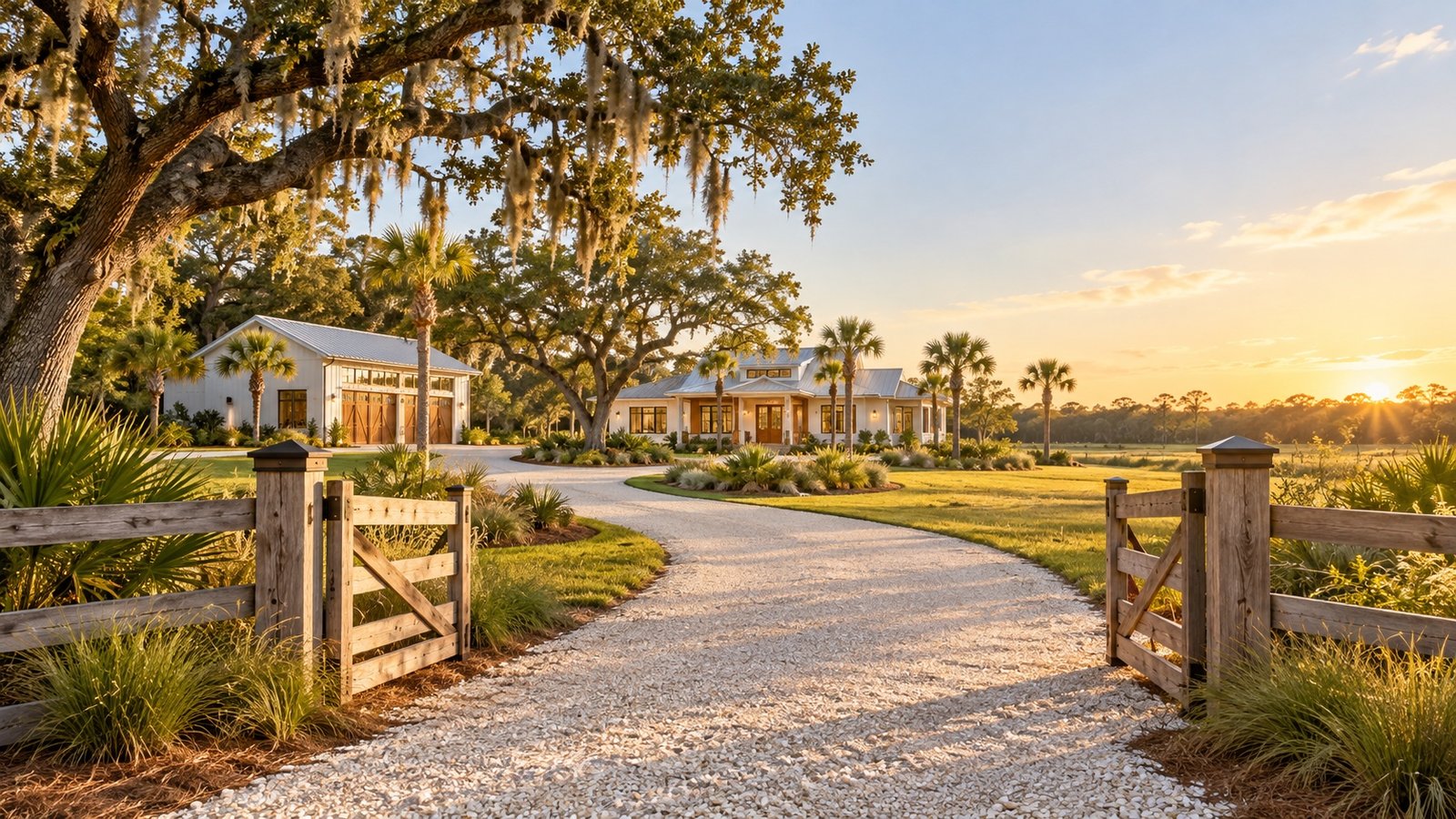
Buying in Mims for a KSC Commute? Verify the Access Easement Before You Count on the Outbuilding
By Carrie Liotta, Space Coast REALTOR® with REAL Broker
If a Mims acreage home depends on a shared driveway, do not treat the drive or detached building as a bonus until the recorded access, maintenance responsibility, permits, and insurance picture all line up. For a Kennedy Space Center commute, those details can matter more to daily life and resale than an extra acre or a larger workshop.
I like Mims for buyers who want breathing room, room for equipment, and a different rhythm from a subdivision. But acreage changes the due-diligence list. A driveway that looks established may cross another parcel. A gate may be neighbor-maintained. A handsome outbuilding may be useful, partially documented, or simply not part of the coverage assumption a buyer made from the listing photos.
Start with the route you have the legal right to use
On a conventional neighborhood street, access is usually not the question. On rural or semi-rural property, it can be. I want my buyer to understand the route from the public road to the home, garage, and outbuilding before we decide whether the property truly fits the KSC commute and the lifestyle plan.
That means asking for the survey, title commitment, recorded easements, road-maintenance agreement if one exists, and any documents that explain a shared gate, culvert, or turnaround. The goal is not to turn every country driveway into a problem. It is to distinguish a recorded, workable arrangement from an assumption based on tire tracks and a neighbor’s verbal explanation.
The Brevard County Clerk’s Official Records information explains that the Clerk records many real-estate instruments, including deeds, plats, surveys, and contracts. It also cautions that an online search is not itself the official public record. In practice, that is a good reason to let the title company and, when appropriate, a real-estate attorney connect the recorded documents to the parcel you are buying.
When I walk a property with a buyer, I ask a deliberately plain question: could you comfortably drive this route at 5:30 in the morning, in rain, with a contractor, delivery truck, or trailer behind you? The legal document and the physical route both need to make sense.
A shared driveway is a cost question, not just an access question
Access can be clear on paper and still create a carrying-cost issue. Gravel, grading, drainage, tree trimming, gate motors, culverts, and pavement repairs do not maintain themselves. Before an offer, find out who pays, how decisions are made, whether there is a regular contribution, and what happened the last time the road needed real work.
Be specific. Ask whether the arrangement covers only ordinary upkeep or also storm cleanup, a failed culvert, washouts, and the cost of restoring the drive after a heavy truck damages it. If several owners use the route, ask whether there is a written process for collecting money and approving work. A vague answer does not mean the home is wrong; it means I would build more time and clarity into the inspection period.
For buyers still comparing the larger location choice, my guide to Mims versus Titusville for space-industry buyers is a useful companion. This article is narrower: once you are leaning toward acreage, access needs its own line item in the decision.
Do not assume the outbuilding has the same documentation as the house
An outbuilding can be a real reason to choose Mims: a place for tools, hobbies, vehicles, a boat, or a home-based workspace. It can also be the feature that needs the most careful questions. I would ask what it was built for, whether power and water were added, whether its current use matches the records, and whether there are permits, plans, final inspections, invoices, or contractor names available.
Florida’s building-permit statute, section 553.79, generally requires a permit for construction, alteration, repair, or demolition unless an exception applies. That is not a shortcut to deciding what was required on one specific parcel. It is a reminder to verify the actual records and the current condition rather than relying on a seller’s estimate of when a structure was built.
Brevard’s Advanced Service Site says non-registered users can search building, development, and enforcement records. I use that as a starting point, then compare the result with the seller’s documents and the inspection. If the property is inside a municipality or the record is older, there may be another office or another layer of research. A missing online record is a question to pursue, not proof that work was never permitted.
Bring the insurance conversation forward
Insurance is not a detail to postpone until the week before closing. Give your insurance professional the actual address, the year and construction of the home, the detached-building information, and the features that make this acreage property different. Ask what documentation they need and whether the intended use of the building changes the conversation. The Florida Office of Insurance Regulation’s consumer resources are a useful route for a consumer who needs help understanding where to ask questions, but they do not replace a quote and underwriting review for the specific property.
I would also check the precise address in the FEMA Flood Map Service Center. FEMA calls the MSC the official public source for NFIP flood-hazard information and notes that maps can be updated. A map lookup is not an insurance quote, and an insurance quote is not a survey, but both belong in the same early conversation when a driveway, drainage path, and detached building are part of the value.
There is a practical sequencing benefit here. If a buyer learns early that the access paperwork needs clarification or that an insurer needs more detail on the detached structure, there is time to investigate before the inspection deadline becomes a scramble. That is much better than discovering an open question after the moving truck has been scheduled.
Test the KSC commute the way you will actually live it
I never promise a commute time from a listing. Traffic, a person’s gate, shift timing, construction, weather, and the exact work location can change the experience. Instead, I encourage a buyer to drive the route at the time they expect to leave and return. If that is not possible, we map the likely route together and plan a second look when the buyer is in town.
On a Mims acreage property, add the driveway to that test. Is the entrance easy to spot before daylight? Is there room to turn around without backing a trailer through a gate? Does a rainy day make the surface feel different? Can an emergency vehicle, moving truck, septic company, or appliance delivery reach the home without a neighbor having to unlock something? Those are ordinary-life questions, and they are often more revealing than a map pin.
Buyers comparing utilities and lot size can also read my guide on city sewer versus a larger lot with uncertain septic history for Titusville KSC relocators. The market is different, but the decision habit is the same: look at the full ownership system, not just the headline feature.
My offer-period checklist for a Mims acreage home
Before the inspection period closes, I would want a buyer to have a written answer, document, or qualified professional lined up for each of these points:
- Recorded access: Review the title commitment, survey, and recorded easement language with the title company. Confirm the route, width, users, and any stated limits.
- Physical access: Walk and drive the actual route. Look at gates, drainage, culverts, turnaround space, sightlines, and the condition after recent weather if possible.
- Maintenance: Ask for the written agreement, contribution history, invoices, and the contact information for the people who share the drive.
- Outbuilding history: Request permits, plans, final inspections, invoices, electrical details, and a clear explanation of how the building has been used.
- Insurance and flood review: Obtain an address-specific quote early, share the detached-building facts, and check the current FEMA map rather than assuming a rural setting means the same risk as a neighboring parcel.
- Septic, well, and inspections: Match the inspection plan to the property. A larger lot can be wonderful, but it may need more specialized questions than a city-water, city-sewer home.
- Commute reality: Test the route at a useful time of day and include the driveway, gate, and turn-around in the test—not only the highway portion.
None of these items has to be perfect for a Mims home to be the right home. The important thing is that the price, terms, and ownership plan reflect the real property. A buyer who understands the access agreement and the outbuilding before closing is in a much stronger position than a buyer who assumes both will sort themselves out later.
When I would slow down
I would slow the process down when the recorded route is unclear, the driveway in use does not seem to match the survey, the maintenance arrangement is only verbal, a structure has electrical or plumbing work without a clear record, or an insurance quote depends on information no one can provide. Slowing down does not mean walking away. It means directing the right question to the title company, inspector, contractor, county record source, or insurance professional before a buyer loses leverage.
This is especially important for an out-of-area KSC buyer. A long-distance move can make rural acreage feel like a relief after months of scrolling listings, and I understand the appeal. My job is to help make sure the quiet setting also works on a Tuesday morning, during a delivery, after a summer downpour, and when the next owner asks the same questions.
Bottom line
A Mims acreage home can be an excellent fit for a Kennedy Space Center buyer who values space and an outbuilding, but the shared driveway cannot be treated as scenery. Confirm the recorded access, understand who maintains it, document the detached structure, get property-specific insurance input, and drive the full route you will actually use.
If you are comparing North Brevard acreage with a more conventional Titusville or Port St. John option, I can help you sort through the access, inspections, insurance questions, commute tradeoffs, and resale story without pretending every large lot works the same way. Reach out for a no-pressure conversation about Brevard County homes for sale with Carrie Liotta, Space Coast REALTOR® with REAL Broker. Your next chapter starts here.
