

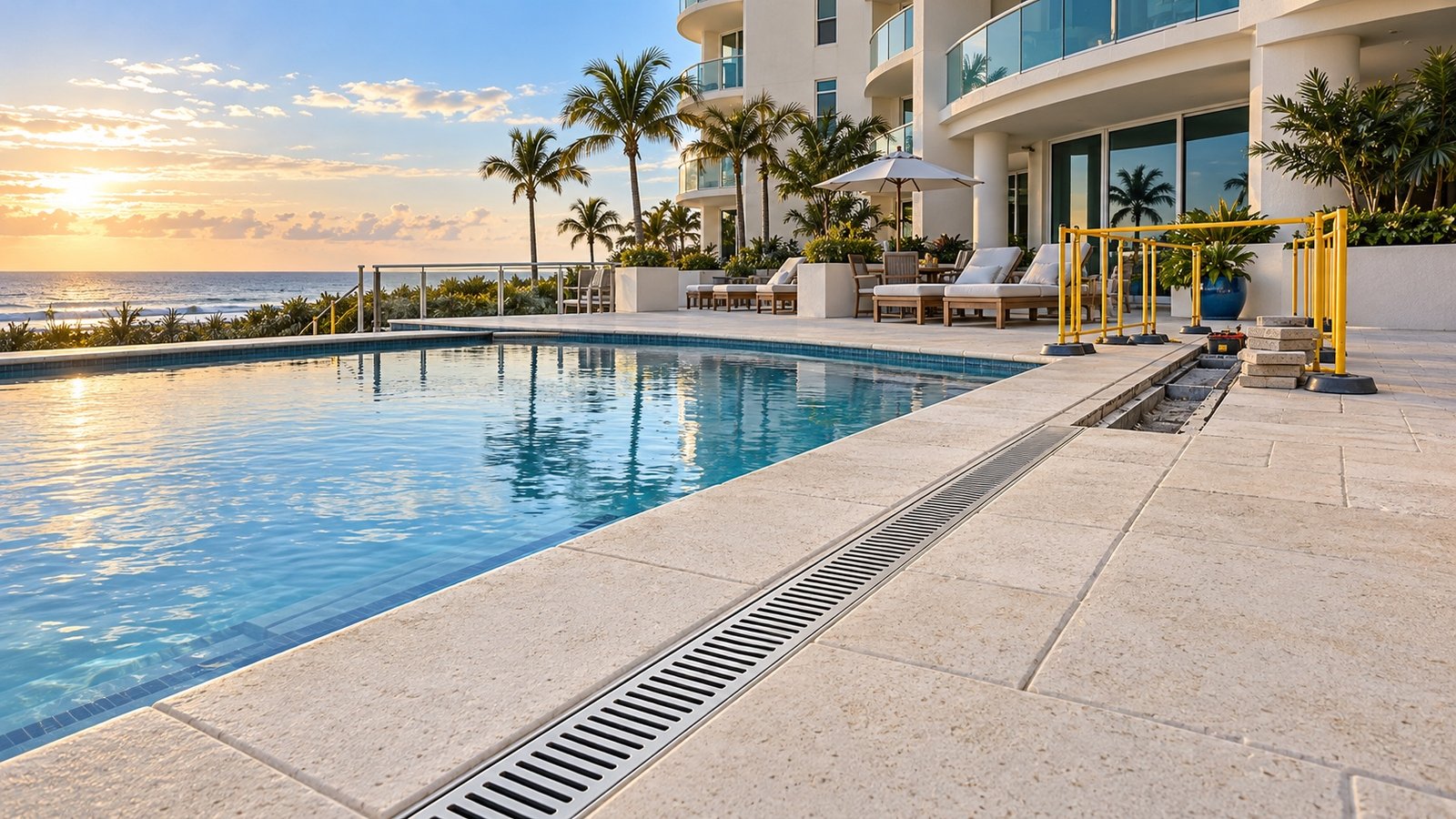
What Should Cocoa Beach Condo Buyers Ask When the Association Is Replacing Pool-Deck Drains in Phases?
By Carrie Liotta, Space Coast REALTOR® with REAL Broker
If a Cocoa Beach condo association is replacing pool-deck drains in phases, ask for the complete scope, drainage plan, contract, permits, funding source, schedule, warranties, and results from any finished phase. Phasing is not automatically a problem. The real question is whether the association has one coordinated plan or is treating recurring drainage symptoms one section at a time.
A clean-looking pool area can still leave important questions unanswered. Water has to move somewhere after a summer downpour, a pool cleaning, or daily deck use. If the drains are undersized, poorly sloped, clogged, corroded, or tied into a larger system with limited capacity, replacing one visible section may not solve what is happening beyond that section.
When I help a buyer evaluate this kind of project, I want to understand the work as both a physical system and an association decision. The engineering, contractor scope, board minutes, invoices, reserves, and owner communications should tell the same story.
Start with one question: what problem is the association solving?
“Replacing the pool-deck drains” can describe several very different projects. The association might be replacing cracked channel drains, correcting deck slope, repairing underground piping, changing discharge points, tying several drain runs together, or rebuilding waterproofed areas around the pool. It may also be addressing water that ponds near doors, equipment rooms, expansion joints, or lower-level common areas.
Ask for the written diagnosis, not only the project name. Who identified the problem? Was it the property manager, a pool contractor, a licensed engineer, a waterproofing consultant, or the general contractor? Was the concern routine deterioration, repeated ponding, a failed pipe, water intrusion, a trip hazard, or damage found during another repair?
The answer matters because the repair should match the cause. A new drain grate can improve a worn surface without correcting a poorly pitched deck. A new channel may collect water but still depend on an old underground line. A phased plan can be sensible when the design is complete and the work is sequenced for access and budgeting. It is less reassuring when each phase begins only after the last repaired area exposes another unknown.
Ask for the full plan, including the phases that have not started
I would ask for a marked plan or drawing showing every phase, the areas included, the drain routes, connection points, discharge locations, and the work that remains. Buyers should be able to see whether the association is moving through one approved design or approving separate pieces as money becomes available.
Then ask these practical questions:
- How many phases are planned, and which phases are complete?
- What triggers the start of the next phase: a calendar date, funding, seasonal occupancy, contractor availability, or observed performance?
- Will later work disturb a section that has already been repaired?
- Does the contract include deck demolition, pipe replacement, slope correction, waterproofing, paver or coating restoration, and testing?
- Are the pool, restrooms, beach access, gates, or nearby parking expected to close during construction?
- What temporary drainage or safety measures are required between phases?
A coordinated answer does not guarantee a perfect project, but it makes the risk easier to price. A vague answer such as “the board is handling it” is a reason to keep reading before you rely on the listing description.
Review the records behind the project
Florida condominium records can be especially useful here. The Florida Department of Business and Professional Regulation explains that association official records include items such as plans, permits and warranties provided by the developer, current insurance policies, contracts, accounting records, contracts for work and bids, structural integrity reserve studies, and required inspection reports. Buyers should not assume every project document will arrive in the standard resale packet, but that official list shows why a focused written request matters. See the Florida DBPR condominium records guidance.
For this project, request the board meeting minutes and owner notices from before the first phase through the most recent update. Look for the original proposal, competing bids, approved contractor, change orders, engineer or consultant recommendations, invoices, payment approvals, delays, complaints, and discussion of future funding.
Also ask whether permits or inspections are required for the exact scope and, if so, request the permit number and inspection status. Do not infer that no permit was needed simply because no one has produced one. The association or its contractor should be able to explain which authority reviewed the work and what closeout documentation will be retained.
Study the completed phase before judging the unfinished work
If one or more phases are finished, those areas become evidence. Visit after rain if the timing allows, or ask for dated photos and maintenance reports from wet-weather events. Look for standing water, staining, algae, loose grates, cracked coatings, patched transitions, uneven pavers, or water being redirected toward doors and walls.
Ask whether the completed section passed a flood test or other acceptance test and who signed off. Find out whether the contractor returned for corrections. A warranty is helpful, but its value depends on what it covers, when it starts, who holds it, and whether the contractor remains responsible when later phases connect to the completed work.
Pay close attention to transitions. Phased construction often creates boundaries between old and new drains, old and new deck surfaces, or finished and unfinished waterproofing. Those boundaries are where I want clear details about elevation, slope, sealants, expansion joints, and future tie-ins. Buyers do not need to become drainage engineers, but they should know whether a qualified professional coordinated the interfaces.
Find out exactly how the project is being paid for
Ask for the approved total budget, amount spent to date, remaining contract balance, contingency, and funding source. Is the association using operating funds, general reserves, a dedicated reserve account, a special assessment, or a loan? If several sources are involved, the records should show how much each one contributes.
Then bring the question back to the unit you are considering:
- Has a special assessment already been levied?
- What portion is assigned to this unit, and how much remains unpaid?
- Could later phases require another owner vote or assessment?
- Are change orders covered by a contingency or passed through to owners?
- Has the seller paid the current obligation, and what does the purchase contract say about future installments?
Florida’s resale disclosure statute requires important condominium information in applicable sales, including specified milestone-inspection and structural-integrity-reserve-study disclosures. The exact documents and timing depend on the building and transaction, so buyers should review their contract and legal rights rather than treating a verbal summary as enough. Read Florida Statutes Section 718.503 and consult a Florida attorney when legal interpretation is needed.
Ask whether this project connects to a larger building issue
A pool-deck drain replacement can be a contained maintenance project. It can also overlap with waterproofing, structural concrete, below-deck spaces, expansion joints, seawalls, pool equipment, or recurring water intrusion. Ask directly whether an engineer, insurer, milestone inspector, reserve specialist, or lender has identified related concerns.
That does not mean every pool-deck project belongs in a structural alarm category. The goal is to avoid separating documents that should be read together. If meeting minutes discuss drain replacement in one month and garage staining, spalling, or waterproofing in another, ask whether the association has confirmed that the issues are unrelated.
Financing deserves an early check too. Fannie Mae’s current project standards identify condominium projects in need of critical repairs, including material deficiencies and significant deferred maintenance, as ineligible. A routine, funded drain replacement is not automatically a critical repair, but unclear scope or evidence of broader deferred maintenance can lead a lender to ask more questions. Buyers should send the project records to their lender before the financing timeline becomes tight. See Fannie Mae’s ineligible-project guidance.
Measure the lifestyle impact, not just the repair bill
In Cocoa Beach, the pool deck may be one of the building’s most-used shared spaces. Construction can affect more than swimming. Ask about noise hours, dust control, contractor staging, gate access, furniture storage, beach crossover access, guest rules, temporary walkways, parking spaces, and the expected reopening process.
If you plan to occupy the condo seasonally or offer it as a rental where permitted, compare the phase schedule with your actual use. A project scheduled during lower-occupancy months may be a thoughtful plan, but weather and material delays can shift the calendar. Ask what happens if a phase runs into winter or hurricane season and whether the association has communicated realistic buffers.
Also check whether the rules and insurance requirements changed during construction. Owners may face temporary restrictions on grills, furniture, deliveries, pets, or use of nearby common areas. None of those issues alone should decide the purchase, but they belong in the value comparison.
How I would compare two Cocoa Beach condos
If two units are otherwise similar, I would not automatically reject the building doing phased drain work. A building that has diagnosed a problem, hired qualified professionals, approved a full plan, funded the work, documented completed phases, and communicated clearly may be making the responsible choice.
I would be more cautious when the board cannot produce a complete scope, the same area has been repaired repeatedly, funding stops after the current phase, completed work still ponds, warranties are unclear, or minutes show unresolved disagreement about the cause. That uncertainty should affect your offer strategy and your willingness to accept future assessment risk.
This is the same principle I use throughout beachside condo due diligence: evaluate the association’s response, not merely the existence of maintenance. For a broader document checklist, read what Space Coast condo buyers should review before making an offer. If drainage work also touches a unit’s balcony or sliding-door area, compare it with my guide to replacement sliding doors and balcony drainage.
My buyer checklist before the inspection period ends
- Written diagnosis and complete phased scope.
- Engineer, consultant, contractor, and project-manager information.
- Drawings showing drainage routes, tie-ins, discharge points, and phase boundaries.
- Board minutes, owner notices, bids, signed contracts, change orders, invoices, and payment history.
- Permit and inspection status when applicable.
- Photos, test results, punch lists, and warranties for completed phases.
- Total budget, contingency, amount spent, balance remaining, and funding source.
- Current and possible future special-assessment responsibility for the unit.
- Construction schedule and realistic impact on pool, beach, parking, and common-area access.
- Lender and insurance review of any broader building-condition concerns.
Bottom line
Phased pool-deck drain replacement is not a reason by itself to walk away from a Cocoa Beach condo. It is a reason to ask for the whole project story. The strongest file will connect the diagnosis, design, phases, permits, contractor work, funding, testing, warranties, and owner communication without leaving the buyer to guess.
If you are comparing Cocoa Beach condos and want help reading the association’s project records alongside the unit, financing, insurance, and resale picture, I can help you organize the questions and identify the gaps. Reach out to Carrie Liotta, Space Coast REALTOR® with REAL Broker, for a no-pressure conversation about Brevard County homes for sale. Your next chapter starts here.
