

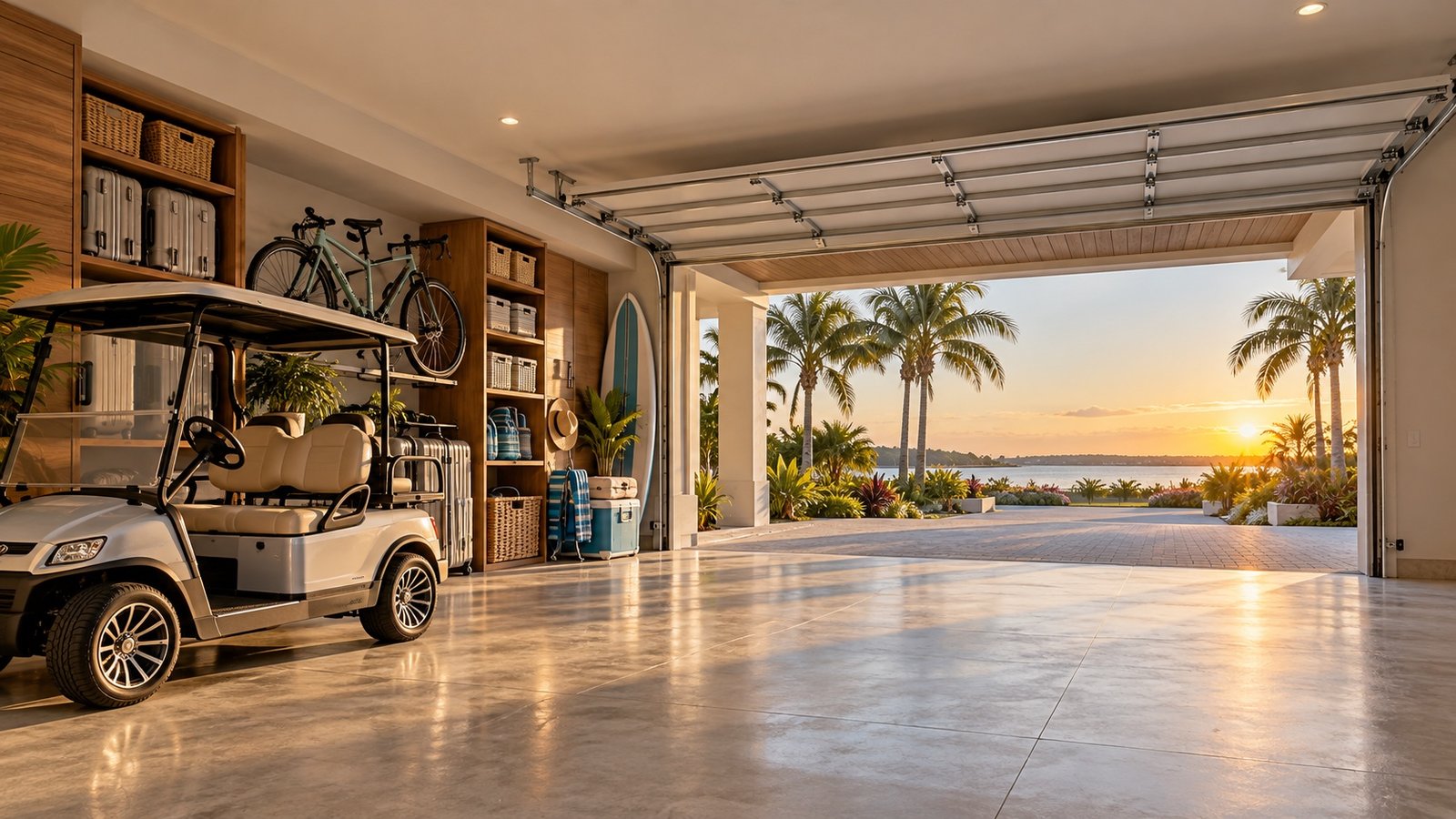
Garage Storage or Golf-Cart Access in Viera? What Airport-Commuting Relocators Should Compare
By Carrie Liotta, Space Coast REALTOR® with REAL Broker | Published October 19, 2026
If one partner will commute to Melbourne Orlando International Airport, I would usually choose the Viera home with the garage that truly fits your daily life over a home marketed for golf-cart access. A golf cart can make nearby errands enjoyable, but it does not replace a reliable car commute, and its legal route may be far narrower than a listing makes it sound.
That answer is not anti–golf cart. It is a reminder that relocation buyers need to separate a pleasant neighborhood convenience from an everyday ownership need. When I help someone compare two Viera homes, I want to know what actually has to live in the garage, which roads the cart could lawfully use, what the neighborhood documents say, and whether the airport drive works at the time the household will really leave.
Start with the thing you cannot easily add later
Garage capacity is often the harder feature to create after closing. A third bay, a deeper tandem section, a utility alcove, or a genuinely usable overhead-storage plan can change how a home lives every day. It may hold a commuter vehicle, a second household car, luggage, bikes, strollers, golf clubs, tools, seasonal items, and the things that accumulate during a move. A home can look like it has a large garage in photos and still leave no practical room once the doors, water heater, electrical panel, shelves, and cars are in place.
Before comparing square footage, I ask buyers to do a literal inventory. Measure the longest vehicle, count the bicycles and bins, note whether a work vehicle stays home, and decide whether the garage must also serve as a workshop, gym, freezer zone, or storm-supply storage. Then tour with a tape measure or request clear dimensions. A promised “three-car” garage may be a true three-car layout, a tandem bay, or a two-car garage with just enough extra depth for a compact car. Those are different ownership experiences.
For an airport commuter, this matters because the car has a non-negotiable job. Early departures, late arrivals, rain, luggage, or a change in shift can turn a casual parking arrangement into a daily annoyance. A golf cart is a lifestyle bonus; it cannot take the place of a road-legal, weather-ready vehicle for the airport run. If the garage decision is close, I would rather preserve protected space for the vehicle you depend on than assume a driveway, curb, or outdoor storage workaround will feel fine after a Florida summer.
What “golf-cart access” should mean before you pay for it
This phrase deserves much more scrutiny than it gets in a listing. It might mean a private path inside a neighborhood, a short ride on private streets, proximity to a golf course, a cart-friendly social habit, or a lawful designated public-road route. Those are not interchangeable. It also may mean that the seller has used a particular path without proving that a buyer may do the same after closing.
Florida law starts from a cautious place. Florida Statutes section 316.212 generally prohibits golf carts on public roads unless the county, municipality, or qualifying water-control district has designated the road after a safety determination and posted appropriate signs. The statute also addresses crossings, equipment, operating hours, and identification or license requirements. In other words, seeing other carts nearby is not the same as having a lawful route from the house to the destination you care about.
The state also distinguishes a golf cart from a low-speed vehicle. The Florida Highway Safety and Motor Vehicles guidance explains that low-speed vehicles have different equipment, titling, registration, insurance, and road-use rules. That distinction matters when a buyer says, “We can just make it street legal.” Do not make that assumption. Ask what vehicle is being discussed, what local rules apply, and which specific roads or crossings are actually authorized.
Viera is not one rulebook
Viera is a collection of neighborhoods, public infrastructure, private associations, and different development eras—not a single promise that applies to every address. The Viera Stewardship District describes its public-infrastructure and long-term maintenance role in West Viera, including drainage-related work. That is useful context, but it is not a neighborhood-by-neighborhood golf-cart permission slip.
For a particular home, I would request the HOA declaration, rules, amendments, architectural guidelines, current notices, and the seller’s written explanation of where the cart has been used. I would also identify whether each stretch of the desired route is private, county-maintained, state-maintained, or governed by another entity. A cart route that works entirely inside one private community may stop at a busy road, a gate, a trail crossing, or a jurisdiction line. If reaching coffee, school pickup, a clubhouse, or a friend’s home requires a public-road segment, verify that segment rather than relying on a broad community label.
This is especially important for families relocating from places where a golf cart is treated as a second car. In Brevard County, the practical question is not whether a cart looks useful on a sunny Saturday. It is whether the home still works when the cart stays parked: during a downpour, after dark, with groceries, with visiting family, or when the airport commuter has to leave before the neighborhood is awake.
Test the airport commute separately from the neighborhood lifestyle
A Viera address can be convenient on a map and still feel different at the hour your household travels. The route from each prospective home to Melbourne Orlando International Airport will depend on the specific street, the chosen exit, construction, school traffic, weather, and the time of day. I do not like giving relocators a single universal drive-time promise because it creates false confidence. Instead, I recommend testing the route from the actual address on the days and times that resemble the work schedule.
Do that test in both directions. Leave the neighborhood at the likely departure time; then make the return trip when the airport commuter would normally be coming home. Notice the first and last few minutes as much as the main road. Is it easy to pull out? Does the route stack up at a school or a major intersection? Is the home far enough inside the neighborhood that the convenience of a golf cart for errands is real, while the daily car trip still feels manageable? A short test drive tells you more than a marketing map.
I would also make room for the airport routine itself. Is there a spot for luggage to land inside the garage? Can a returning traveler unload under cover? Is there a place for a car seat, stroller, bike rack, or work gear without blocking access to the house? These details may sound small during a showing, but they are exactly what turns a “nice garage” into a functional one. For the bigger route-versus-neighborhood question, read my guide to daily errands and the Melbourne airport route for Viera relocators.
When golf-cart access can be the better choice
There are buyers for whom the cart feature deserves real weight. If both homes have enough enclosed storage, the desired cart route is documented and lawful, and the household will use it several times a week, a cart-friendly location can improve daily life. It can make a short trip to a nearby amenity or neighbor feel effortless and reduce the number of times the car leaves the garage. For retirees, families with an established social routine, or buyers who value a particular private-neighborhood pattern, that can be meaningful.
But I would assign value to the verified use, not the idea of it. Ask the seller for the route they actually take, then walk or drive it with the relevant rules in hand. Ask whether the HOA restricts parking, charging, storage, or overnight visibility of carts. Confirm whether the garage will accommodate the cart and the cars, rather than assuming a cart can sit in the driveway without consequence. If the answer is yes across all of those points, golf-cart access becomes a legitimate tie-breaker instead of a vague amenity.
When garage storage should win without much debate
I would prioritize the garage when the household has two working vehicles, a long commute, young children, outdoor equipment, a future move plan, or little closet storage in the house. It should also win when the golf-cart route depends on an unverified public crossing, a rule that may change, or an impractical place to store the cart. This is not a choice between fun and practicality. A well-designed garage can protect the equipment that makes beach weekends, golf, travel, and family logistics easier.
Buyers often underestimate the resale side too. Not every future buyer will care about a cart route, and some will be wary of unclear rules. Usable enclosed storage has a broader audience, particularly when it is visible, accessible, and does not compromise the home’s mechanical systems. My related guide on three-car garages, storage, and golf-cart needs on the Space Coast can help you think through that tradeoff without treating a bigger garage as an automatic win.
A practical offer-period checklist
- Measure the garage interior, door openings, bay depth, and the space around equipment before assuming everything fits.
- Review the HOA rules and all amendments for vehicle, cart, parking, charging, and exterior-storage limits.
- Map the intended cart route one segment at a time and confirm who controls each road or crossing.
- Ask for written confirmation or the applicable rule—not just a neighbor’s recollection—that a route is permitted.
- Drive the airport route from the actual address at a representative work time.
- Consider whether the home works during rain, darkness, family visits, and a busy travel week with the cart unused.
- Have the inspection professional flag any garage moisture, panel-clearance, door, slab, or storage concerns that affect day-to-day use.
My bottom line for Viera relocators
Choose the garage first when it protects the car commute and the household’s real storage needs; choose golf-cart access first only when the route, rules, storage, and daily use are all verified. The best Viera home is not the one with the most appealing amenity list. It is the one that still makes sense on a rushed Monday morning and feels easy on a relaxed Saturday afternoon.
If you are narrowing down Viera homes around a Melbourne airport commute, I can help you compare the actual addresses, documents, garage layouts, and route realities without overselling any one feature. You can also read my comparison of Viera East and Rockledge for different I-95 interchange commutes. Reach out for a no-pressure conversation about Brevard County homes for sale with Carrie Liotta, Space Coast REALTOR® with REAL Broker. Your next chapter starts here.
