

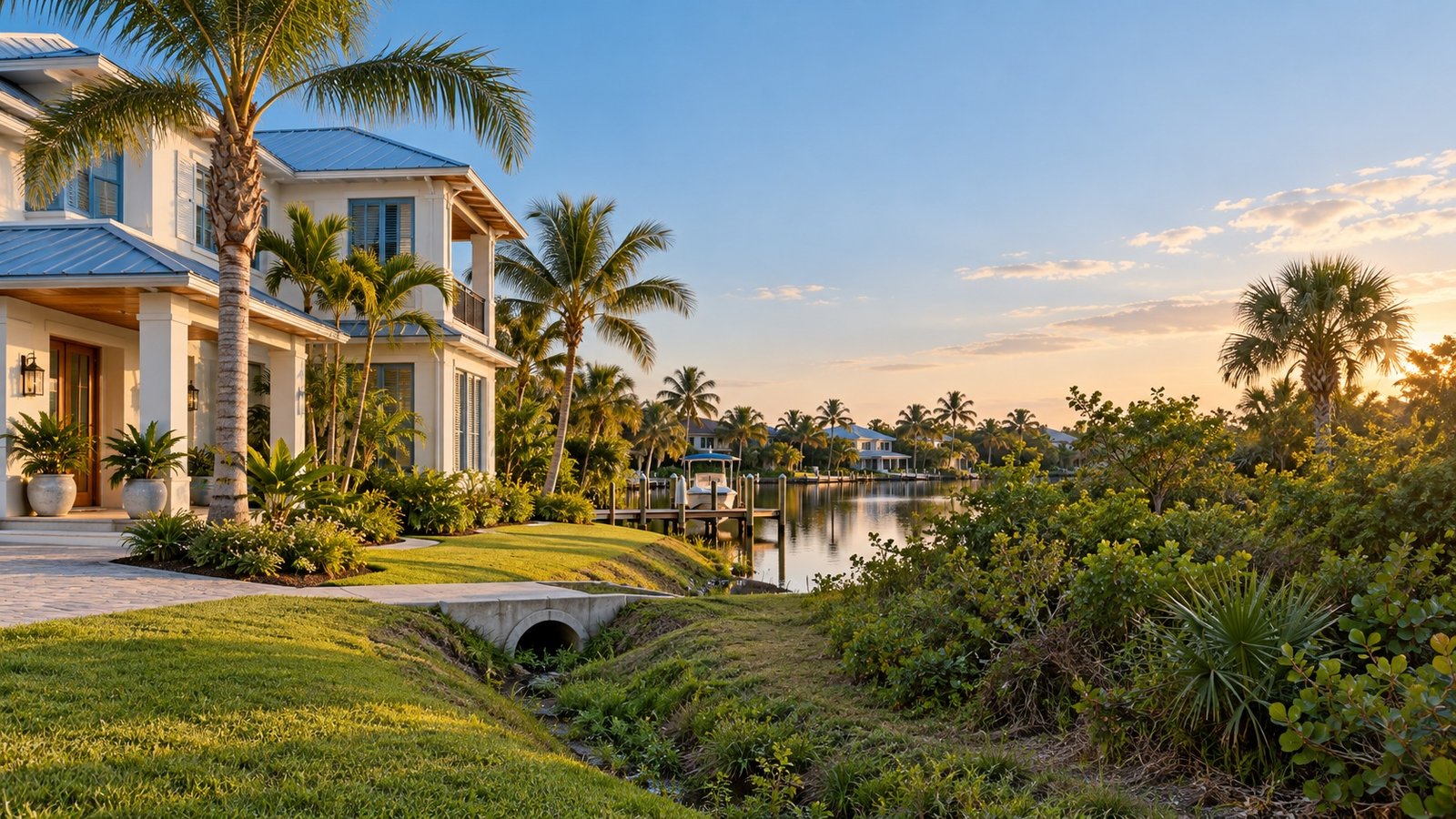
Merritt Island Canal Homes Beside Vacant Lots: What Buyers Should Verify About Side-Yard Drainage
By Carrie Liotta, Space Coast REALTOR® with REAL Broker | Published October 17, 2026
If a Merritt Island canal home sits beside a vacant lot and a drainage ditch runs along the side yard, do not decide what it is from the grass line or a showing-day conversation. Before you make an offer, confirm the property line, recorded easements, who may use or maintain the route, and whether the water path is working as it should.
That sounds cautious because it is. A canal view can make a side-yard ditch feel like background scenery. Sometimes it is simply part of a property’s drainage layout. Sometimes it falls within a recorded easement, serves more than one parcel, or leads toward an outlet that deserves a closer look. The answer is address-specific. The buyer who treats it as a due-diligence item early has more choices than the buyer who discovers it after inspection.
Start with the question the yard cannot answer
When I walk a canal property with a buyer, I want to separate three things that often get blended together: where the boundary actually lies, who has rights affecting the strip of land, and how water moves across or away from the property. A ditch can be inside the legal parcel and still be affected by an easement. It can appear to belong to a neighbor because it sits on the edge of the yard. Or it can be maintained under an arrangement that is not obvious from the fence line.
That is why I would not accept “the vacant lot takes care of it” or “it has always drained that way” as a complete answer. Ask the seller what they know, but then ask for the documents. The working file should include the recorded plat when available, the prior title materials the seller can share, any survey, drainage or grading plans, permits for relevant work, invoices, photographs, and correspondence about recurring water issues or maintenance. A local title professional and surveyor are the right people to help a buyer understand what the record actually says; this is not a place for a real-estate guess.
The Brevard County Clerk’s Official Records information explains that the clerk records and indexes real-estate documents including deeds, subdivision plats, surveys, and other instruments. It also cautions that online records are not the official public record and that users must assess accuracy and reliability. That is a useful reminder: an online map can orient a buyer, but it does not replace a current survey, title review, or a qualified interpretation of the documents.
Why the vacant lot changes the conversation
An empty lot next door can feel like a bonus: more light, a longer view, fewer windows nearby, and an easier place to see the canal breeze. It is not a promise that the lot will remain empty, and it is not a reason to assume its drainage will remain unchanged. Buyers should ask what the current owner knows about the lot, whether it is separately buildable, whether there are visible swales, culverts, outfalls, or utility features, and whether any planned work has been discussed with the seller or neighbors.
I would also look for practical clues without treating them as proof. Does the ditch hold standing water long after a normal rain? Is there erosion at a culvert or washout near the canal edge? Are fence panels, mulch, or pool equipment crowding what looks like an access route? Does the listing’s survey show an irregular strip along the side yard? Those observations help a buyer ask better questions. They do not establish ownership, maintenance duty, or a permit history.
Read the records in the right order
My practical order is simple. First, get the current survey and compare it with the property description and the recorded plat. Next, let the title review identify recorded easements, restrictions, or exceptions that need a question. Then match the paperwork to the ground: side-yard fence, drainage swale, culvert, canal edge, dock access, pool enclosure, and any improvements that would make access difficult.
Florida law recognizes several types of access rights in particular circumstances. For example, Florida Statutes section 704.01 addresses ways of necessity and access over land in defined situations. That statute does not tell you what any one Merritt Island side yard means, and it is not a substitute for legal advice. It does underline why an apparent route should be checked through the property documents rather than assumed from how it looks.
If the seller has an older survey only, ask whether a new survey is appropriate for the transaction. If a ditch, fence, drain line, or access strip sits close to the boundary, the small expense of clarity can be much cheaper than a surprise after closing. I also like buyers to ask whether a contractor, association, county department, or adjacent owner has ever accessed the area, and what notice or coordination was involved. “No one has ever come through” is different from “there is no recorded right.”
Drainage is a property-system question, not a cosmetic one
A neat side yard can still have a drainage story. On a canal property, water may move through swales, pipes, culverts, yard grades, and outfalls before it reaches a lawful outlet. A buyer does not need to become a drainage engineer, but should understand whether there is a history of ponding, erosion, backups, or work that changed the path of water.
The Florida Department of Environmental Protection’s Environmental Resource Permitting overview says the ERP program regulates activities involving alteration of surface-water flows, including upland construction that generates stormwater runoff. In a purchase decision, that is a reason to slow down before assuming a ditch can be filled, piped, bridged, screened over, or casually redirected after closing. The responsible agency and permit path depend on the exact work and site.
I would ask the seller for records of any grading, drainpipe, culvert, seawall-adjacent work, landscaping that changed slopes, or work completed on the vacant lot side if they have it. If a home inspector observes a condition, bring in the appropriately qualified professional during the inspection period. The goal is not to create a list of hypothetical repairs. It is to find out whether a visible feature is functioning, documented, and compatible with the way you plan to use the home.
Do not skip flood context because the ditch looks shallow
A side-yard drainage feature and a flood determination are not the same thing. One does not prove the other. Still, a buyer looking at a canal home should review both the local water-management question and the property’s mapped flood context before treating monthly ownership costs as settled.
The FEMA Flood Map Service Center is the official public source for flood-hazard information used to support the National Flood Insurance Program. FEMA also notes that flood maps are updated and can be superseded. Start there with the address, then discuss the result with the insurance professional who will quote the actual property. A map label is not an insurance quote, and a dry-looking ditch is not an insurance analysis.
I would bring the drainage question into that same early conversation. Ask the insurer and lender what documents they need. Ask the inspector what is visible. Ask the seller whether water has ever entered the home, garage, enclosure, or yard and request the records behind the answer. If the house has a pool, a screen enclosure, a dock route, or a boat-lift electrical run along that side yard, make sure the inspection plan accounts for access as well as drainage.
What I would verify during the inspection period
For a Merritt Island canal buyer, the inspection period is where a good question becomes a useful answer. I would build the work around the property rather than rely on a generic checklist:
- Boundary and rights: Compare the survey, title commitment, recorded plat, and any easement language with what is visibly on the ground.
- Water path: Ask a qualified inspector or drainage professional about ponding, grading, culverts, erosion, visible pipes, and whether the observed flow has a sensible outlet.
- History: Request prior repair records, seller disclosures, photos after significant rain if available, and information about prior access or maintenance.
- Future use: Before budgeting for a fence, pool expansion, landscaping wall, shed, or boat-storage change, confirm whether an easement or drainage feature affects the plan.
- Cost and timing: Obtain specialist opinions and estimates while you still have the contractual ability to evaluate the findings, rather than converting uncertainty into a post-closing project.
There is a useful comparison in my article on choosing a wider side yard for boat storage or a shorter route to the causeway: usable space is more than a measurement on a listing. Access, restrictions, equipment, and the way you actually live with the property all matter. The same thinking applies here. A side yard beside a vacant lot can be wonderfully usable, but only after you understand the paperwork and the water.
How this affects the offer and negotiation
Clear records do not make a property perfect; they make it easier to evaluate. If the survey, title materials, and inspection findings show a working feature with understandable access and maintenance, a buyer can decide whether the home fits. If the records are incomplete, a drainage concern is active, or the future-use limits are more restrictive than expected, the buyer can revisit price, terms, further inspection, or the decision to proceed.
A factual file helps buyers evaluate the feature instead of guessing. That is why documented waterfront conditions carry real weight in resale. My guide to pre-listing seawall inspections for Space Coast waterfront sellers explains the same principle: clarity reduces negotiation friction.
A calm, practical way to evaluate the home
I do not want buyers to walk away from every canal home with a ditch or an empty lot beside it. Merritt Island has many waterfront settings where water, access, and lot shape are simply part of the lifestyle. I do want buyers to see the full property rather than just the part framed by the patio doors.
Visit after rain if the timing allows. Look at the side yard, the canal edge, the fence line, and the culvert with the same attention you give the roof and electrical panel. Ask what is documented. Let the survey, title work, inspection findings, insurance quote, and your future plans inform one another. And avoid making a decision based on a neighbor’s shorthand or a listing photo.
Bottom line
A Merritt Island canal home beside a vacant lot can be a great fit, but the side-yard drainage ditch needs a real answer before closing. Verify the boundary, recorded rights, drainage function, maintenance history, flood context, and future-use limits with the right documents and professionals. Once you know what the feature is and how it affects the property, you can decide whether the home’s canal lifestyle is worth the tradeoff for you.
If you are comparing Merritt Island waterfront homes, I can help you build a due-diligence plan around the address, your boating or outdoor-living priorities, and the questions that matter before the inspection clock runs out. I’m Carrie Liotta, Space Coast REALTOR® with REAL Broker, and I’m here to help you make a confident, well-documented choice. Your next chapter starts here.
