

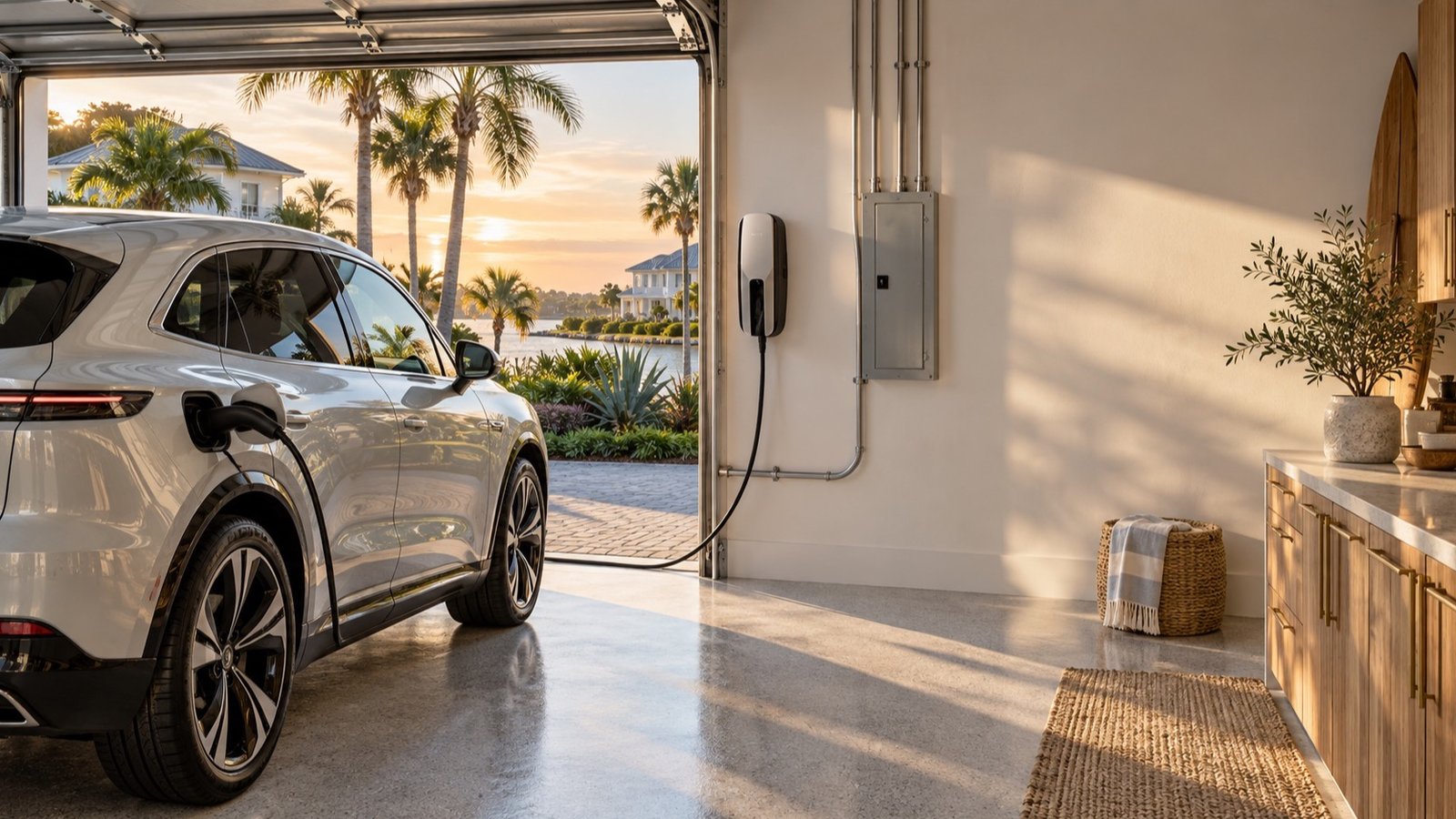
Should Viera Relocators Pay More for a Home With a Permitted EV Charger if HOA Rules Affect Exterior Charging Equipment?
By Carrie Liotta, Space Coast REALTOR® with REAL Broker | Published October 16, 2026
If you drive an EV, a Viera home with a properly documented, permitted charger can be worth paying more for—but only when the electrical work, association approval, and day-to-day setup actually fit your life. I would not pay a premium for a charger simply because it is mounted on the wall. I would pay for a clean, transferable setup that saves you a project after closing.
Relocating buyers often notice the charger during a showing and treat it as a bonus. Sometimes it is. Other times it raises a very practical question: was the equipment installed correctly, can it stay, and will the HOA object if a replacement or exterior change is needed later? In Viera, where many homes sit inside planned communities with architectural rules, the answer is tied to the specific property—not the listing description.
Start with the question that matters: what are you buying?
An EV charger can mean several different things. It may be a hardwired Level 2 unit on a dedicated circuit, an outlet added for portable equipment, or a more complicated installation involving a subpanel, load-management device, exterior conduit, or a detached garage. Those are not interchangeable. A clean wall-mounted charger may look simple, while the useful part of the investment is hidden in the panel capacity, wiring route, permit record, and final inspection.
Before deciding whether the home deserves a higher price, I want a buyer to separate the hardware from the infrastructure. The hardware can be replaced. The right electrical capacity, a safe circuit, sensible charger location, and good documentation are harder to recreate after closing—especially if the garage is already carrying a pool heater, workshop tools, air conditioning equipment, or future solar and battery plans.
That is why I would value a documented charger more than an expensive-looking one with no paper trail. The buyer is not purchasing a gadget. The buyer is purchasing less uncertainty and, ideally, less post-closing work.
When a charger premium makes sense
A premium can be reasonable when the installation solves a real daily problem. A Level 2 setup that lets you charge overnight in your own garage can be meaningful for a household that commutes around central Brevard, drives to Melbourne, beachside, or north toward the Space Coast, and does not want to plan errands around public charging. It can also matter when both cars use the garage and the cable location is orderly enough that nobody is stepping over it or closing a door on it.
I would give the setup more credit when the seller can show a permit record, a final inspection, the installer’s invoice, equipment manual, warranty information, and any association approval. Those documents do not guarantee that the next owner will never have a question, but they give the buyer and insurer a factual starting point. Florida’s permit statute generally requires a permit for construction and specifically does not extend its small-work exemption to electrical work; the practical buyer takeaway is to verify the jurisdictional record rather than assume a charger was a casual plug-in project. See Florida Statutes section 553.79.
When I would not pay extra
I would slow down if the seller cannot identify who installed the charger, whether it is hardwired or outlet-based, or which breaker serves it. I would also pause if the listing calls it “EV ready” but the only evidence is a standard receptacle in the garage. EV-ready can be a useful phrase, but it is not a substitute for confirming the circuit, the equipment rating, and whether the configuration works with the buyer’s vehicle and charging needs.
The same caution applies when the home’s electrical capacity is already being asked to do a lot. A buyer may love the charger but discover that adding a pool heater, workshop equipment, a second refrigerator, or a future battery system will require a panel upgrade or a different load-management plan. That does not make the house a bad choice. It means the buyer should stop treating the charger as a free upgrade and include the next electrical decision in the total cost of ownership.
For a related Viera comparison, I would also read my guide to choosing between a home-battery load plan and a larger pool heater. The details differ, but the habit is the same: ask what the service can support before you pay for the feature that is easiest to see.
HOA approval is a document question, not a guess
Viera is not one single HOA. Each community can have its own declaration, rules, architectural-review process, and enforcement history. A charger entirely inside a garage may create a different approval question from exterior conduit, a wall-mounted exterior unit, a pedestal, a new trench, or equipment visible from the street or a neighboring lot. Do not let anyone—including me—give you a blanket answer without the documents for that address.
Florida’s HOA statute, section 720.3045, addresses an association’s ability to restrict certain items that are not visible from the parcel frontage or adjacent property. It is not a universal promise that a visible exterior charging installation is approved. That distinction matters. The resale package, architectural guidelines, board correspondence, and any approval letter are more useful to this buyer than a broad internet summary of HOA law.
If the home is a condominium rather than a typical Viera single-family home, the analysis changes again. Florida’s condominium statute has specific provisions for EV charging stations in limited common elements or exclusively designated parking areas, including separate metering, owner responsibility for installation and maintenance, reasonable architectural standards, insurance, and removal. You can read the current text in Florida Statutes section 718.113. That law is not a shortcut for a single-family HOA; it is a reminder to establish the ownership boundary and responsibility before assuming the charger transfers cleanly.
The five records I ask for before inspection day
- Permit and final inspection: Ask which jurisdiction issued the permit and request the permit number, finaled record, and scope of work.
- Installer and equipment details: Get the installer’s name, invoice, charger model, serial number, manual, and warranty information.
- Electrical path: Confirm the breaker size, whether the equipment is hardwired or outlet-based, and whether a subpanel or load-management device is part of the installation.
- HOA or architectural approval: Request the application, approval, conditions, and any correspondence that identifies the location or exterior appearance.
- Conveyance and responsibility: Put in writing whether the charger stays, who removes it if it does not, and whether any future buyer responsibility is described in the association documents.
Those records also give your inspector and electrician a better place to start. They are not a substitute for professional advice, but they keep the inspection period focused on real questions instead of detective work.
Compare the two homes by the cost after closing
When two Viera homes are close in price, I would not use an EV charger as the tie-breaker until the buyer has compared the next twelve to twenty-four months. Home A may have a permitted charger and a modestly higher price. Home B may lack a charger but have a newer panel, a lower HOA obligation, or enough price difference to pay for a buyer-selected installation. The better value depends on what must happen after the keys change hands.
Here is the comparison I use with relocating buyers:
- Documented, convenient charger: Favor it when the permit, final inspection, electrical capacity, approval history, and conveyance are all clear. It may let you settle in without immediately hiring an electrician or navigating an architectural-review process.
- Undocumented charger: Treat it as a question mark, not a premium feature. Ask whether an electrician and the appropriate permitting office can confirm what is installed before you price it into the offer.
- No charger, stronger electrical foundation: This can be the smarter choice when the panel, garage layout, and HOA rules make a future installation straightforward. You can choose the equipment, installer, and placement that fit your own vehicle.
- Exterior equipment with unclear approval: Do not assume the buyer inherits permission simply because the equipment is already there. Price in the possibility of documentation work, redesign, relocation, or removal until the association responds in writing.
This is the same broader discipline I use when comparing Viera carrying costs. A home’s asking price is only one number. HOA fees, insurance, taxes, maintenance, and planned upgrades belong in the same conversation. My article on Viera CDD fees, HOA dues, and insurance is a useful companion when you are building that monthly picture.
Ask one electrician question before you waive inspection
I would ask a licensed electrician: “What would you need to see to be comfortable with this charger and the home’s current electrical load?” That question invites a useful answer without asking the electrician to predict every future upgrade. Depending on the home, the answer may involve the panel rating, breaker labeling, wire size, charger settings, condition of the equipment, and whether other major loads are scheduled at the same time.
The Florida Building Commission identifies the effective date of the current 8th Edition (2023) Florida Building Code as December 31, 2023. That does not mean every existing home has to be rebuilt to a newer standard because it has a charger; it does mean that permit and code questions should be routed to the proper local authority and qualified professionals, not settled by a seller’s recollection. Review the Florida Building Commission’s current-code information alongside the actual permit record.
My advice for a Viera relocation buyer
Do not dismiss a permitted EV charger as a small detail if it fits the way you will actually live. For the right household, it can make the first month in a new home easier and remove a real cost and scheduling project. But do not let it distract you from the whole property. The charger should be one part of a sound home decision, alongside location, total payment, condition, insurance, association rules, and resale.
If the documents are complete and the setup works, I am comfortable treating it as a meaningful convenience. If the documents are incomplete or the exterior approval is unclear, I would keep the offer focused on the house—not on a feature you may have to rework. A careful review before contract deadlines is far less expensive than discovering after closing that the charger is not what you thought you bought.
Bottom line
A Viera home with a permitted EV charger can justify a higher price when the installation is documented, the electrical capacity is appropriate, the association record is clear, and the equipment genuinely saves you work after closing. If any of those pieces are missing, treat the charger as a lead for more due diligence rather than a reason to stretch your budget.
If you are relocating and comparing Viera homes, I can help you organize the questions that affect the real decision—from HOA records and permit history to monthly carrying costs and resale. Reach out for a no-pressure conversation about Brevard County homes for sale with Carrie Liotta, Space Coast REALTOR® with REAL Broker. Your next chapter starts here.
