

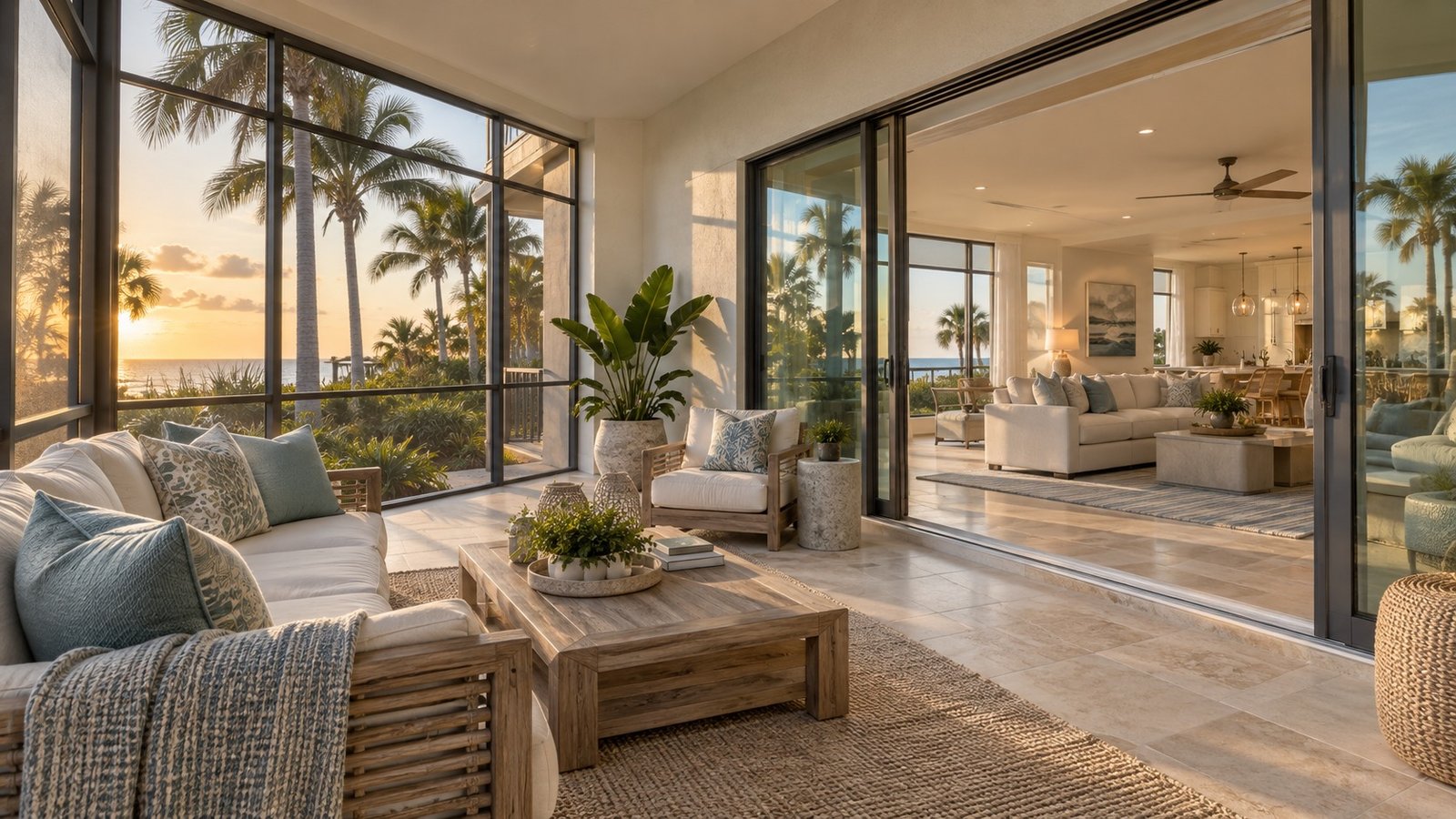
Screened Porch or Impact-Rated Sliders in Satellite Beach? How Buyers Should Choose
By Carrie Liotta, Space Coast REALTOR® with REAL Broker | Published October 15, 2026
If salt exposure is similar, I would not treat a screened porch and impact-rated sliders as interchangeable upgrades. A screened porch can make a Satellite Beach home more enjoyable every day; documented impact-rated sliders can strengthen the opening-protection and insurance conversation. The better choice is the one that fits your routine and has the clearer condition, permit, product, and maintenance file.
Buyers sometimes see both features as “coastal upgrades” and assume the more expensive-looking one wins. That shortcut misses the point. One feature changes how you use a patio, pool area, or outdoor room. The other may change how a large glazed opening functions, how you prepare for a storm, and what an insurer or inspector can actually verify. On a beachside property, salt exposure is a maintenance consideration for both—not a reason to guess at performance from a listing photo.
Start by separating the two jobs
A screened porch is primarily a lifestyle and enclosure decision. It can create a shaded, bug-reduced place to eat, read, let a dog out, or keep doors open without turning the living room into the outdoors. Its value is real when the enclosure is well kept, the layout works, and the patio drains correctly. But a screen enclosure should not be casually counted as storm opening protection just because it is around the patio.
Impact-rated sliders are first a large exterior opening. Buyers may value them for their operation, locks, glass, weather seals, noise reduction, and the ability to move easily between indoor and outdoor space. They may also matter to the home’s documented wind-mitigation profile. The Florida Office of Insurance Regulation explains that the current Uniform Mitigation Verification Inspection Form, OIR-B1-1802, became effective April 1, 2026. That form is completed by an authorized inspector; a listing description is not a substitute for it.
That difference should guide the showing. At the screened porch, ask whether you would use it on an ordinary Tuesday. At the sliders, ask whether the installed product, permit history, final inspection, and current wind-mitigation records support the story the seller is telling.
When the screened porch is the better fit
I often favor the screened porch when a buyer’s real priority is daily livability. For a full-time owner, that might mean breakfast outside without fighting insects, a protected place for wet towels and beach gear, or a breezy room that makes a modest backyard feel more useful. For a family, it might be the buffer between a pool, a pet, and the house. For a remote worker, it may be the one place they will genuinely use after a long day.
Still, I want buyers to inspect the porch as a system, not just a pleasant photograph. Look at the frame, screens, doors, fasteners, slab or deck, roof connection, drainage, and the way the enclosure meets the home. Open the screen door. Check for torn panels, loose framing, corrosion, staining, standing water, patched concrete, and furniture that hides a drainage path. Ask when it was installed, whether it was rebuilt after a storm, and whether records are available.
Salt exposure is not identical across Satellite Beach. Orientation, landscaping, roof overhangs, whether the porch is enclosed on several sides, and how consistently it has been rinsed and maintained can all change what you see. I would not ask a seller or agent to predict remaining life. I would ask the appropriate licensed professional to identify observed conditions and explain any recommended repair scope.
When impact-rated sliders deserve the premium
Impact-rated sliders can be the more meaningful choice when the buyer wants a documented large-opening upgrade and a simpler storm-preparation routine at that opening. But “impact” needs evidence. Florida’s product-approval law covers exterior doors, windows, shutters, and impact protective systems, and it requires the state product-approval process for products marketed as hurricane, windstorm, or wind-borne-debris impact protection. That is why I ask for the manufacturer information, applicable product approval, installation paperwork, permit and final record, warranty, and any current wind-mitigation report.
Then operate every panel with permission. A slider that looks new can still have a difficult track, weak lock engagement, damaged screen, worn rollers, water staining at the threshold, or a patio slope that directs water toward the door. None of those observations establishes a code conclusion; they are reasons to bring the right inspector or contractor into the inspection period.
The other question is coverage. A home may have upgraded sliders but different windows, entry doors, garage openings, or shutters elsewhere. Do not assume the largest doors tell the whole storm-preparation story. My earlier guide on documented HVAC care versus newer impact sliders in Satellite Beach walks through the broader whole-house comparison.
Compare the ownership cost, not just the upgrade list
A screened porch and impact sliders create different future reserves. With the porch, ask about rescreening, door hardware, framing and fastener condition, roof or gutter interfaces, and repairs where the patio meets the home. With the sliders, ask about rollers, locks, screens, seals, threshold maintenance, glass, installation documentation, and the condition of the remaining openings. Neither list is a prediction of what will fail; it is a way to avoid calling two unlike upgrades “equal” because the home prices are close.
Insurance belongs in the comparison early. OIR notes that the revised OIR-B1-1802 can be valid for up to five years when there are no material changes and no inaccuracies. That does not promise a discount or tell you what any individual carrier will charge. It does mean a buyer should give the insurance professional the actual report, roof information, and opening-protection records for the exact address before assigning a dollar value to a slider upgrade.
I would also separate an insurance file from a personal reserve. A favorable quote does not repair a sticky door, rescreen a porch, improve drainage, or replace corroded hardware. Build a modest five-year worksheet with inspection findings, the seller’s records, contractor opinions, and the expenses you would take on after closing. It is much more useful than broad online averages.
Permits and product records are part of the value
Florida Statute 553.73 places construction, alteration, modification, and repair within the Florida Building Code framework, with enforcement handled locally. That is why the question is not simply, “Does this look professionally installed?” Ask which jurisdiction issued the permit, whether the final inspection is recorded, and whether the documents match what is actually installed. Older homes and phased renovations can have a perfectly reasonable explanation; the point is to confirm the story rather than fill in blanks.
For sliders, keep the records together: invoice, manufacturer, product approval, permit, final inspection, warranty, and wind-mitigation report if one exists. For a screen enclosure, keep its permit and final record if applicable, contractor invoice, repair records, and any documentation about roof tie-in, drainage work, or post-storm reconstruction. If a seller cannot provide records, that is not an automatic deal breaker. It is a reason to give the issue more weight in due diligence and pricing.
Florida’s product-approval statute also gives buyers a useful vocabulary. It says the approval system maintains an accessible acceptance list and relies on testing or evaluation methods for products within its scope. I would not try to interpret approval documents at the kitchen counter. I would send them to the installer, inspector, or local building department when a compatibility or installation question matters to the purchase.
Use the inspection period to test the transition between indoors and outdoors
The smartest comparison happens with the doors open and the patio in view. Stand inside during the warmer part of the day. Notice glare, temperature, wind, noise, and how the slider threshold feels underfoot. Then step into the screened porch and ask whether it protects the kind of outdoor time you actually want. A beautiful enclosure has less value if it blocks the only usable yard path, traps water beside the home, or becomes too hot for your routine. A dramatic slider wall has less value if it is hard to operate or creates a maintenance question you cannot document.
Look closely where water travels. Check the patio slope, drains, weep paths, planters, pool deck, downspouts, and staining around the threshold or exterior wall. I also like buyers to observe the frame and hardware up close rather than assuming that fresh paint equals a clean condition report. For related exterior-detail homework, read my Satellite Beach guide to shutter fasteners and impact-slider frames.
How I would break a tie between two homes
If two Satellite Beach homes are similarly priced and similarly exposed, I would favor the screened-porch home when the enclosure is sound, the drainage is convincing, the buyer will use it often, and the home otherwise has a clear, workable storm-protection plan. That choice is about daily quality of life. It can be the right answer for buyers who want a true outdoor room more than a single large-opening upgrade.
I would favor the impact-slider home when the installation is fully documented, the doors operate well, the current wind-mitigation file supports the insurance conversation, and the rest of the home’s opening-protection story is not a mystery. That choice is about a verified large-opening feature, not a marketing label.
What I would not do is choose either home based on one line in a listing. Compare the roof, remaining windows and doors, garage door, drainage, electrical, HVAC, insurance quote, and inspection results along with the porch or sliders. My comparison of impact windows and a newer garage door in Brevard makes the same broader point: a good feature has the most value when it improves a documented whole-home plan.
A practical buyer checklist
- Decide whether your priority is everyday screened outdoor living, a documented large-opening upgrade, or both.
- Request permits, finals, invoices, warranties, product information, and repair records before the inspection period ends.
- Operate every slider and screen door with permission; look at tracks, locks, rollers, seals, thresholds, and visible water paths.
- Inspect the porch frame, screens, roof connection, slab or deck, drainage, and fasteners with the appropriate professional.
- Give your insurance professional the actual wind-mitigation and opening-protection documents for the specific home.
- Price unanswered questions with property-specific opinions or bids, not a generic estimate.
- Walk the home at a time that lets you test heat, wind, noise, shade, and how you will move between the house and patio.
Bottom line
In Satellite Beach, a screened porch and impact-rated sliders can both be worthwhile, but they answer different buyer needs. Choose the porch when it creates outdoor living you will truly use and its condition, drainage, and records hold up. Choose documented impact-rated sliders when the large-opening upgrade fits your storm-preparation and insurance plan and the whole-house file supports it.
If you are comparing beachside homes and want help organizing the inspection, permit, insurance, and lifestyle questions before an offer deadline, I can help. Reach out to Carrie Liotta, Space Coast REALTOR® with REAL Broker, through 321 Coastal Living for a no-pressure conversation about Brevard County homes for sale. Your next chapter starts here.
