

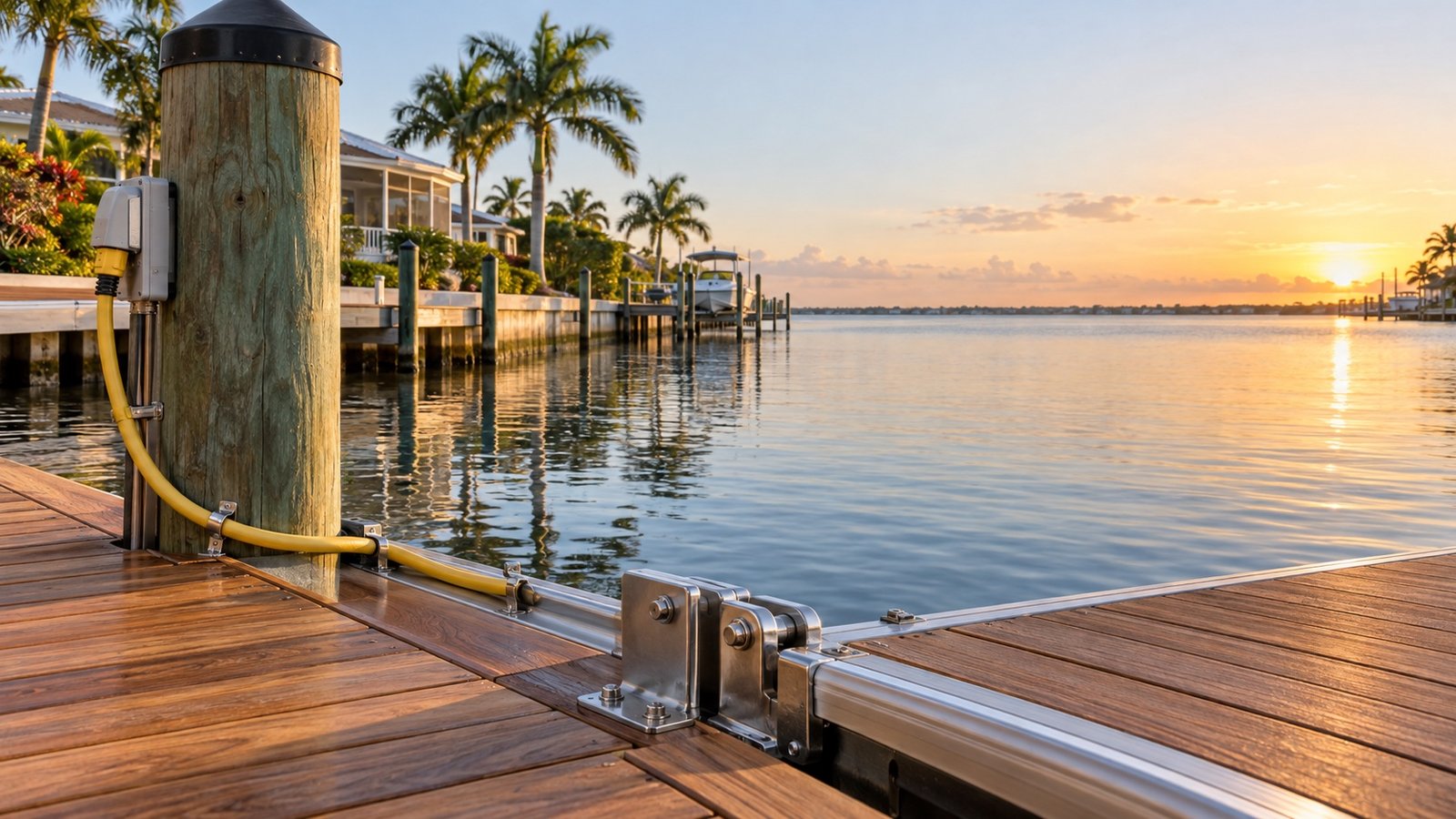
Floating-Dock Shore-Power Cable at the Hinge: What Merritt Island Buyers Should Verify
By Carrie Liotta, Space Coast REALTOR® with REAL Broker | Published October 15, 2026
If a shore-power cable crosses the hinge travel path on a Merritt Island floating dock, do not treat it as a cosmetic detail. Before you buy, have qualified waterfront and electrical professionals identify the cable’s purpose, trace its route through the dock’s full movement, inspect its protection and connection points, and explain the repair plan if anything is worn, pinched, improvised, or undocumented.
A floating dock is supposed to move with changing water levels; that is the point of the hinge, gangway, collars, guide piles, and connections. A cable that crosses or approaches that movement can be perfectly intentional, but only if the installation leaves appropriate slack and protection through the actual range of travel. At a showing, I would not ask a buyer to tug a cable, open an enclosure, or test an energized receptacle. I would ask for records, a safe demonstration, and the right specialists during the inspection period.
Start with the question the cable has to answer
First, establish what the cable serves. “Shore power” can mean a supply for a boat receptacle, dock lighting, a lift, a battery charger, a pump, or a different waterfront load. The answer changes the inspection scope. A cable feeding a boat pedestal may have a different route and equipment than one feeding a low-voltage dock accessory, and neither should be assumed from its appearance.
Ask the seller or dock manager for the dock plan, electrical invoice, equipment manuals, and the name of the contractor who performed the work. From a safe distance, photograph labels, disconnect locations, receptacles, junction boxes, conduit transitions, strain-relief hardware, cable supports, and the cable’s path on both sides of the hinge. A written component map from the qualified professional is more useful than a collection of dock photos after closing.
Then ask the professional to follow the route from the house panel or source, through any disconnect and fixed wiring, to the flexible section at the moving dock and out to the served equipment. The key buyer question is not simply, “Does the cable look long enough today?” It is whether the route remains protected at high water, lower water, normal wake movement, and the practical positions the dock reaches in ordinary use.
On canal property, I also want the buyer to separate electrical questions from access questions. A beautiful floating dock does not establish navigable depth, turning room, bridge fit, or lift suitability for the buyer’s boat. My guide to Merritt Island canal homes for boats needing clearance and deeper water explains why those route questions deserve their own due diligence.
Watch the hinge through a normal range of motion
A single still photo cannot show how a cable behaves. If it is safe to do so, have the seller or dock professional demonstrate ordinary dock movement while everyone remains clear of the hinge, gangway, moving hardware, and water. The purpose is observation, not a buyer-run stress test.
The professional should explain where the cable is intended to flex, where it is secured, and how it avoids sharp hardware. Look for a path that stays clear of pinch points, abrasion at a hinge barrel or bracket, unsupported loops that can snag, and a route that becomes tight only when the dock rises or falls. Water staining, flattened insulation, cracked jacket material, taped repairs, improvised ties, corrosion at supports, or a cable resting where moving metal can rub it are reasons to pause and obtain a written evaluation.
Do not assume a recently painted dock or a new-looking receptacle answers that question. The flexible portion may be older than the visible fixture, and a repair can change the path without changing the rest of the dock. I covered another version of this principle in how dock-power conduit crossing a seawall expansion joint should be evaluated: the transition between fixed and moving waterfront elements deserves more attention than a quick glance allows.
Keep the inspection safely divided between the right people
A general home inspector can flag visible conditions and help a buyer organize concerns, but the condition of energized waterfront equipment and the moving dock structure may call for more specialized review. I would ask for a licensed electrical contractor to assess the electrical installation and a qualified dock or marine professional to assess the floating-dock, hinge, flotation, connection, and movement issues. If a contractor says the scope is outside their specialty, that is useful information, not a reason to accept a vague answer.
Florida regulates electrical contracting. The state’s electrical-contracting definitions in Florida Statute 489.505 distinguish, among other terms, a certified electrical contractor and the scope of electrical contracting. Before relying on an opinion, verify the business and individual credentials through the state’s Electrical Contractors’ Licensing Board resources, and ask whether the professional is taking responsibility for the specific waterfront work being evaluated.
Neither a buyer nor a real estate agent should open a live panel, disconnect a cable, enter the water, work beneath a moving dock, or create a fault to see what happens. The value of a professional review is that it compares the actual installation with the applicable equipment instructions and current requirements without turning the inspection into a dangerous experiment.
Build a waterfront record file before the inspection period ends
For a Merritt Island canal home, I like a buyer’s dock file to tell a chronological story. Begin with the original dock and electrical work, then add later floating-dock installation, hinge or piling work, shore-power upgrades, lift work, lighting, repairs, and storm-related repairs. Each invoice should say who did the work, when it was done, and what portion of the system it covered. A receipt that simply says “dock repair” may not explain whether the cable route, support hardware, or connection point was part of the work.
The Brevard County permit search is a useful starting point for an unincorporated-property record review. Confirm the property’s actual jurisdiction first; a Merritt Island address may require a different records path depending on location and the work involved. An absent online result does not prove work was exempt, approved, or unpermitted. Compare the public record with invoices, final paperwork, seller disclosures, and what the professionals see at the property.
Ask for service notes as well as installation papers. Notes about a recurring trip, corrosion, a damaged cable cover, hinge adjustment, storm cleanup, a failed pedestal, or a replacement connector can be far more informative than an undated statement that the dock “works fine.” Ask whether a repair was a permanent correction or a temporary measure pending a larger job.
It also helps to request a clear handoff list: which breakers and disconnects serve the dock, where they are located, what keys or access codes exist, what equipment is included in the sale, who services it, and whether any warranties transfer. That is especially important for a remote or seasonal owner who may not be at the property when a waterfront issue appears.
Price the uncertainty, not just the visible cable
The correction may be modest if a qualified contractor finds a simple support, routing, or weather-protection issue. It may be much broader if the flexible run is damaged, the source equipment is outdated, the dock movement has changed, permits or records cannot be reconciled, or multiple waterfront systems share an unclear route. That is why a buyer should not negotiate from a phone-photo estimate or a guess based on cable length.
Request an itemized scope that says what will be inspected, what must be repaired or replaced, what access is needed, whether work affects the dock structure or fixed electrical system, whether permitting or jurisdictional review is expected, and what testing or final documentation the contractor will provide. If two specialists disagree, ask them to identify the boundary between their scopes rather than assuming one proposal covers everything.
This is also a resale issue. A buyer who receives manuals, invoices, permit history where available, a clear service path, and a recent professional opinion can make a calmer decision than one who inherits an unexplained cable crossing a moving hinge. The same documentation becomes valuable when that buyer later sells. For a related record-keeping perspective, read my article on documenting a floating dock’s hinge and gangway grounding before a Merritt Island sale.
Use the findings to make a clean offer decision
I would be comfortable moving forward when qualified professionals can explain the system’s purpose and route, ordinary movement does not expose a concerning pinch or abrasion path, the installation and repairs are supported by usable records, and the buyer understands the ongoing service plan. A clean report is not a promise that waterfront equipment will never need maintenance, but it replaces mystery with a documented starting point.
I would slow down when the cable’s use is unknown, its route cannot be demonstrated safely, the hinge travel appears to contact or strain it, labels and records conflict, the work looks improvised, corrosion or water intrusion is visible, or no qualified professional will take responsibility for the evaluation. Those conditions do not automatically mean walk away. They do mean the buyer needs a written scope, realistic timing, and a decision about whether seller repairs, a price adjustment, a credit that works with the lender, or walking away is the prudent answer.
Do not let a dock issue become an afterthought because the house itself is attractive. Waterfront ownership works best when the land-side systems, dock structure, moving components, electrical equipment, insurance questions, access, and boat plans are all evaluated together. I help Merritt Island buyers organize that due diligence before the contract clock gets tight.
Bottom line for Merritt Island floating-dock buyers
A shore-power cable near a floating-dock hinge is not automatically a deal-breaker, but it is a condition that deserves a real answer. Identify what it serves, trace the entire route, observe normal dock movement from a safe position, have licensed electrical and qualified dock professionals evaluate their respective scopes, assemble permits and service records, and negotiate from written findings rather than assumptions.
If you are comparing Merritt Island canal homes, reach out for a no-pressure conversation about Brevard County waterfront homes for sale with Carrie Liotta, Space Coast REALTOR® with REAL Broker. You can also join my private Facebook group, Moving to Brevard County Florida, for practical local guidance. Your next chapter starts here.
