

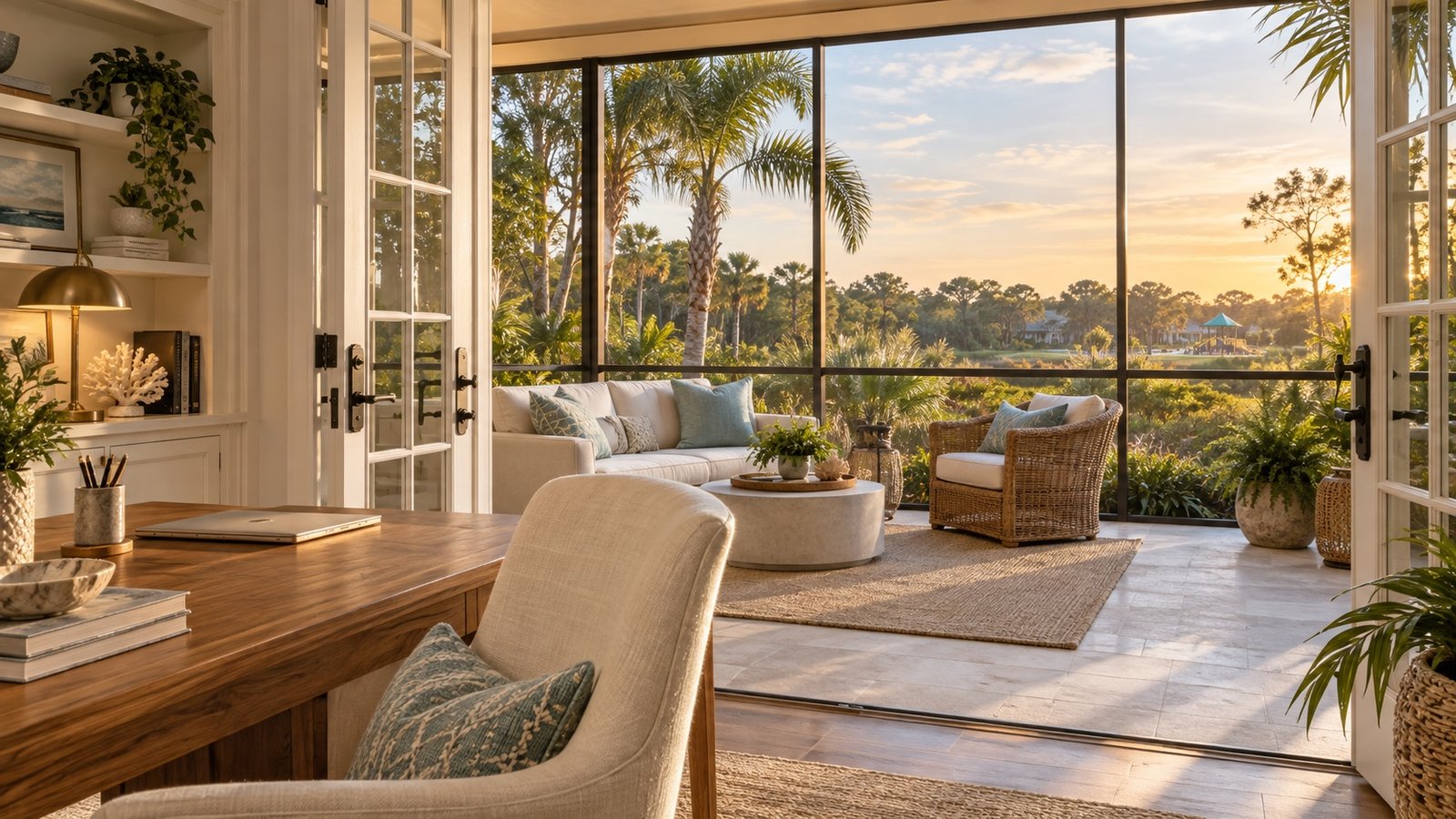
Community Playground or Preserve Lot: How Should Viera Relocators Choose if Work-From-Home Calls Matter?
By Carrie Liotta, Space Coast REALTOR® with REAL Broker | October 14, 2026
If work-from-home calls are part of your normal week, I would usually choose the Viera home whose office, primary bedroom, and outdoor space feel calm at the hours you actually live there—not the one that merely sounds quieter on a listing. A community playground can be wonderfully convenient, while a preserve lot can feel private; neither is automatically the better remote-work choice.
I help relocating buyers make this kind of decision address by address because the label on the lot tells only part of the story. The real question is how the home handles sound, sightlines, parking, sun, outdoor use, drainage, and your family’s routine at 8:30 a.m., 3:30 p.m., and Saturday morning. A beautiful preserve view is not a promise of silence, and a house near a playground is not automatically too busy for focused work.
Start with the routine, not the amenity
Before we compare houses, I ask buyers to describe a normal Tuesday. Are you taking video calls from a front bedroom? Do you need quiet for concentrated work, or do you simply need a door you can close? Will children use the playground after school? Is a partner leaving early, returning late, or working on a different schedule? The right lot changes when those answers change.
A home beside a community playground can be an excellent fit for a family that will use it often. The convenience is real: a short walk, a predictable place for children to meet friends, and less pressure to create entertainment in the backyard. For a remote worker, it can also be perfectly manageable when the office is on the opposite side of the house, windows are well placed, and the busiest periods do not overlap with important calls.
A preserve-edge lot often appeals to buyers who want a softer view, fewer rear neighbors, and a more tucked-away feeling. That can be lovely for a home office. But I never let clients assume “preserve” means a permanently empty, silent, or unrestricted backdrop. The view may include a drainage feature, a trail, wildlife activity, maintained landscape, roadway noise that carries differently than expected, or association limits on what can be added at the edge of the yard.
What does “quiet” actually mean for your calls?
Remote work is not one thing. A buyer who makes occasional internal calls may be happy near a play area. A therapist, attorney, sales professional, executive, or anyone who needs confidential or camera-on calls may want more control over sound and background movement. I encourage clients to separate four issues that get lumped together as “quiet.”
- Sound: Can you hear voices, balls, whistles, traffic, lawn equipment, or pool activity from the exact room where you work?
- Visual distraction: Does the desk face a busy street, a sidewalk, a play area, or a rear window with constant movement?
- Privacy: Can people outside see directly into the office, patio, or bedroom?
- Control: Can you close a solid door, use a different room, add shades, or move the desk without making the whole house less functional?
That is why I prefer a practical showing test over a quick impression. Stand in the intended office with the windows closed, then open. Step onto the patio. Sit in the primary bedroom. Notice where the garage, driveway, sidewalks, and common-area access are relative to the rooms you use most. If the seller allows it and the schedule makes sense, revisit at a different hour rather than deciding from a ten-minute daytime tour.
For another angle on working from home in Viera, my guide to choosing between community-pool convenience and a quieter interior street can help you map activity patterns instead of chasing an abstract idea of calm.
How a playground-adjacent home can work beautifully
There are buyers for whom the playground location is a feature, not a compromise. If your children are young, a close play space may turn an ordinary weekday into an easier one. You may appreciate being able to walk over after dinner, meet neighbors without getting in the car, or keep a backyard free for a garden, pool, or quieter outdoor setup.
The house matters more than the distance alone. A plan with an office toward the front of the home and living space facing the park may work very well. So might a home with a flex room that can become a dedicated office, a garage buffer between the workspace and the activity area, or mature landscaping that softens sightlines. A corner location can bring extra openness and parking convenience, but it can also bring more movement. I want clients to see both sides before they write an offer.
Ask what happens during school breaks, after-school hours, weekends, community events, and maintenance days. Do not ask a neighbor to predict the future; simply observe the setting and review the community rules. The best purchase is not the one with zero activity. It is the one whose activity level fits your household without requiring you to rearrange your workday around it.
What preserve-lot buyers need to investigate
Preserve lots deserve a slower look because the attractive view can make buyers skip ordinary due diligence. Start with what you can see from the house, then identify what you cannot see: the surveyed lot line, any easements, the community’s maintenance responsibilities, and the approval process for fences, pools, screens, landscaping, or exterior changes.
Florida’s Environmental Resource Permitting program regulates activities involving changes to surface-water flows, including stormwater runoff and dredging or filling in wetlands and other surface waters. That does not tell you what is allowed on a particular Viera lot. It does explain why a buyer should not treat a preserve-edge area as extra backyard or assume that future grading, drainage work, or improvements will be simple.
I would request the survey, seller disclosures, association documents, and any available information on drainage features before the inspection period ends. Then I would ask the right professionals about anything that affects your plans. If you may add a pool, fence, screen enclosure, or substantial landscaping, get the community’s current architectural requirements and ask whether a preserve buffer, easement, or drainage feature affects the design. A verbal “I think that should be fine” is not a plan.
My earlier article on privacy, drainage, HOA approval, and pool planning on Viera preserve lots is a useful companion when your outdoor plans are a major part of the decision.
Documents matter more than a seller’s description
For either location, ask for the current declaration, rules, budget, recent meeting minutes, and architectural-review information. Florida’s homeowners’ association statute includes association-record provisions; buyers can review the current text of Section 720.303, but I recommend using the actual community documents and appropriate professionals for the specific property rather than relying on a general internet interpretation.
On a playground-adjacent home, the documents may clarify hours, parking, common-area maintenance, lighting, or event rules. On a preserve lot, they may identify responsibilities for landscape buffers, irrigation, drainage, fences, and exterior changes. The records will not answer every lifestyle question, but they can stop you from buying based on an assumption that the community does not share.
I also use the Brevard County Property Appraiser as one local starting point for parcel-level information. It is not a survey, a permit search, an environmental opinion, or an association approval. It is simply part of a layered review that should include the title work, survey, inspection, and the documents tied to the actual address.
Test the work-from-home setup before you fall in love with the view
When a client is serious about a house, I like a simple “call day” walkthrough. Bring a phone, open the camera, and spend a few minutes in the room that would become the office. Look at the background. Check whether a window puts bright late-day sun directly behind you. See whether the room can hold a proper desk without making a guest room unusable. Note the distance to the kitchen, laundry, garage door, and living room.
Then go outside. From the preserve lot, look for visible swales, drains, pond edges, irrigation heads, or grade changes and ask questions rather than drawing conclusions. From the playground location, count the obvious approach paths and parking spaces during the hour that matters to you. Listen for sound with the patio door open and closed. The purpose is not to find a flawless property. It is to learn which tradeoff you can genuinely live with.
Light deserves its own review. A quiet preserve-facing room can still be a poor video-call room if it is too dark or has difficult backlighting, while a busier side of the house may have the better workspace. I explain that balance in my Viera home-office guide on shade versus daylight.
Which choice is usually better for different buyers?
I lean toward the playground-adjacent home when the household will use the amenity frequently, the office is protected by the floor plan, and the activity feels like a benefit rather than an interruption. It can be especially smart for a family that wants connection and convenience but does not need a secluded rear yard.
I lean toward the preserve lot when privacy, a calmer rear view, and outdoor relaxation are central to the move—and when the buyer is comfortable doing more document and site-specific homework. A preserve lot is not a shortcut around due diligence. It is a property feature with its own questions.
Neither choice should be decided by resale mythology. There will be future buyers who value a short walk to the playground and others who will pay attention to the preserve view. The stronger resale position is a home that functions well, has clear records, and is honestly priced for its lot, condition, and community rules.
My bottom line for Viera relocators
Choose the home that supports your actual workday and family rhythm. For remote workers, that means testing the office location, observing the site at useful times, reviewing the records, and being honest about whether you want energy nearby or a more private backdrop. A playground can create community. A preserve lot can create breathing room. The winning choice is the one that lets you enjoy Viera without asking your work life to tolerate a daily mismatch.
If you are comparing Viera homes and want a second set of local eyes on the lot, office layout, community documents, and monthly ownership picture, reach out for a no-pressure conversation about Brevard County homes for sale. I am Carrie Liotta, Space Coast REALTOR® with REAL Broker, and I will help you sort through the tradeoffs before your next chapter starts here.
