

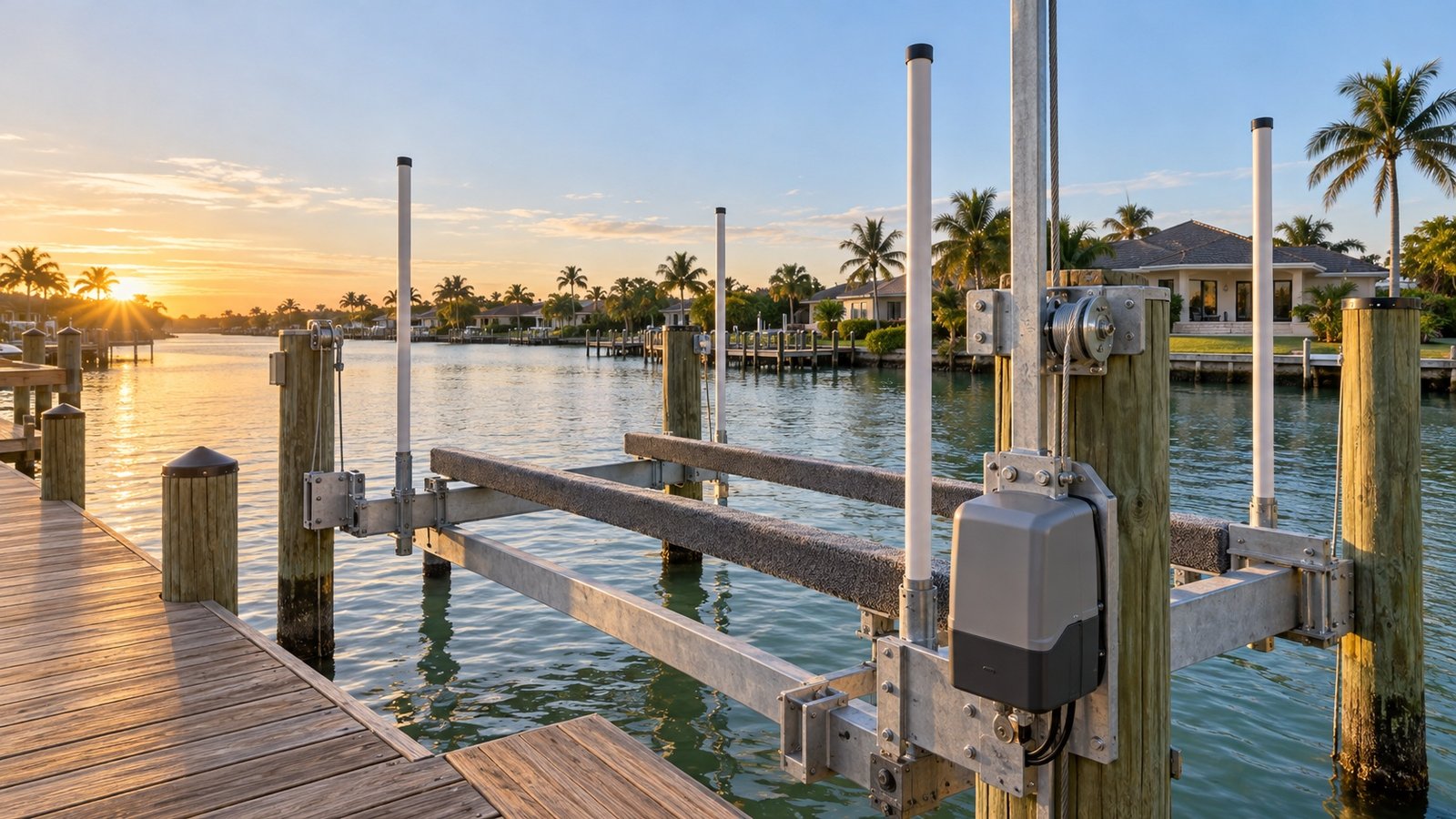
Newer Boat-Lift Motor, Older Bunks and Guideposts: What Should Merritt Island Buyers Verify?
By Carrie Liotta, Space Coast REALTOR® with REAL Broker | Published October 14, 2026
A newer boat-lift motor is encouraging, but it does not make the whole lift newer. Before buying a Merritt Island canal home, verify the lift’s rated capacity, bunk fit, guidepost alignment, cables, structure, controls, permits, and service history as one working system. The real question is whether the lift safely fits your boat, not whether one component has a recent date.
I see why buyers focus on the motor. It is visible, easy to describe in a listing, and expensive enough to sound like a meaningful upgrade. But a motor can turn smoothly while older bunks support the hull in the wrong places, worn carpet hides soft wood, or leaning guideposts make every return to the dock harder than it should be. On a waterfront purchase, I would treat “newer motor” as the beginning of the inspection, not the conclusion.
Why the motor date tells only part of the story
A boat lift is a connected system. The motor supplies movement, but the cables, drive components, cradle, beams, bunks, fasteners, guideposts, electrical supply, and dock structure all affect how the boat is raised, supported, and lowered. Replacing one failed motor may restore movement without correcting age, corrosion, alignment, capacity, or hull-fit problems elsewhere.
Ask for the motor invoice and model information. Then ask why it was replaced. Was it a planned upgrade, a storm-related repair, a response to repeated tripping, or simply the first component to fail? The answer does not automatically create a problem, but it helps your marine inspector understand where to look. I also want to know whether the replacement included the gearbox, switches, controls, wiring, or only the motor itself.
This distinction is especially important when a listing uses the phrase “new boat lift.” If the invoice covers one motor on an older lift, describe it accurately in your own decision file: newer motor, age of remaining system not yet verified.
Start with your boat, not the seller’s boat
The seller may have used the lift successfully for years and still have a setup that is wrong for you. Hull shape, length, beam, weight distribution, engines, fuel, batteries, gear, towers, and other equipment all affect fit. Do not rely on a single advertised boat weight or assume that an empty published figure represents the boat as you actually use it.
Gather your boat’s specifications and photographs before the marine inspection. Ask a qualified lift professional to compare the loaded boat with the lift’s documented rating and configuration. If the rating plate is unreadable or the model cannot be confirmed, do not fill the gap with a guess. Capacity is one of the facts I want resolved before a buyer pays a waterfront premium.
Also verify usable slip width, water depth through the normal range, overhead clearance, and the route out of the canal. A mechanically sound lift does not solve a canal or bridge-clearance mismatch. My broader guide to choosing a Merritt Island canal-front home explains why the waterway and boating route should be evaluated with the house.
What older bunks can reveal
Bunks are where the lift meets the hull, so their condition and placement matter more than their appearance from the dock. During the inspection, look for cracked, bowed, loose, rotted, or uneven bunk material; worn covering; protruding fasteners; improvised shims; and brackets with corrosion or movement. A tidy carpet wrap can hide what is underneath, which is why a hands-on professional review is more useful than listing photos.
Fit matters just as much as age. The bunks should support the correct areas of the intended hull and allow the boat to settle consistently. Evidence that they were moved may be perfectly explainable, but it should lead to questions: Which boat were they configured for? Who made the change? Were brackets and hardware replaced? Did the installer document the setup?
If the lift previously held a different hull, read my related explanation of boat-lift bunks reconfigured for another boat. The practical lesson is the same: a buyer needs evidence of present fit, not just evidence that the lift operated for the seller.
Guideposts are an alignment tool, not proof of support
Guideposts help position the boat as it enters the lift. They are not a substitute for correctly placed bunks, and they should not be used to force a poor fit. Older guideposts deserve attention when they lean, wobble, bind against the hull, show cracked PVC sleeves, have loose brackets, or appear uneven from side to side.
Watch how the boat approaches in the actual canal conditions if the seller and inspection professionals can demonstrate it safely. Wind, current, neighboring docks, canal width, and the angle of entry can expose an awkward setup that looks fine while empty. Ask whether rub marks are ordinary contact with a replaceable sleeve or evidence that the boat is being pushed out of alignment.
A useful inspection separates cosmetic aging from functional misalignment. Faded PVC may be a minor replacement. A corroded bracket or post that no longer holds position can affect daily use. The goal is not to demand that every old piece look new; it is to understand which parts are merely weathered and which parts change how the system works.
Operate the entire lift during due diligence
I would not accept a brief up-and-down demonstration as the only test. Arrange for a qualified marine contractor to inspect the lift under appropriate conditions and follow the manufacturer’s procedures. The professional should observe whether the cradle travels level, whether cables wind evenly, whether the controls respond normally, whether the motor or gearbox makes unusual sounds, and whether limit or stop functions work as intended.
The inspection should also cover visible cable condition, pulleys or sheaves, fasteners, welds, beams, brackets, pilings or supports, dock attachment, and the electrical installation. Salt air and brackish-water exposure make documentation and maintenance especially valuable. Do not reach into moving equipment, stand beneath a suspended boat, or attempt to diagnose electrical components yourself.
A newer motor beside questionable wiring is a separate risk. I have written about how buyers can compare documented dock electrical work with a newer lift motor. For this purchase, ask who installed the motor, whether the work required electrical or building review, and whether the disconnect, controls, receptacles, conduit, and grounding or bonding were evaluated by the appropriate licensed professional.
Build a record trail before you assign value
Request the original lift information if available: manufacturer, model, rated capacity, installation invoice, plans, permit or final inspection records, and warranties. Add later service invoices for motors, gearboxes, cables, controls, bunks, guideposts, structural repairs, and electrical work. Photographs taken before components were covered or replaced can be useful too.
For properties in unincorporated Brevard County, the Brevard County building permit search is a starting point for available records. A Merritt Island mailing address does not, by itself, tell you which office holds every record, and older files can be incomplete. Confirm the property’s jurisdiction and ask the relevant agency directly rather than treating a blank online search as proof that no permit exists.
Future dock or lift changes may also involve environmental-resource or water-management review depending on the site and scope. Before relying on a plan to move the lift, expand the dock, or substantially change the structure, review the St. Johns River Water Management District permitting resources, then verify the specific proposal with the agencies and local jurisdiction.
How I would structure the offer decision
If the lift fits your boat, carries a confirmed rating, operates evenly, and receives a favorable inspection, older bunks or guidepost sleeves may be manageable maintenance items. Get written estimates anyway. Small pieces can lead to labor, hauling, alignment, electrical, or dock-access costs that are easy to underestimate from shore.
If the motor is documented but the rating is unknown, the bunks do not fit your hull, the guideposts are unstable, or the structure has unresolved corrosion, do not credit the property with the value of a ready-to-use lift. Your choices are to negotiate a repair by qualified contractors, request an appropriate credit where the contract and lender allow it, adjust your price, or walk away if boating utility is essential.
I prefer written scope over vague promises. “Service lift” is not specific enough. A useful proposal identifies the observed issue, the contractor, the components to be repaired or replaced, the capacity and configuration being verified, required permits, and how completion will be documented.
Do not lose sight of the rest of the waterfront property
A good lift does not erase seawall, dock, flood, roof, insurance, or canal-access concerns. Review the seawall and dock with qualified professionals, obtain property-specific insurance quotes, examine the survey and easements, and look up the address through the FEMA Flood Map Service Center. Flood-map information is one due-diligence input, not a complete insurance quote or prediction of what will happen at the property.
I also recommend seeing the canal more than once when practical. Visit at a different tide or time of day, observe neighboring boat traffic, and trace the route to the water you plan to use. The best canal home is not simply the one with the newest visible equipment. It is the one where the house, waterfront structures, lift, boat, budget, and route all work together.
My bottom line for Merritt Island buyers
Give the newer motor appropriate credit only after the rest of the lift earns it. Confirm capacity and model, match the bunks to your loaded boat, inspect guidepost alignment, test the complete system, review electrical and structural components, and assemble the permit and service record. If any of those facts remain uncertain, price the uncertainty instead of assuming the newest part represents the whole.
I help buyers compare Merritt Island waterfront homes beyond the listing photos, including canal route, dock and lift usability, seawall condition, records, insurance questions, and future resale. Join my private Facebook group, Moving to Brevard County Florida, or reach out for a no-pressure conversation about Brevard County homes for sale. Your next chapter starts here.
