

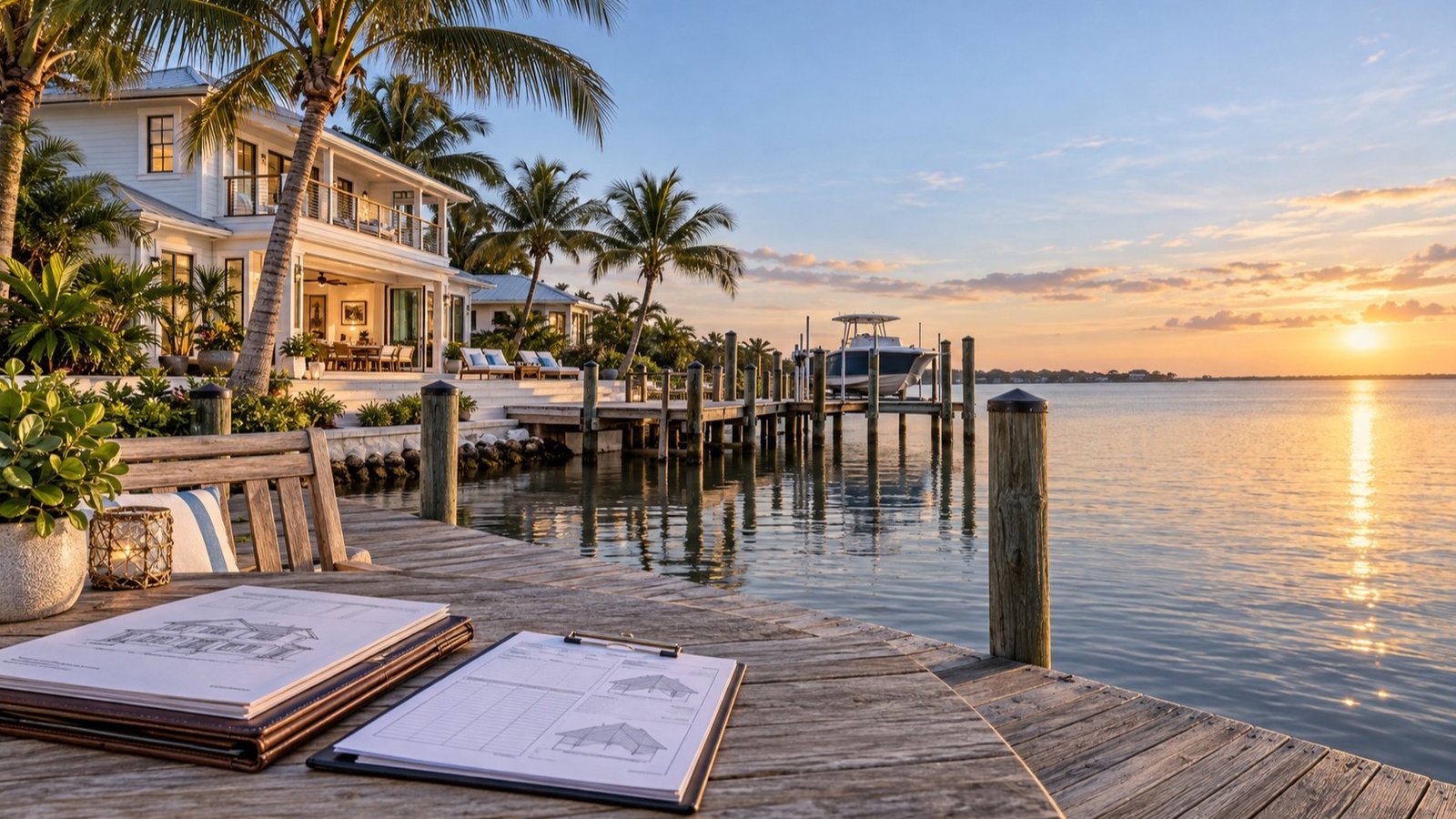
How Should Space Coast Waterfront Buyers Compare Dock Permits, Flood Quotes, and Wind Mitigation Before Choosing a Lower-Priced Home?
By Carrie Liotta, Space Coast REALTOR® with REAL Broker | Published October 14, 2026
If the lower-priced Space Coast waterfront home has unanswered dock, flood-insurance, or wind-mitigation questions, do not treat the price gap as savings yet. I would compare the records, the real insurance quotes, and the work that may be needed before deciding which home is actually the better buy.
Waterfront buyers often see this choice: one house costs less, has the view or canal access they want, and looks like a project they can handle. The competing house may be less exciting at first glance but comes with a cleaner file: permits or approvals for waterfront improvements, a current insurance picture, and documentation for wind-resistant features. Neither option automatically wins. The mistake is letting the lower list price make the decision before the unknowns have a dollar amount and a timetable.
On the Space Coast, I encourage buyers to separate three questions that listings tend to blur together. First, what is legally and physically there at the water’s edge? Second, what will the specific home cost to insure after closing? Third, what features can an insurer actually verify for wind-loss mitigation? Once those answers are in the same folder, the comparison becomes much calmer.
Start with the dock as a record-and-condition question
A dock, lift, walkway, or shoreline improvement is not just a lifestyle feature in listing photos. It is part of the property you are buying, and its usefulness depends on more than whether it looks tidy from the patio. Ask the seller for the improvement records they have: permits or authorizations, plans, contractor invoices, repair history, electrical work, lift service records, surveys, and any correspondence that explains an easement or shared access.
That request is not an accusation that something is wrong. It is how you learn what you would inherit. The state’s sovereign-lands authorization law makes clear that work involving state lands requires the appropriate consent, and other permits or approvals can be implicated depending on the work. That is a reason to verify the actual property file with the right agencies and local authorities, not a reason to assume every waterfront improvement has the same path.
I would also walk the improvement with the person who understands the intended use. A buyer who wants to kayak may see a very different value in a dock than a buyer who expects to keep a boat on a lift. Look for practical questions: Can you reach it safely? Is there visible deterioration? Where are utilities routed? Is there a shared structure, access agreement, or maintenance responsibility? If an easement is part of the story, my guide to dock-access due diligence is a useful companion before you assume access is exclusive.
Then decide what must be inspected during your contract period. A general home inspection may identify obvious concerns, but a dock, lift, seawall, or electrical issue can call for a qualified waterfront or marine professional. The goal is not to demand a perfect dock. It is to know whether the lower price already accounts for the condition, whether the work is feasible, and whether you can live with the timing.
Do not use the flood map as a premium quote
A FEMA map is essential, but it answers a different question from an insurance quote. FEMA says its Flood Map Service Center and flood-map products are the official sources for National Flood Insurance Program hazard mapping. The map helps show the property’s relationship to mapped flood hazards and helps lenders determine insurance requirements. It does not promise that two houses in the same area will carry the same flood premium.
That distinction matters more than ever under FEMA’s current NFIP pricing approach. FEMA explains that pricing considers multiple risk and property variables, including flood frequency and type, distance to water, elevation, and rebuilding cost. So a seller’s declaration page, a neighbor’s anecdote, or a quick map lookup is useful context, not the number you should put into your monthly budget.
Build quotes before you decide which house is cheaper
Before the inspection period is nearly over, ask an insurance professional to quote each address with the information available to you. Give the same inputs for both homes where possible: intended occupancy, replacement-cost assumptions, roof information, current inspection reports, elevation documentation if available, and the exact feature details the carrier requests. Ask what information is still missing and what could change the quote. A preliminary number is valuable only if you understand its assumptions.
I also ask buyers to distinguish the flood question from the broader homeowners and wind question. Flood coverage, homeowners coverage, wind deductibles, and carrier underwriting are connected in a real budget, but they are not one interchangeable line item. A lower-priced house can be the right purchase if the total cost remains comfortable after you price its known needs. It is not the right bargain if the insurance and deferred-maintenance picture erases the purchase-price advantage.
If the seller has an existing flood policy, request it as background and confirm whether assignment is available and appropriate for the transaction. Do not treat it as a promise of your future premium or coverage. I explain that distinction in more detail in my comparison of a seller’s flood policy and a new buyer quote. The address, the policy structure, the buyer’s needs, and the insurer’s current underwriting still deserve their own review.
Wind mitigation is documentation, not a guess from the roofline
Buyers sometimes hear “newer roof” and assume the insurance conversation is settled. A newer roof can be important, but it is not a complete wind-mitigation report. Roof-deck attachment, roof-to-wall connections, opening protection, and other construction details are examples of information that may need to be documented. The useful question is not, “Does this house look hurricane-ready?” It is, “What can the insurer verify for this property today?”
Florida law requires insurers to notify personal-lines residential policyholders about available hurricane-loss-mitigation discounts, credits, rate differentials, or deductible reductions. That does not mean every feature earns the same credit with every insurer. It does mean the Florida mitigation-notice statute supports asking for the carrier’s requirements and obtaining the right inspection when it is useful.
For a waterfront home, the practical file may include a wind-mitigation inspection, a four-point inspection when requested, roof permit or invoice records, and documentation for opening protection. Have the insurance professional tell you which reports are acceptable and whether their age or format matters. My related guide to roof connections and wind-mitigation credits in Brevard County can help buyers understand why visible shutters or a roof date alone may not answer every underwriting question.
The lower-priced home may still come out ahead. Perhaps it has a well-documented roof and opening protection but needs a modest dock repair. Or perhaps the nicer dock is paired with a thin insurance file and a roof near its planning horizon. The point is to price the package, not to award points for one attractive feature.
Use one comparison sheet, not three separate worries
When I help a buyer compare two waterfront homes, I want the decision on one page. Put the purchase price at the top, then make three columns below it: waterfront improvement file, flood-insurance path, and wind/homeowners-insurance path. Under each column, note what is documented, what must be inspected or quoted, who is responsible for obtaining it, and the date the answer is due.
- Waterfront improvement file: identify dock, lift, seawall, electrical, shared-access, and permit or authorization records; note any specialist inspection or agency confirmation still needed.
- Flood-insurance path: save the map lookup, elevation information if available, the insurer’s quote assumptions, coverage limits, deductibles, and any unanswered underwriting item.
- Wind and homeowners path: collect roof records, wind-mitigation and four-point reports when applicable, opening-protection details, deductible options, and the carrier’s conditions for binding coverage.
Then add the visible work: repair estimates, service needs, or replacements that your professionals identify. I would not invent a repair allowance because a dock is older or a home is near the water. Let the appropriate professional tell you the condition and scope. What matters is that both houses are being measured the same way.
How to make the offer decision without oversimplifying it
A lower purchase price gives you room, but only if the room is real. If the dock file is complete, inspections show manageable conditions, and your insurance quotes fit your payment plan, the lower-priced home may be an excellent opportunity. You may prefer putting money into improvements that are visible, useful, and scheduled on your terms.
On the other hand, a higher-priced house can be worth the premium when it removes meaningful uncertainty. A documented waterfront setup, a straightforward insurance file, and verifiable mitigation features can make the first year of ownership far easier to budget. That does not mean you should overpay for paperwork. It means clean documentation has value when it reduces the chance that a purchase turns into several urgent decisions at once.
There is also a middle answer: negotiate for information rather than guessing. Depending on the contract and the facts, a buyer may ask for records, inspection access, a repair or credit discussion after qualified review, or time to obtain insurance feedback. Your lender, insurer, inspector, and real estate professional each play a different role. Bring them in early enough that their answers can inform the contract timeline rather than arrive after it.
My pre-offer waterfront checklist
Before choosing the apparently lower-priced Space Coast waterfront home, I would want to know:
- Which waterfront improvements are included, and what records support them?
- Is access private, shared, or subject to an easement or agreement?
- What does the current FEMA map show, and what does the actual insurance quote assume?
- What coverage, deductibles, and underwriting conditions apply to the home you want to buy?
- Which wind-resistant features are documented rather than assumed?
- Do roof, wind-mitigation, four-point, dock, lift, or seawall specialists need to weigh in during the inspection period?
- After the verified costs and likely work are added, which home still fits your cash, monthly payment, and tolerance for projects?
The practical bottom line
The best waterfront choice is rarely the home with the cheapest list price or the prettiest dock alone. It is the home whose water access, documentation, insurance costs, and future work you understand well enough to own with confidence. I help buyers turn those separate questions into a clear comparison before they commit. If you are weighing Space Coast waterfront homes, reach out for a no-pressure conversation about Brevard County homes for sale. Your next chapter starts here.
