

Should Merritt Island Buyers Prioritize a Newer Dock or a Better Garage Layout if They Kayak More Than They Boat?
By Carrie Liotta, Space Coast REALTOR® with REAL Broker | October 13, 2026
If kayaking is the way you will actually use the water, I would usually prioritize the better garage layout over the newer dock. A dock still needs to be safe, usable, and properly documented, but a smooth launch, dry storage, and room for everyday gear often matter more than a boat-ready setup that sits unused.
That answer surprises buyers who start a Merritt Island waterfront search by comparing dock boards, lifts, and how close a house looks to the Banana River. Those features can be valuable. But a kayak lifestyle has a different rhythm. You may be loading before work, rolling a cart through the side gate, rinsing gear after a windy paddle, and deciding whether the paddle, PFDs, and dry bags have a sensible home. The house that makes those ordinary steps easy is often the house you enjoy more.
I would not reduce the choice to “dock versus garage,” though. The best decision comes from separating three questions: Is the waterfront improvement sound and permitted for what is there? Does the home make your actual water routine easy? And what future buyer will the property appeal to when you sell? My broader guide to buying canal-front property in Merritt Island is useful for the water-side evaluation; this article is about matching that waterfront to a kayak-first life.
Start with the activity you will repeat, not the feature that photographs best
A newer dock is immediately visible. It can create a strong first impression, particularly on a canal or lagoon-facing lot. Yet a buyer who owns a 12-foot kayak, paddles locally, and rarely trailers or keeps a powerboat does not use a dock the same way as a buyer planning offshore weekends or a larger center console.
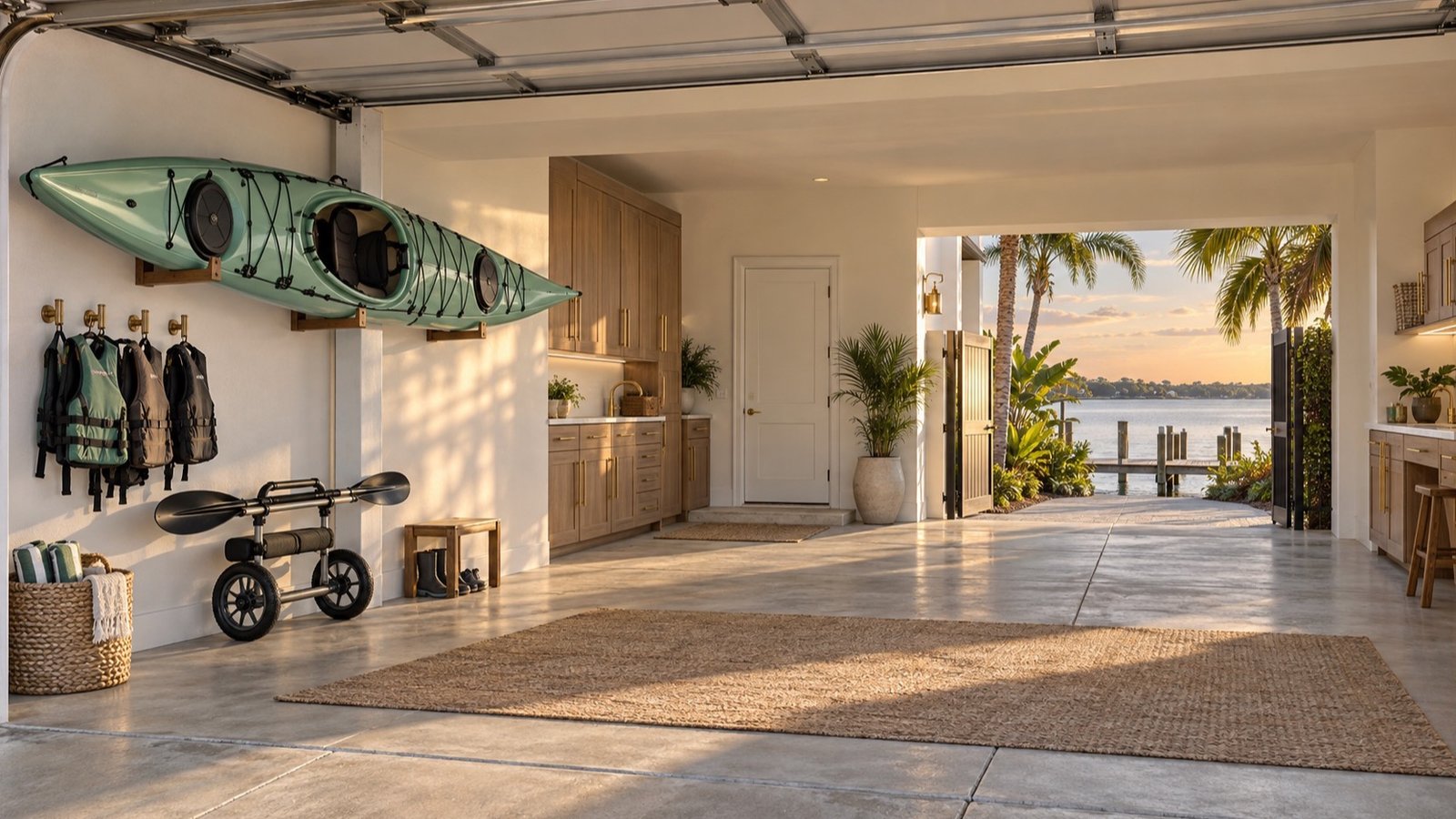
For a kayak-first buyer, I ask more practical questions. Can you get the kayak from garage to water without lifting it over a fence or squeezing past outdoor furniture? Is there a side yard wide enough for a cart? Does the driveway give you room to unload after a paddle? Is there shaded, secure storage that keeps the boat off the ground and out of the way? Where will wet PFDs, paddles, fishing gear, and a small cooler go?
Those are not small details. They determine whether a spontaneous hour on the water feels inviting or turns into a project. A one-car garage with a handsome newer dock can be the wrong fit if every paddle requires moving bicycles, bins, lawn equipment, and a vehicle. A two-car or deep garage with a practical side door may give you a more useful waterfront life even when the dock is older and simpler.
What does a “better garage layout” mean for a Merritt Island paddler?
It does not necessarily mean the largest garage. I look for a layout that works on a normal Tuesday. A long bay can be more valuable than extra width when a kayak needs to be stored on a wall rack or suspended clear of the floor. A side service door can eliminate a tight turn through the main garage opening. A utility sink, hose bib, or sensible spot to rinse gear can make post-paddle cleanup less messy. Good lighting and enough outlets are helpful for charging a light, phone, or small accessory, but buyers should have an inspector evaluate any electrical questions rather than assuming an outlet is ready for a particular use.
Storage should also be honest. Sellers sometimes market a garage as “oversized” when the usable wall space is interrupted by a water heater, electrical panel, attic access, sprinkler equipment, or a large HVAC air handler. Walk the space with a tape measure and your own gear dimensions. I want my buyers to open the garage door, mentally park the vehicles, and then decide whether the kayak still has a protected path in and out.
Do not let “newer dock” skip the due-diligence conversation
A kayak-first buyer can reasonably choose the better garage, but not by treating the dock as decoration. A dock, seawall, walkover, lift, and shoreline edge still belong in the inspection and contract conversation. The question is whether the existing waterfront setup is safe and documented for its current use—not whether it happens to be the newest-looking feature on the lot.
On a showing, look beyond the surface boards. Notice whether the approach feels stable, whether there are changes in level, whether the path to the water is practical, and whether a kayak could be launched without creating an awkward or unsafe routine. Ask the seller for records on major work, the contractor if known, permits or approvals if available, and any service history for a lift. If you see movement, damaged decking, corrosion, loose hardware, or a shoreline concern, bring in the right qualified professional. A general home inspection may identify visible issues, but a waterfront component can need a more focused evaluation.
It also matters what sits beyond the property line. Florida law says that activities involving sovereign or other state lands may require the appropriate lease, license, easement, or other consent, and related authorizations can include environmental-resource permits. That does not mean every existing residential dock has the same approval path or that a buyer should decide legality from an old listing. It means future changes should be checked before a buyer assumes an expansion, replacement, lift, or shoreline project will be simple. Read Florida Statutes section 253.77, then confirm the property-specific path with the appropriate local and state contacts and your own professionals.
This is especially important when the comparison is a newer dock versus a more functional garage. A shiny dock may deserve a premium if it resolves a real access need and has clean documentation. It should not automatically win if it is simply more elaborate than your lifestyle requires. For a related example of why waterfront equipment should be evaluated rather than admired from the patio, see my article on boat-lift cables winding unevenly on a Merritt Island drive pipe.
Compare the carrying cost, not just the feature list
The dock-versus-garage decision is partly a cost decision, even when neither seller is quoting a repair estimate. A waterfront improvement can bring future maintenance, inspection, repair, insurance, or permitting questions. A garage can bring its own costs if it needs storage systems, drainage work, door repair, or electrical updates. The right comparison is not “new dock equals better house.” It is “which home has the more useful setup after I understand the condition, records, insurance, and likely work?”
Flood exposure belongs in that same comparison. Waterfront proximity alone does not answer the insurance question, and neither does a city name. The FEMA Flood Map Service Center is the official public source for flood-hazard information produced for the National Flood Insurance Program, and FEMA notes that maps can be updated. Check the address you are considering, then have an insurance professional quote that actual home. Elevation, lender requirements, policy details, construction, and the broader insurance profile can all matter.
I encourage buyers to request quotes while they still have time to make a decision, not after they have emotionally committed to a view. That is also when I want a realistic list of expected first-year purchases. A roof rack and storage hooks are different from dock repairs, lift service, seawall work, or a contractor visit to solve a drainage issue. Neither house has to be perfect; the price, records, and plan need to match its condition.
When should the newer dock win?
There are times when I would put the dock ahead of the garage. If the water access itself is the reason you are buying the home, a safer and more usable dock can be the better long-term choice. That is true when the alternative dock creates an access problem, appears to need significant work, lacks records for material improvements, or makes the shoreline difficult to use. It can also be true when a future buyer is likely to be a serious boater and the newer dock materially strengthens the property’s resale story.
The key is that the dock should win because it solves a verified lifestyle or risk issue—not simply because it is newer. A buyer who will use it as the daily launch point, needs it to safely transfer gear, or wants a property that supports both paddle craft and a future boat has a stronger reason to pay for it. A buyer whose kayak normally rides on a cart to a nearby public launch may reasonably value dry garage storage, a wider side yard, and a more convenient commute instead.
Location remains part of the calculation too. Merritt Island is not one waterfront experience. A protected canal, a river-facing home, and a neighborhood where you drive to paddle can all lead to different answers. If you are balancing water access with work travel, compare the daily routes alongside the property features. My guide to Tropical Trail versus Courtenay Parkway for Merritt Island KSC relocators is a helpful companion when commute and lifestyle are both on the list.
Use a real-world showing test before you choose
I would bring a simple checklist to both homes and score the routines rather than the listing adjectives:
- Park where you would normally park and measure the clear storage path for the kayak.
- Walk from garage to gate to water with a cart in mind. Notice turns, steps, soft ground, gates, and obstructions.
- Inspect the garage’s practical walls, ceiling height, outlets, drainage, and conflicts with the home’s mechanical equipment.
- Ask for dock, lift, seawall, and shoreline records; do not rely on “recently redone” without understanding what was done.
- Check the specific address through FEMA’s map tools and obtain insurance guidance early.
- Decide which feature you would use in an ordinary week, not only on a perfect Saturday.
This approach keeps the conversation grounded. It also gives you better inspection and negotiation questions. You may find that the newer dock is genuinely the more sensible choice. Or you may discover that the home with the better garage, simpler water access, and fewer unknowns gives you the lifestyle you wanted all along.
My bottom line for Merritt Island kayak buyers
For most kayak-first buyers, I would choose the better garage layout when the older dock is safe, serviceable, and appropriately documented. Your home should make the activity you love easy to repeat. The right garage can protect your gear, simplify launch days, and keep the house working after the saltwater and sand come home with you.
But I would never use that rule to ignore a questionable dock, seawall, shoreline, flood, or insurance issue. Verify the waterfront improvement, the property records, the inspection findings, and the insurance picture before you make the tradeoff. Reach out for a no-pressure conversation about Merritt Island and Brevard County waterfront homes for sale with Carrie Liotta, Space Coast REALTOR® with REAL Broker. Your next chapter starts here.
