

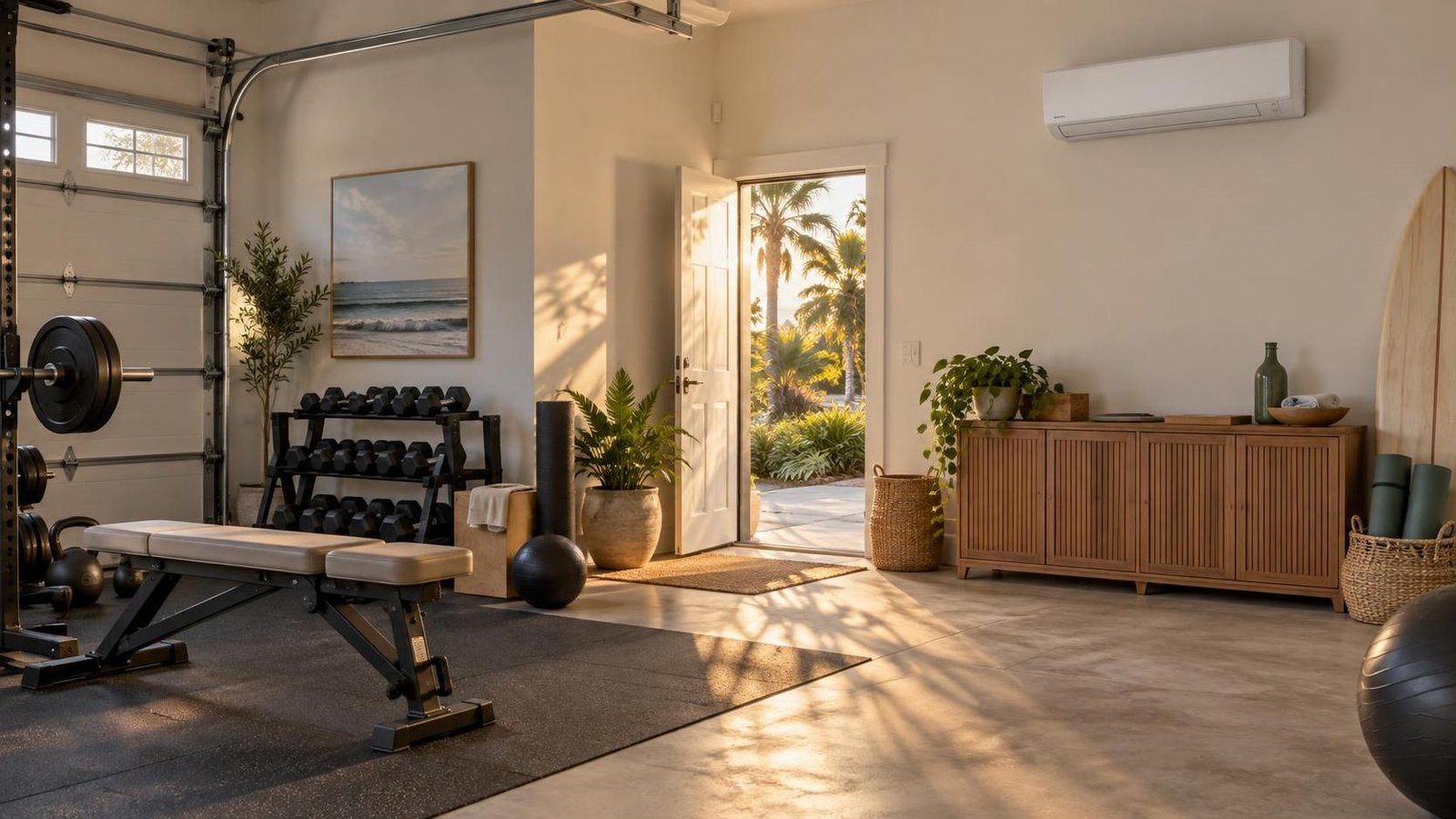
Insulated Garage Doors or a Dedicated Mini-Split: What Should Viera Relocators Choose for a Home Gym?
By Carrie Liotta, Space Coast REALTOR® with REAL Broker | Published October 12, 2026
If you are relocating to Viera and expect to use the garage as a real home gym, start with the insulated garage door when the room is simply uncomfortable, then consider a dedicated mini-split when you need dependable, frequent conditioning. The best answer is usually not a product contest. It is an honest look at the room, the way you train, and the work already needed.
I see this question often with buyers whose garage is more than car storage. They may be bringing a rack, treadmill, bike, weights, or recovery equipment from out of state. In Viera, a three-car garage can make a home look like an obvious fit until an afternoon workout reveals how much sun, humidity, door use, storage, and equipment placement affect the experience.
An insulated door and a mini-split solve different problems. One can improve a large part of the garage envelope. The other actively cools and dehumidifies the space. Before choosing either, I want a buyer to understand which problem they are paying to solve.
What is the practical difference?
An insulated garage door is a passive improvement. It does not create cooled air, remove moisture, or correct a hot roofline, air leak, undersized main system, or a garage door that will be opened repeatedly during the day. Its value is that it can reduce one source of heat transfer through the largest moving surface in many garages. That can make a room feel less punishing and may reduce how hard a future cooling system has to work, but it is not a promise that the garage will perform like the conditioned rooms inside the home.
A ductless mini-split is a separate heating and cooling system for the zone where its indoor unit is installed. The U.S. Department of Energy’s Building America Solution Center explains that ductless heat pumps provide heating, cooling, dehumidification, and filtration without central ductwork, with indoor units that condition the space directly. That zoning can be useful for a garage gym because you are not asking the home’s main system to serve a space it may not have been designed to condition. Read its ductless mini-split heat-pump guide for the system basics.
That distinction is the decision. If the buyer wants a more tolerable garage for occasional stretching, storage projects, or short workouts, door insulation may be a sensible first conversation. If the garage gym will be used before work, after school, or through a Viera summer, the buyer is really evaluating a conditioned-use project, not just a door upgrade.
Why Viera buyers should look beyond the listing photo
Viera homes offer a wide range of garage situations: three-car layouts, tandem bays, new-construction garages, resales with mature landscaping and different sun exposure, and homes where one bay already holds bikes, strollers, tools, or golf gear. Two garages that look identical online can live very differently once a west-facing door absorbs afternoon sun or a side bay becomes the only route for a family to enter the home.
I encourage relocators to visit at the time they expect to use the gym whenever the showing schedule allows. Stand in the intended workout area with the door closed. Notice the sun on the door and driveway, the ceiling height for overhead lifts or a rack, outlets, lighting, the route to the electrical panel, the position of water heaters or air-handling equipment, and whether stored vehicles will still fit. A gym plan that depends on moving two cars to the driveway every day should be a conscious lifestyle choice, not a surprise after closing.
Also separate comfort from suitability. A hot garage may be a thermal problem. It may also be a layout problem, an electrical-capacity question, a moisture issue, or evidence that the buyer is trying to convert a work bay into a room the house does not support as-is. My comparison of three-car garage space and a lower monthly payment in Viera is useful context when the garage is carrying too many jobs at once.
When an insulated door is the better first move
I would put the door option first when the buyer is not asking it to do more than it can do. It may be the right first priority when the existing door is flimsy, noisy, damaged, poorly sealed, or clearly the hottest surface in a garage that will still be used primarily for vehicles and occasional exercise. It can also be a practical choice when the buyer wants to improve comfort without committing immediately to equipment, electrical work, condensate routing, a mounted indoor head, and an outdoor unit.
The right questions are specific: What is the door’s condition? Are the tracks, springs, opener, bottom seal, weather stripping, and wall attachment points sound? Is the seller representing a particular insulation value, and can that be documented by the manufacturer label or invoice? Will the new door add weight that requires a properly matched spring and opener setup? Those are contractor questions, not guesses to make from a listing photograph.
Door insulation is also easier to understand financially because it can be a discrete project. But I would not let a lower initial price decide the issue. If the household is already planning daily training in the space, replacing the door alone can become a costly detour if the actual need is controlled temperature and humidity.
When a dedicated mini-split makes more sense
A dedicated mini-split deserves serious consideration when the garage gym will be used routinely, when someone has a heat-sensitive workout schedule, or when a buyer wants the space to feel predictably usable rather than merely less hot. The point is not to make the garage match every room in the house. The point is to design a system for the intended zone and use it responsibly.
Before treating one as an easy add-on, have a qualified contractor evaluate the actual space. The contractor should see the room dimensions, ceiling height, door and wall condition, windows, orientation, electrical panel, intended equipment, proposed indoor-head location, outdoor-unit location, line routing, and condensate plan. A model number from an online cart is not a load calculation, installation plan, or local approval.
Dehumidification matters in this conversation. A mini-split may help with moisture as part of normal operation, but it does not cure a water intrusion problem. The U.S. Environmental Protection Agency is clear that moisture control is the key to mold control and that a water problem should be fixed rather than simply covered up. If a garage has staining, active leaks, wet drywall, musty odor, or recurring condensation, start with the source and the appropriate professional. The EPA’s guide to mold and moisture in homes explains why that sequence matters.
What should buyers verify before making an offer?
For a buyer who may add a mini-split after closing, the inspection period is the time to gather facts, not demand a promise from the seller. Ask for permits and invoices for any existing garage HVAC equipment, electrical work, insulation, door replacement, or prior conversion. Confirm whether the garage is still represented as a garage and whether the seller knows of prior water, mold, roof, electrical, or door-operation issues. If there is already a wall-mounted unit, do not assume it was permitted, sized correctly, or professionally installed just because it turns on during the showing.
Use a licensed professional appropriate to the scope. Florida’s DBPR Licensee Search lets consumers look up regulated licensees. For project rules, ask the contractor and the local building authority what permits, drawings, inspections, and code requirements apply to the actual address and scope. The Florida Building Commission states that the 8th Edition (2023) Florida Building Code took effect December 31, 2023; its official code portal is a good starting point, not a substitute for local confirmation.
For Viera purchases, add HOA and architectural-review questions before signing a contract for exterior changes. The rules may affect where an outdoor unit can sit, how a line set is screened, and how an exterior change is approved. The association’s current documents, not a neighbor’s past project, control the answer for the home you are buying.
How should you compare the cost without fooling yourself?
Compare complete scopes, not a door quote against a headline price for a mini-split. The door side may include the door, hardware, springs, opener compatibility, seals, haul-away, and any related repair. The mini-split side may include equipment, electrical work, mounting, line set, condensate management, permits, inspections, and restoration. Then include the items neither option addresses: roof or wall leaks, damaged drywall, missing ventilation strategy, poor lighting, flooring, storage, and safe equipment clearance.
That is why I tell buyers not to treat this as a resale-value calculation alone. A well-documented, properly planned garage improvement can make a house easier to understand, but no one should assume it will return every dollar or appeal to every future buyer. The better test is whether the project makes the home work for your household without creating an unmanageable maintenance, approval, or budget burden.
If the property also has a separate guest suite or another zone question, read my guide to choosing a second HVAC zone versus one system in Viera. It covers the broader habit of matching the system decision to the way a household actually uses the space.
My recommendation for Viera relocators
Do not choose a mini-split simply because a garage feels hot during one showing, and do not choose an insulated door simply because it is the smaller project. Start with the gym’s real schedule and the room’s condition. If the garage will stay a multipurpose vehicle-and-storage bay with occasional workouts, a sound, better-insulated door and good sealing may be the sensible first step. If daily exercise is part of why you are buying the home, budget for an evaluated, permitted cooling plan after you understand the enclosure, electrical capacity, moisture conditions, and HOA rules.
I can help you keep the real-estate side organized: compare layouts, request documents, identify the questions for the inspection period, and weigh the project against the home’s total monthly ownership picture. Reach out for a no-pressure conversation about Viera homes for sale with Carrie Liotta, Space Coast REALTOR® with REAL Broker. Your next chapter starts here.
