

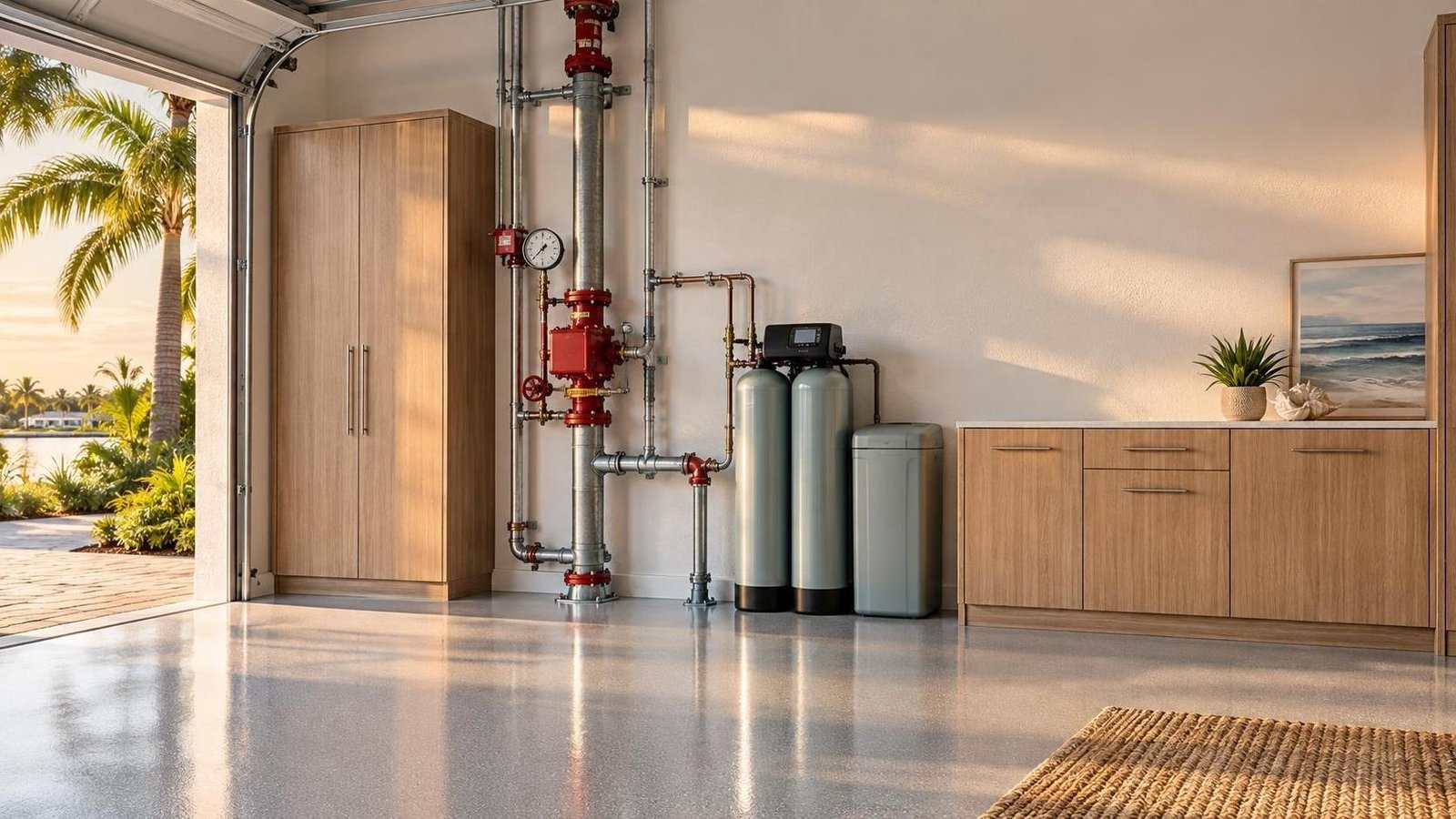
Garage Fire-Sprinkler Riser Beside Storage and a Water Softener: What Should Viera Buyers Verify?
By Carrie Liotta, Space Coast REALTOR® with REAL Broker | Published October 11, 2026
If a Viera home’s fire-sprinkler riser shares a garage wall with storage and a water softener, verify the system identity, valve and test access, permit history, current condition, and who can service it. The arrangement is not automatically defective, but blocked, altered, leaking, or undocumented equipment deserves specialist review before your inspection period ends.
I would not judge this setup from one garage photo, and I would never turn a valve during a showing. The useful question is whether the installed arrangement still matches its approved design and can be inspected, tested, and repaired without first dismantling shelving or moving heavy treatment equipment. That takes records, a careful visual review, and, when anything is unclear, a qualified fire-sprinkler contractor.
First, confirm that you are actually looking at the sprinkler riser
A garage mechanical wall can be confusing. A buyer may see a pressure gauge, several valves, a water-softener bypass, irrigation controls, and domestic plumbing close together and assume every pipe belongs to one system. Do not rely on color, pipe material, or a seller’s memory to identify it.
The Home Fire Sprinkler Coalition’s explanation of a typical stand-alone sprinkler water supply says a riser may include a pressure gauge, flow switch, backflow device where required, and test-and-drain assembly. It also explains that residential layouts may be stand-alone or multipurpose. That distinction matters: in a multipurpose layout, sprinkler piping is integrated with domestic plumbing, while an independent system has a separate branch. The exact Viera house may not look like an online diagram, so ask a specialist to trace the installed configuration.
I want the buyer to identify, without operating anything:
- the sprinkler control valve and whether its position is plainly indicated;
- the pressure gauge, flow device, test-and-drain point, and any backflow component that belongs to the system;
- the domestic main shutoff and water-softener bypass, so they are not confused with sprinkler controls;
- any alarm panel, exterior bell, monitoring connection, or electrical feed associated with water flow; and
- the route a contractor would use to reach and work on each component.
This is identification, not a do-it-yourself test. A mislabeled valve can create a serious problem if someone shuts off fire protection while trying to bypass the softener.
Why the storage and water-softener placement matters
The concern is not simply that three things occupy one wall. Garages often have to work hard in Viera: two vehicles, bikes, storm panels, holiday bins, a water-treatment setup, and mechanical equipment may all compete for space. The concern begins when ordinary storage changes access or creates a new exposure.
A deep cabinet may prevent a technician from reaching a valve. Freestanding shelving may hide a label or block the test-and-drain outlet. Boxes stacked against piping can make a small leak difficult to spot. A softener’s salt tank may be removable for service, but it should not be the only thing protecting exposed sprinkler components from a rolling cart or parked vehicle. Conversely, a shelf installed after closing should not be anchored through concealed piping.
Look closely at the floor and wall, too. White deposits, rust, staining, patched drywall, an improvised drain hose, or a gauge that is unreadable are not a diagnosis, but they are reasons to investigate. Ask whether the softener ever overflowed, whether the sprinkler assembly has leaked, and whether either system was moved after the house was built.
This is similar to the practical service-access issue I discuss in what Viera sellers should document when garage racks, an EV outlet, and attic access share one bay. A garage can look beautifully organized while still making the next repair harder than it needs to be.
Ask for the system file, not just a verbal assurance
For a sprinklered home, I would ask the seller for the original permit and final approval, installer information, system or riser diagram if available, equipment manuals, alarm or monitoring records, and any later repair or test documentation. If the water softener was added later, ask for its invoice, permit information when applicable, plumbing route, drain route, and service records as a separate file.
Brevard County’s building permit search is a useful starting point for many Viera addresses, but jurisdiction and record completeness must be confirmed for the specific property. A permit search is not the same as proving current performance. It helps establish what work was approved and whether a later alteration appears in the public history.
The Florida State Fire Marshal explains that the 8th Edition Florida Fire Prevention Code has been effective since December 31, 2023, is enforced by local fire officials, and may be supplemented by local amendments. That is why I do not apply a generic internet clearance number to a specific garage. The approved plan, the system type, the equipment listing, the work performed, and the authority having jurisdiction all matter.
Have the right professional test the right things
A general home inspector can flag visible concerns and help you understand the garage as a whole, but a residential fire-sprinkler system is a specialty system. If access is tight, labels are missing, a valve appears altered, records conflict, or the softener was installed after the original construction, bring in an appropriately qualified fire-sprinkler professional. The contractor should determine what belongs to the sprinkler system, whether it matches the available records, what testing is appropriate, and whether any correction needs a permit or local approval.
The Home Fire Sprinkler Coalition’s home sprinkler ownership guidance says owners should not paint or cover sprinkler devices, hang objects from piping, or treat the system like ordinary garage storage. It also discusses checking alarm operation through the test-and-drain valve. That is useful context, but it is not an invitation for a buyer to perform an unfamiliar test during a walkthrough. A test can release water, trigger a local alarm, or involve monitoring procedures that need to be coordinated.
Ask the specialist to explain the results in writing. A useful report should identify the system reviewed, visible condition, tests performed, deficiencies observed, inaccessible areas, and recommended next steps. “Looks fine” is not enough if the purchase decision depends on moving a softener, removing built-ins, restoring alarm monitoring, or correcting an unapproved alteration.
Do not confuse fire sprinklers with smoke alarms
Buyers sometimes assume a sprinklered home makes smoke alarms less important. It does not. The U.S. Fire Administration’s home fire-sprinkler guidance describes sprinklers and smoke alarms as complementary protection and explains that residential sprinklers respond to heat; typically, only the sprinkler near the fire activates. A water-flow device may also connect to a bell, strobe, or monitored security system, but that arrangement varies.
During due diligence, confirm which alarms stay with the home, whether any monitoring account transfers, and who can reset or service the connected devices. Do not assume a smart-home panel controls the sprinkler system merely because both apps appear on the seller’s phone. Likewise, do not assume an unmonitored system is defective without checking the approved design and local requirements.
How I would structure the inspection period
When I help a Viera buyer with this setup, I divide the work into four tracks instead of asking one inspector to answer everything.
- Home inspection: Review the garage wall, visible leaks, drainage, wall repairs, storage anchoring, vehicle impact risk, and the surrounding plumbing and electrical conditions.
- Sprinkler review: Identify the system, valves, alarms, test points, access needs, records, and any recommended testing or corrections.
- Water-treatment review: Confirm the softener’s ownership, bypass, drain and discharge route, power connection if present, leak history, and service access.
- Permit and insurance review: Reconcile the public record and seller file, then ask the buyer’s insurer whether the system or any available inspection record affects underwriting or discounts.
If the softener and laundry plumbing also interact, my article on a Viera water softener and laundry sharing one standpipe explains why the drain route deserves its own investigation. The goal is to keep separate systems separate in your decision, even when they happen to occupy the same corner.
When the layout should affect your offer
A tidy, documented arrangement with visible labels, accessible controls, clean test history, and room for both contractors may need no negotiation at all. A cramped wall with missing records is different. Price the actual correction, not the anxiety.
Possible outcomes include removing a nonessential cabinet, modifying shelves, adding protection from vehicle contact, relabeling valves, servicing a leaking component, relocating water-treatment equipment, restoring an alarm connection, or obtaining approval for prior work. Those scopes are not interchangeable. Ask for written estimates before choosing among a seller repair, credit, price adjustment, or acceptance as-is. A credit only helps if the correction can legally and practically be completed after closing.
I would also keep the larger insurance picture in view. A fire-sprinkler question does not replace the roof, electrical, plumbing, and HVAC review that may appear in a Brevard County four-point inspection. It is one more system to understand, not a reason to ignore the rest of the house.
My Viera buyer checklist before the inspection deadline
- Photograph the mechanical wall without turning or moving anything.
- Identify the sprinkler components, domestic shutoff, and softener bypass with qualified help.
- Pull available permits and compare them with the seller’s invoices and system documents.
- Confirm whether shelving or the softener was added after the sprinkler installation.
- Check for staining, corrosion, impact exposure, missing labels, blocked test points, and inaccessible valves.
- Verify alarm and monitoring arrangements without assuming they transfer automatically.
- Get a written specialist opinion and written correction estimates when anything is uncertain.
- Make the contract decision while inspection, insurance, and negotiation rights are still open.
Bottom line
A residential fire-sprinkler riser beside garage storage and a water softener can be a perfectly workable Viera arrangement. What matters is whether every component is correctly identified, accessible, documented, and protected from later alterations and everyday garage use.
I help buyers slow this kind of decision down long enough to separate a harmless space-planning issue from a real service or documentation problem. Join my private Facebook group, Moving to Brevard County Florida, or reach out for a no-pressure conversation about Brevard County homes for sale with REAL Broker. Your next chapter starts here.
