

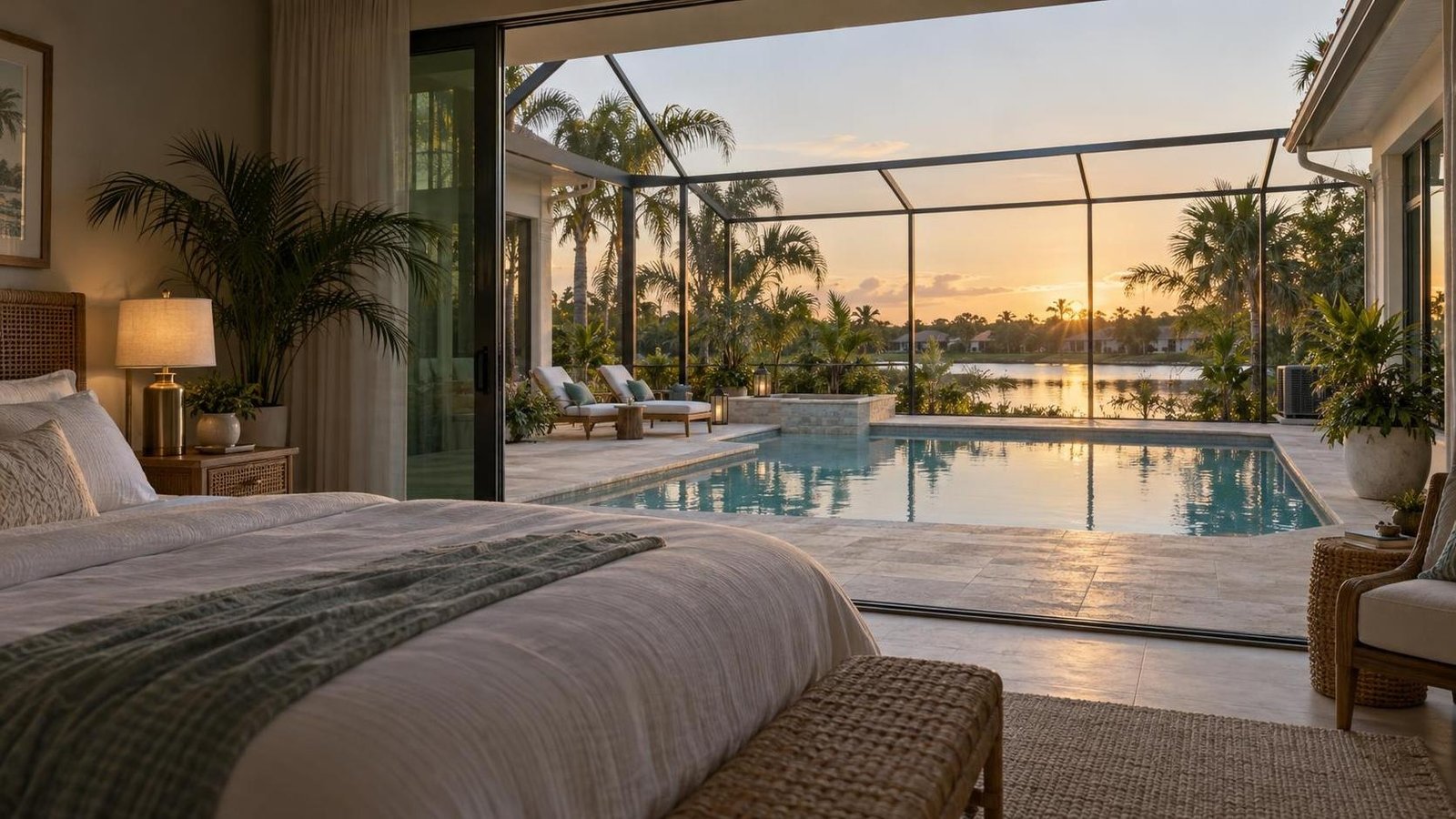
Shaded Bedroom Wing or Larger Pool Deck: What Should Palm Bay Night-Shift Relocators Choose?
By Carrie Liotta, Space Coast REALTOR® with REAL Broker | Published October 9, 2026 on 321 Coastal Living
For most Palm Bay night-shift relocators, I would choose the shaded bedroom wing if it is truly dark, quiet, evenly cooled, and supported by a credible plan for the older HVAC. Choose the larger pool deck only when daytime sleep already works and your household will use the outdoor space enough to justify its maintenance and reserve demands.
This is not really a choice between an indoor feature and a prettier backyard. It is a choice between protecting the part of the home that makes a night-shift schedule sustainable and buying outdoor space that may improve family life when everyone is awake. Because both homes have older air-conditioning systems, the decision also has a capital-planning layer: which property leaves you with the clearer comfort plan and the stronger reserve after closing?
Start with the sleep window, not the pool photograph
Night-shift buyers need to evaluate a house at the hours when most showings do not happen. A bedroom that feels comfortable at 6 p.m. may collect heat and light by late morning. A quiet street on Sunday may sound different when lawn crews, deliveries, school traffic, construction, and household routines overlap on Tuesday.
The CDC/NIOSH guidance for night-shift sleep recommends protecting the post-shift sleep period, making the sleep environment very dark, blocking light and noise, and getting cooperation from family and friends. That is occupational guidance, not a promise that one floor plan will solve sleep. It does explain why I give the bedroom wing more weight than a lifestyle feature when a buyer routinely sleeps after sunrise.
Identify the exact room that will be used for daytime sleep. Then map the kitchen, laundry, garage, front entry, living room, children’s rooms, plumbing walls, air handler, pool pump, driveway, and neighboring outdoor areas around it. Shade helps, but separation from daytime activity can be just as important.
What makes a shaded bedroom wing valuable?
“Shaded” should describe a condition you can verify, not a listing adjective. The room may benefit from its orientation, a deep roof overhang, covered lanai, healthy mature trees, smaller windows, exterior shading, or interior coverings. Each source of shade has a different ownership story.
A north- or east-facing bedroom may avoid some late-day solar exposure, but orientation alone does not establish comfort. Large windows, weak seals, insufficient attic insulation, duct imbalance, or limited return-air movement can still leave the room warm. Mature trees may create useful shade while also requiring an arborist’s view of health, clearance, roots, and storm exposure. Blackout coverings may control light without correcting a hot wall or weak airflow.
During a weekday visit near the intended sleep hours, close the room as you would when sleeping. Let the HVAC operate normally. Notice whether the room feels materially different from the thermostat location, whether the door needs to remain open to stay comfortable, and whether the system cycles or runs continuously. Listen with the equipment on and off. Check whether light enters around the bedroom door, bathroom, windows, and adjoining hallway.
Do not treat that visit as a mechanical diagnosis. It is a way to identify questions for the inspection and HVAC evaluation. My article about a quieter bedroom wing versus a shorter KSC route explains the broader shift-work principle: the harder-to-change sleep problem often deserves priority over the more visible convenience.
The older HVAC makes room balance the real issue
Older equipment is not automatically failed equipment. I want buyers to separate age from present condition, installation quality, maintenance history, and the way the system serves the actual floor plan. Two same-age systems can create very different ownership experiences.
Ask for the installation permit when available, model and serial information, service records, repair invoices, thermostat history, and any duct, insulation, or room-balance work. Have a qualified professional evaluate the equipment and discuss capacity, operating condition, airflow, temperature differences, return path, condensate management, electrical condition, and whether the sleeping room receives appropriate service. Verify applicable Florida credentials through the official DBPR license search.
The ENERGY STAR HVAC maintenance checklist includes thermostat settings, electrical connections, controls, condensate drainage, coils, refrigerant, blower components, airflow, and filters. It notes that airflow problems can reduce system efficiency by up to 15 percent. I would use that list to organize professional questions, not to infer a repair or remaining life from one number.
Most important, price the likely next step before choosing the home. The answer might be routine service, duct correction, insulation or shading work, a room-specific comfort solution, or eventual replacement. It might also be that no reasonable adjustment makes the room acceptable for daytime sleep. A buyer should know which situation applies before the inspection period ends.
What are you buying with the larger pool deck?
A larger pool deck can be a meaningful daily-life feature, especially for a Palm Bay household that expects visiting family, outdoor meals, children’s activities, exercise, or quiet time after a shift. Usable deck space can be more valuable than a larger pool when it gives the household shade, safe circulation, room for seating, and a practical transition between the house and yard.
But square footage is not the same as usability. Visit when the sun hits the deck. See which areas are shaded and whether furniture can sit without blocking doors, screen-enclosure exits, equipment access, or drainage paths. Look for settlement, cracking, slippery finishes, low spots, coping condition, drainage direction, enclosure corrosion, screen condition, door operation, and the relationship among the deck, house wall, downspouts, and neighboring grade.
Review the pool, deck, enclosure, electrical, heater, resurfacing, and major repair records that apply to the property. The useful question is not, “Is this a big deck?” It is, “Which parts of this outdoor space are documented, comfortable, safe, and likely to require money during my first years of ownership?”
For the wider property-file review, my guide to choosing a Brevard pool home with lower insurance friction covers roof, four-point items, drainage, permits, barriers, enclosure condition, and insurance questions. A beautiful pool deck should not distract you from an older HVAC system or another major component already competing for the reserve.
Compare the two homes with one reserve, not two wish lists
I would build a five-year comparison for both properties. Start with purchase price, taxes, insurance, HOA obligations if any, roof and water-heater condition, and the cash remaining after closing. Then add two focused columns.
For the shaded-bedroom home, list HVAC service or replacement planning, duct or room-balance work, insulation, window or door improvements, blackout coverings, tree care, and any sound-control recommendation. For the larger-deck home, list HVAC planning again, then pool equipment, deck or coping work, drainage, enclosure repairs, resurfacing horizon, barriers, and ongoing service.
Do not use one contractor’s rough comment as a complete budget. Get property-specific opinions where the issue matters. Avoid assigning a fake dollar value to sleep or assuming a pool creates a particular resale premium. The comparison is useful when it shows how many unresolved systems will draw from the same savings account.
An older HVAC system in both homes is the equalizer. If one property also needs pool-deck drainage, enclosure work, and near-term equipment, its larger outdoor area may be adding obligations at the same time the air conditioner is approaching a buyer’s planning horizon. If the shaded-bedroom property has serious tree risk, weak ducts, hot windows, and no service history, its apparent sleep advantage may be just as expensive or uncertain.
Run a Palm Bay “day after work” test
A standard showing asks whether you like the house. A night-shift test asks whether you can recover there. If possible, visit each home during the actual daytime sleep window and again when the household would use the pool. Keep the test factual and non-destructive.
- Trace arrival: Park where you would after work and walk the normal path to the bedroom. Notice doors, alarms, pets, family circulation, and morning light.
- Test the room: Use normal door and window positions, let the HVAC cycle, and listen for the garage, laundry, pool equipment, road, yard service, and adjacent rooms.
- Map the shade: Identify what creates it and whether that feature is permanent, healthy, maintainable, and allowed under any association rules.
- Walk the deck: Check usable shade, drainage, enclosure exits, equipment access, safe circulation, and where furniture would actually fit.
- Review the file: Match visible conditions to permits, invoices, service records, warranties, disclosures, and inspection findings.
- Price the first decision: Determine what must be addressed before move-in, what can be monitored, and what reserve remains for the older HVAC.
Repeat the test after rain if drainage is uncertain. If household noise is the deciding factor, bring the family schedule into the floor plan: school departure, remote work, laundry, meal preparation, pool use, and the hours when the night-shift worker needs protection. My West Melbourne night-shift home test goes deeper on evaluating light, noise, HVAC operation, and household movement during daytime sleep.
When I would choose each Palm Bay home
I would choose the shaded bedroom wing when the room is measurably more comfortable during the intended sleep hours, the shade source is understandable, the floor plan separates daytime activity, and professional review gives the older HVAC a clear service or replacement plan. This choice becomes stronger when the larger-deck home’s sleep space is bright, hot, noisy, or dependent on expensive changes that may not fully solve the problem.
I would choose the larger pool deck when the sleeping room already performs well enough, the household will use the deck regularly, the pool and enclosure file is strong, drainage is understandable, and the buyer can fund both outdoor maintenance and the older HVAC reserve. This can be the better home for a family whose off-hours revolve around swimming, entertaining, and outdoor living rather than trying to retrofit those uses into a cramped deck.
I would pause on both when the sleep room fails the noon test, neither HVAC system has a credible file, or the larger deck brings multiple unresolved conditions into an already tight budget. The right decision is not always choosing the less-bad house. Sometimes the inspection shows that neither property supports the schedule and reserve that prompted the move.
Bottom line
For a Palm Bay night-shift relocator, dependable daytime sleep is usually the scarcer feature. A larger pool deck can improve Florida life, but it cannot compensate for a bedroom that stays bright, warm, noisy, or poorly served by an older air-conditioning system. Verify the shade, test the actual sleep window, inspect both HVAC systems, and compare every likely project against one realistic reserve.
I’m Carrie Liotta, Space Coast REALTOR® with REAL Broker. I use 321 Coastal Living to help buyers compare Brevard County homes around real work schedules, ownership costs, and property condition—not just listing photographs. Join my private Facebook group, Moving to Brevard County Florida, or reach out for a no-pressure conversation about Palm Bay homes. Your next chapter starts here.
