

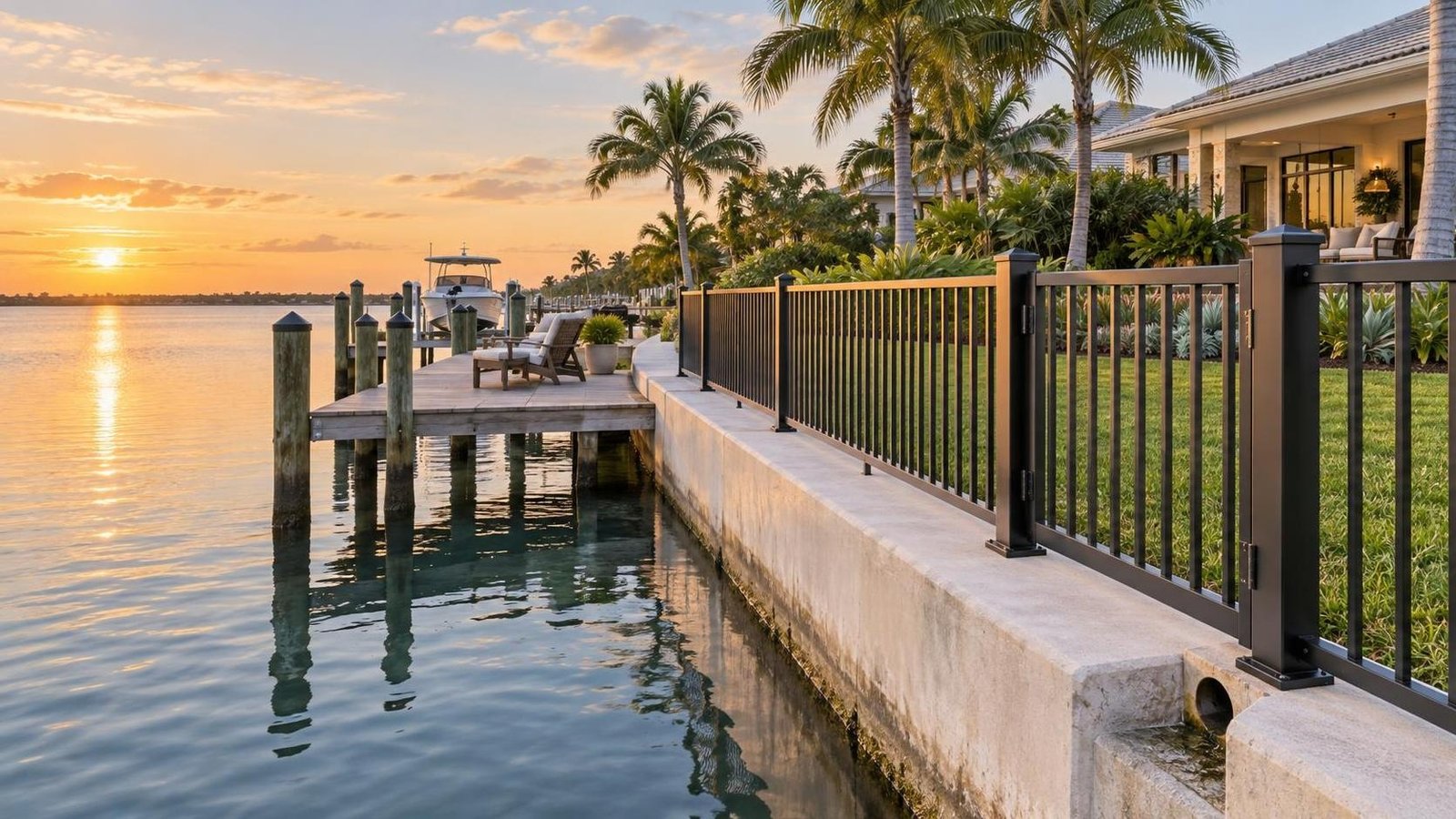
Seawall-Cap Fence Posts Blocking Drainage Weeps: What Should Merritt Island Sellers Document?
By Carrie Liotta, Space Coast REALTOR® with REAL Broker | Published October 9, 2026 on 321 Coastal Living
If fence posts on a seawall cap block access to drainage openings, document every post and opening, the installation sequence, approved plans, attachment details, present drainage condition, and a qualified professional’s access or repair recommendation. Before listing, resolve active problems and give buyers a clear map of what can be inspected, cleaned, removed, or remains uncertain.
The fence and seawall may both be performing normally. The problem is that a post base, bracket, grout pocket, panel, or landscaping can hide where a marine professional needs to inspect or service an opening. I would address that conflict before photography.
First, confirm what each opening actually is
Do not begin by calling every hole or sleeve a “weep.” A seawall can have visible openings, old pipe penetrations, drainage features, patched locations, joints, or abandoned components that look similar to a non-specialist. The first seller task is identification, not cleaning or repair.
Ask a qualified marine contractor or engineer, within that professional’s scope, to describe what is visible and what cannot be confirmed. The report or marked photograph should distinguish an active drainage opening from an old sleeve or unidentified penetration. It should also note whether a fence component prevents the professional from seeing the opening’s perimeter, checking the area behind it, or reaching it for ordinary service.
This matters because the wrong label can lead to the wrong action. A seller should not pull material from an opening, pressure-flush it, drill through a post base, or remove a patch merely because the feature is assumed to relieve water. If its purpose remains unknown, say so and preserve that uncertainty for the next appropriate inspection.
Create a post-to-opening map of the entire waterfront edge
Start with a current survey or scaled sketch showing the seawall, cap, property lines, dock, gates, fence runs, nearby improvements, and safe access route. Number every post and visible opening from one property corner to the other.
For each location, include a wide photograph, a close view, and a side angle. Record the spacing, visible attachment, grout or sealant, accessible area, and anything limiting the view. Do not state how deeply a post is embedded or where concealed reinforcement lies unless a plan or professional investigation establishes it.
The map should show whether a professional can reach the opening safely, whether a removable panel could provide access, whether the post covers it, and whether it is visible from the canal side, yard side, or both.
That focused map is what separates this question from my broader guide to documenting pool drainage, seawall weeps, and dock conduit together. The broader waterfront file still matters, but here the decision turns on the exact physical relationship between each fence post and each opening.
Rebuild the construction sequence
Determine whether the wall and cap came first, whether the cap was later replaced or widened, and when the fence was installed or altered. A fence that appears original in listing photographs may have newer posts on an older cap. A repaired wall may have kept an existing fence while drainage details changed below it.
Collect the seawall plans, engineering details, permits, finals, invoices, warranties, and photographs taken before work was covered. Build a separate fence file with its approved plan, post detail, approvals, contractor records, changes, and final inspection. Then place both projects on one timeline.
For a home in unincorporated Brevard County, the county’s building permit search is a useful starting point. Confirm the parcel’s jurisdiction and request plans, revisions, inspections, and final status. An empty online search does not prove that work was exempt, approved, or unpermitted.
Compare the paper layout with field conditions. If the approved fence plan shows surface-mounted plates but the visible installation appears different, do not diagnose the change yourself. Ask the authority or qualified professional how to investigate it. If old photographs show open drainage access before the fence, preserve them because they may help explain what is now concealed.
Coordinate the marine and fence evaluations
A marine professional can evaluate visible wall, cap, drainage, soil-loss, movement, and access conditions within that person’s scope. A qualified fence or construction contractor can explain how a post or removable panel was installed and what alteration would require. An engineer may be needed if a solution affects structural concrete, reinforcement, anchoring, or a designed waterfront system.
Put these evaluations on the same marked drawing. Ask each provider to list observations, concealed limits, assumptions, next steps, and exclusions so a fence estimate does not assume work the marine report cannot support.
Document current performance without creating a guarantee
Ask the marine professional what observations are appropriate after rain, irrigation, high water, or another relevant condition. Take dated photographs from consistent positions and preserve older images showing erosion, settlement, staining, repairs, or drainage work.
Record when an opening was evaluated or serviced, who did it, and whether access required fence work. If the opening cannot be evaluated, say so plainly. “Not accessible without temporary fence work” is more credible than “no problem observed” when the area could not be seen.
Keep local building records and waterfront authorization in separate lanes
A fence approval does not automatically establish that the drainage relationship was reviewed, and a seawall record does not automatically approve a later fence attachment. Match each document to its declared scope. If the fence plan never shows the openings, or the seawall plan predates the fence, ask the relevant authority and professionals what additional confirmation is appropriate rather than combining the two records into a broader promise.
State environmental review can be another lane. The Florida Department of Environmental Protection explains that its Environmental Resource Permit program addresses activities involving altered surface-water flows as well as dredging or filling in wetlands and other surface waters. DEP and Florida’s water management districts divide application responsibility under operating agreements. That does not mean ordinary inspection or every fence correction requires an ERP; it means the actual proposed work should be checked with the authority responsible for that scope.
Florida Statutes section 403.813 contains conditional exceptions for certain waterfront activities, including specified seawall restoration. The current statutory text also preserves other potentially applicable land-use, chapter 161, local pollution-control, county, and municipal requirements. A seller should not hear “seawall repair can be exempt” and assume that drilling a cap, moving a drainage feature, or relocating a fence post is automatically authorized.
When correction before listing makes sense
I lean toward correction when a qualified professional identifies an active drainage problem, progressive soil loss, unsafe access, damaged cap material, loose fencing, or an opening that requires maintenance but cannot be reached. Correction may also be sensible when one removable panel, revised bracket, or limited post relocation can create a durable service path with a clear approved scope.
Do not start by moving every fence post. First define which opening matters, what function is confirmed, what access is required, and how the work protects the wall and people near the water. The scope should cover temporary safety, post support, cap protection, drainage access, debris control, restoration, permits, inspections, and progress photographs.
A cosmetic fix is not a correction. Do not trim a base plate, drill an unlabeled hole, grind grout away, hide the conflict, or call an opening abandoned without evidence. If removal could damage the cap or fence, get a design and price first.
If no active defect is found but access remains limited, a current evaluation and defined future-access plan may be the stronger seller response. That is similar to the access analysis in my article about a pool-screen footer over a seawall tieback corridor: the visible overlap is not automatically failure, but a buyer needs to know whether a credible inspection and repair path exists.
Build one buyer handoff file
Organize the file in the order a buyer and inspector will use it:
- Existing layout: survey, numbered post-to-opening map, wide photographs, close views, and identified access routes.
- Construction history: seawall and fence timelines, approved plans, revisions, permits, finals, invoices, warranties, and before-and-after images.
- Current evaluation: marine findings, fence-contractor findings, engineering input when used, concealed limits, and recommendations.
- Maintenance and performance: dated condition photographs, service records, known drainage or soil history, and any monitoring directed by a professional.
- Completed work: defined scope, provider credentials, approvals, progress photographs, final inspection, paid invoice, and restoration record.
- Remaining uncertainty: openings not identified, areas not accessible, recommendations not completed, and estimates for possible next work.
Keep the summary factual. “Post 4 partially obstructs access to Opening B; marine contractor could not inspect the full perimeter; fence contractor provided a removable-panel option” is useful. “Weep holes are fine” is not useful when nobody could see them completely.
Price the defined scope, not the buyer’s imagination
There is no reliable universal allowance for this condition. Cost can change with the fence material, attachment method, cap condition, number and purpose of openings, water-side access, temporary safety measures, engineering, permitting, concrete repair, and finish matching. A round-number credit without a scope may be too small to solve the conflict or much larger than a focused correction requires.
Get written alternatives where reasonable: create access without moving a post, install a removable section, relocate one post under an approved detail, repair the cap, or document why no work is recommended. Compare assumptions and exclusions; a low proposal is not comparable if it omits wall protection, permits, restoration, or temporary safety.
The seller can then choose between completing a defined repair, disclosing the condition with current evaluations and estimates, or pricing for unresolved risk. My guide to Merritt Island seawall drainage and tieback documentation explains why a coherent waterfront history helps negotiations stay tied to evidence instead of fear.
Prepare the edge for showings without concealing the issue
Trim vegetation for safe viewing, remove storage, unlock gates, and identify removable panels. Do not hide an opening, fill a gap with fresh sealant, or erase evidence before inspection. A clean waterfront can still show its history honestly.
Coordinate the listing remarks, seller disclosure, site map, and reports. If fence installation records are incomplete, say that. If a professional found no active concern within visible limits, preserve the limiting language. If further evaluation or access work was recommended, do not market the seawall as fully inspected until that recommendation is resolved.
Bottom line for Merritt Island sellers
Fence posts blocking seawall drainage access are not automatically proof of a failing wall or a bad installation. They are a documentation and serviceability problem that can become expensive when nobody knows what the openings are, which project came first, or how a professional would reach them.
Identify the features, map every conflict, align the seawall and fence records, coordinate the right professionals, correct active problems, and state the remaining limits accurately. That gives buyers a practical basis for inspection and gives the seller a defensible repair, disclosure, and pricing strategy.
If you are preparing a Merritt Island canal home for sale, reach out for a no-pressure conversation with Carrie Liotta, Space Coast REALTOR® with REAL Broker. I can help you organize the waterfront file, identify the right questions for marine and construction professionals, and present the condition without overpromising. Join my private Facebook group, Moving to Brevard County Florida, for more local guidance. Your next chapter starts here.
