

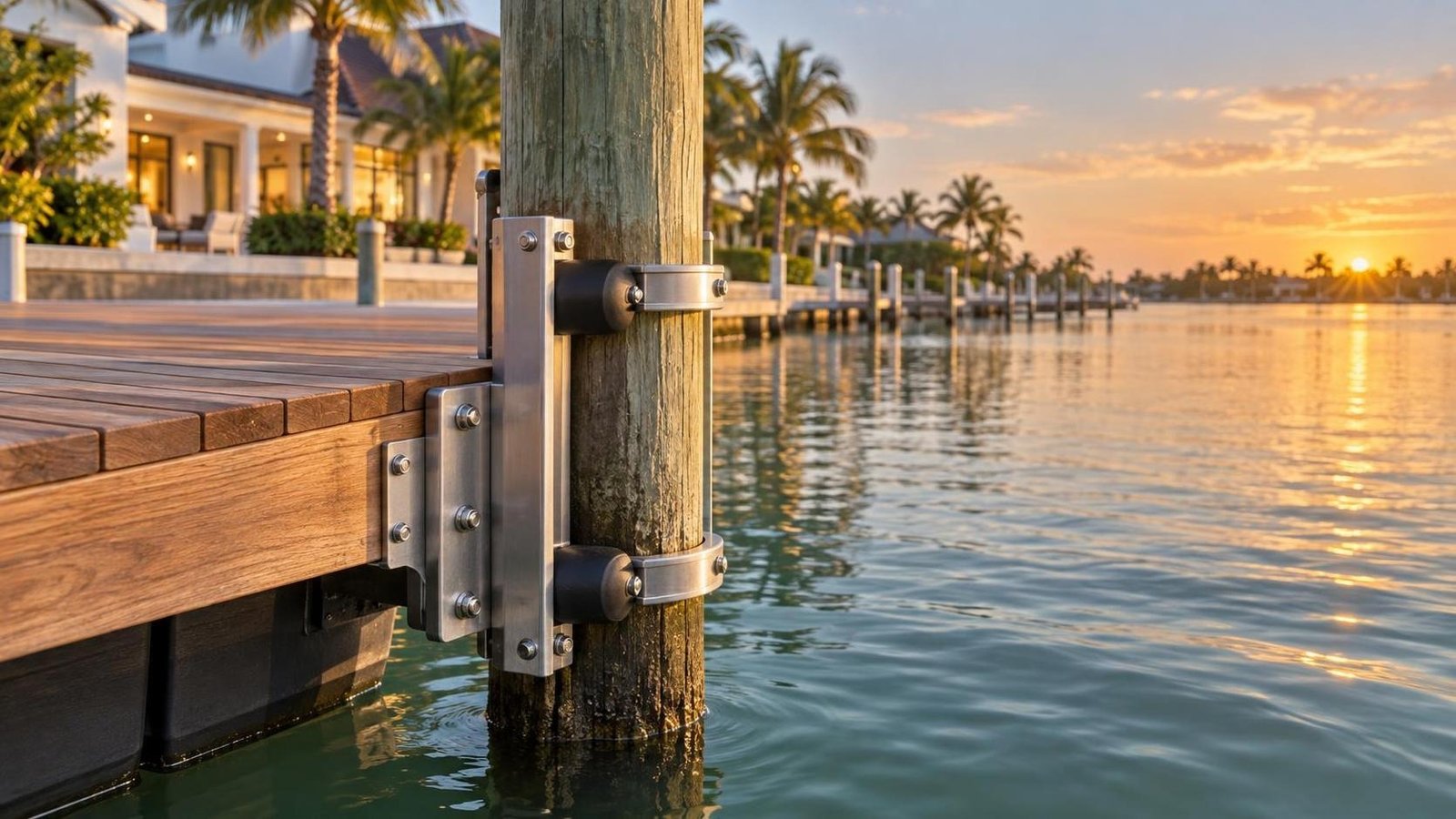
Floating-Dock Collar Rubbing a Guide Pile: What Should Merritt Island Buyers Verify?
By Carrie Liotta, Space Coast REALTOR® with REAL Broker | Published October 8, 2026
If a floating-dock collar is rubbing a guide pile, do not dismiss the wear as normal movement. Identify the actual guide assembly, observe how the dock travels at safely different water levels, inspect the pile, collar, frame, and flotation together, and obtain a marine professional’s written correction scope before pricing the home.
On a Merritt Island canal property, a floating section needs enough freedom to rise and fall while remaining controlled in wind, wake, and changing water conditions. A polished deck can hide a guide that binds, a roller that no longer turns, a pile that is no longer plumb, or a dock frame that has shifted under an uneven load. The important question is not simply, “Does it touch?” It is, “Why is contact occurring, and what is that contact doing to the complete system?”
Start by identifying what the listing calls a “collar”
Waterfront vocabulary is often imprecise. One seller may call the entire metal loop around a piling a collar. Another may use that word for a plastic rub block, roller, sleeve, pile guide, or bracket attached to the floating frame. Before anyone recommends adjustment, ask the marine contractor to identify the manufacturer, model, components, attachment method, intended pile size, and the surfaces designed to make contact.
A manufacturer document can show how specific pieces belong together. Connect-A-Dock’s installation-instructions library, for example, links to a manual whose piling-loop section shows a bracket, loop, and roller kit and tells installers to center that model’s roller kit with the piling. That is useful evidence of why identity and alignment matter. It is not a universal specification for the unknown dock in front of you.
Read the wear pattern as a question, not a diagnosis
I would photograph the guide from the dock side and shore side without leaning over an unstable edge or entering the water. Include wide views showing the floating section, fixed landing, gangway, guide piles, cleats, boat lift, utilities, and nearby dock framing. Then add close views of the collar or loop, rollers or pads, fasteners, welds, pile surface, and the points where the guide connects to the frame.
The location and shape of wear help a professional decide what to investigate. A polished vertical band may tell a different story from a deep groove concentrated at one elevation. Fresh metal, torn plastic, oval fastener holes, cracked weld coating, compressed framing, a roller worn flat, or one guide carrying far more contact than another all deserve explanation. So do scrape marks that stop abruptly, because they may correspond to one water level or one position of the dock.
Observe the complete movement path safely
A one-time showing captures only one position. Ask when the floating section can be observed safely at another normal water level, and whether the seller has dated photographs or service notes from different conditions. Use fixed references in the photos—the top of the pile, a bracket, a deck seam, or the fixed landing—so the marine professional can understand how the geometry changes.
The useful observation follows the entire dock, not just the noisy contact point. Does the float rise evenly? Does one end lag or rack? Does the gangway push sideways? Do both pile guides share the work? Can rollers turn, or are they sliding? Does the guide approach a pile cap, damaged area, splice, taper, or obstruction anywhere in its normal travel? Does contact change when the boat is on the lift, people step onto the dock, or storage weight shifts?
Those are questions for a controlled professional review, not an invitation to force the dock through a bind. Do not loosen hardware, pry the collar away, grease an unidentified material, operate questionable equipment, or ask several people to stand on one corner to “test” it. If the dock jerks, hangs, twists, or makes the walking surface unstable, stop using the affected area and follow the professional’s safety direction.
Separate the pile, guide assembly, and floating frame
Rubbing can begin in more than one place, so I would not accept a quote that addresses only the easiest visible part. The guide pile needs review for its material, dimensions, exposed condition, alignment, movement, damage, and connection to the permitted dock plan. The collar or guide assembly needs review for its rollers or wear surfaces, clearances, corrosion, fasteners, welds, brackets, and compatibility with that pile. The floating frame needs review for squareness, attachment condition, flotation, freeboard, concentrated loads, and evidence of twisting or prior repair.
The gangway and fixed landing matter too. If the gangway is racking the float sideways, replacing one roller may only hide the result. If one flotation module has lost performance or added equipment has changed the load, recentering a collar may not solve the underlying imbalance. If the guide pile itself is damaged or out of position, enlarging the loop can create more uncontrolled movement rather than a sound repair.
This whole-system approach complements my guide to documenting a floating dock’s hinge, gangway, and grounding. That article focuses on the moving shore-to-float connection and utility path. Here, the buyer’s decision centers on the vertical guide relationship and whether the dock can travel without binding, damaging components, or shifting the problem somewhere else.
Match the physical dock to the paper trail
Ask for the dock permit, approved drawings, final inspection information, manufacturer literature, installer invoice, repair records, pile-work documentation, photographs before modifications, and service notes for the floating section. Compare dates and dimensions. A permit for an original fixed dock does not automatically document a later floating extension, replacement pile, altered guide bracket, or added equipment.
Florida’s section 403.813 describes conditional exceptions for certain private docks, mooring pilings, and qualifying repair or replacement work. It also preserves other applicable requirements, including some submerged-land and local-government obligations. A seller’s statement that the repair is “exempt” therefore does not establish that the current pile, floating section, or proposed correction has every approval it may need.
The Florida Department of Environmental Protection explains that its Environmental Resource Permit program covers activities affecting surface waters and that DEP and water-management districts divide application processing under operating agreements. DEP generally includes docking facilities and attendant structures among the activities it reviews when they are not part of a larger development. The U.S. Army Corps of Engineers’ Jacksonville District regulatory page separately directs Florida owners to project-specific federal jurisdiction and permit resources.
That does not mean every worn roller needs several permits. It means the repair scope must come before the approval conclusion. Replacing a documented wear pad in kind is a different project from moving a guide pile, rebuilding the floating frame, changing the footprint, driving a new pile, or altering work in the water. Confirm the parcel jurisdiction and ask each authority about the actual proposed work.
Build the repair estimate around cause, access, and closeout
A useful estimate should say what was inspected, what could not be seen, what caused the contact if the cause can be determined, and which components need repair or replacement. It should also identify who handles safe access, whether the dock must be unloaded or temporarily secured, whether utilities must be protected, and how the work will be documented after completion.
The least complicated outcome may be replacement rollers or wear blocks, corrected hardware, and a properly centered guide assembly. A larger project may involve frame repair, added or replaced flotation, a rebuilt bracket, gangway alignment, pile evaluation, pile relocation or replacement, coatings, deck restoration, engineering, or permit work. Those scopes have different schedules and risks. A verbal allowance for “a new collar” is not enough when the cause remains unknown.
I would ask the contractor to separate the proposal into investigation, temporary stabilization, component work, in-water or pile work, access and mobilization, restoration, approvals, and closeout records. If decking or brackets must be removed, the proposal should explain how concealed conditions will be handled. If the repair depends on reusing an old guide pile, the professional should state what evaluation supports that plan.
For buyers comparing more than this one detail, my broader Merritt Island canal-front buyer guide shows why the dock, seawall, boat route, flood questions, and home systems belong in one budget. A modest guide repair can still be a sensible purchase. It becomes difficult when it sits beside uncertain seawall work, undocumented electrical, a mismatched lift, and no reserve for waterfront maintenance.
Use due diligence to choose among three clear outcomes
By the end of the inspection period, I want a buyer to have one of three answers. The first is that the contact is consistent with the identified system, the replaceable surfaces and hardware are serviceable, the pile and frame are sound within the professionals’ scopes, and the records support continued maintenance. The second is that a defined defect exists and a qualified provider has supplied a complete, feasible correction with cost, timing, approvals, and documentation.
The third answer is unresolved uncertainty: the system cannot be identified, the dock cannot be observed safely, the pile or frame condition is concealed, the guide binds at some positions, records conflict, or the proposed repair assumes facts no one has verified. That does not automatically mean the home is wrong. It means the offer, credit, seller repair, escrow strategy, or decision to walk away should reflect the uncertainty rather than a cosmetic estimate.
Also test the future use of the corrected layout on paper. Will the guide remain accessible for inspection and replacement? Will the repair preserve a clear walking and boarding path? Does it interfere with a lift, ladder, cleat, water line, power route, kayak launch, or maintenance access? My article about a folding ladder entering a boat-lift cable path is a useful reminder that solving one dock conflict should not create another.
My Merritt Island floating-dock review list
- Identify the dock, pile-guide, rollers or wear pads, hardware, and manufacturer instructions.
- Photograph all guides, piles, frame connections, flotation, gangway, fixed landing, and nearby equipment from safe positions.
- Record where wear appears and whether both sides of the dock show the same pattern.
- Arrange a qualified marine review through the relevant movement range without forcing a binding assembly.
- Have the pile, guide assembly, frame, flotation, and gangway evaluated as connected parts.
- Match permits, plans, finals, invoices, repairs, and product documents to what is actually installed.
- Confirm which authorities and approvals apply to the defined correction rather than guessing from the size of the visible part.
- Obtain a written scope that includes access, removal, repair, restoration, testing, and closeout records.
- Budget the waterfront as a whole, not as a series of isolated accessories.
Bottom line
A floating-dock collar rubbing a guide pile may lead to a manageable wear-part repair, or it may reveal misalignment, loading, frame, flotation, pile, or documentation problems. The buyer should not decide which from one scuff mark. Identify the system, observe its movement safely, reconcile the records, and negotiate from a complete professional scope.
I help Merritt Island canal buyers evaluate the waterfront and the house as one ownership decision. Reach out for a no-pressure conversation about Brevard County waterfront homes with Carrie Liotta, Space Coast REALTOR® with REAL Broker. Your next chapter starts here.
