

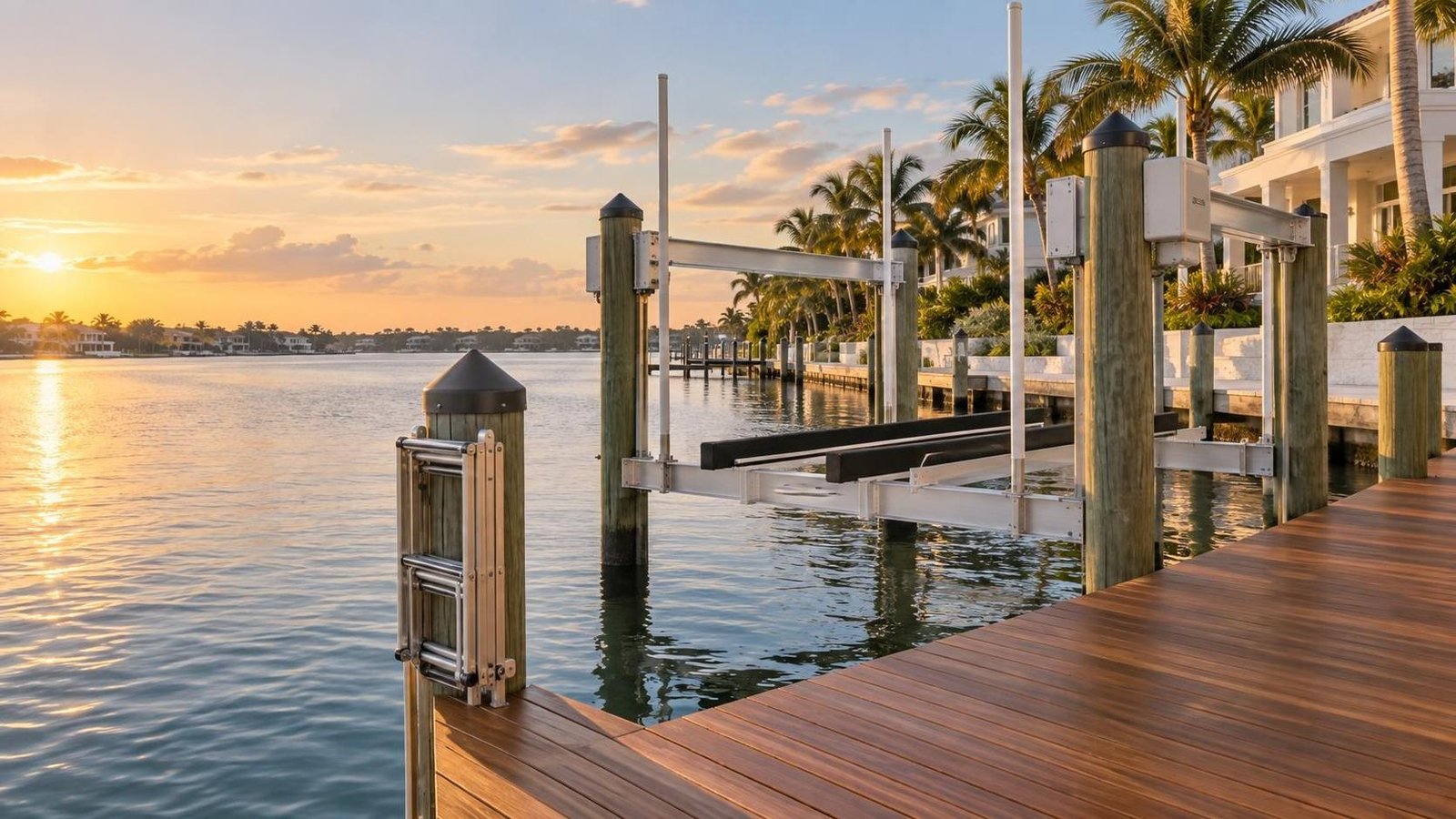
Folding Dock Ladder in a Boat-Lift Cable Path: What Should Merritt Island Canal Buyers Verify?
By Carrie Liotta, Space Coast REALTOR® with REAL Broker | Published October 6, 2026
If a folding dock ladder enters a boat lift’s cable path, do not assume the ladder can simply stay raised. Verify both systems through their full movement envelopes, identify the ladder and lift models, inspect their mounting and condition separately, and price any relocation only after the appropriate marine and lift professionals define the work.
A Merritt Island canal dock can look orderly while everything is stationary. The ladder is folded up, the boat is resting on the lift, and the walking surface feels open. The conflict may appear only when the ladder swings down, the cradle moves, a cable changes position under load, or someone needs the ladder as a safe exit from the water. That makes this a geometry, operation, documentation, and cost question—not a cosmetic accessory question.
First, map every position instead of judging one photograph
I would begin with a simple site sketch and four separate outlines: the ladder stowed, the ladder fully deployed, the lift at its normal upper position, and the lift through its intended operating range. Add the boat’s hull and appendages, lift cradle, cables, pulleys, posts, bunks, dock edge, cleats, pilings, control station, and the route a person uses to board from the dock.
The phrase “cable path” also needs confirmation. A buyer should not label every visible line as a lift cable or assume its position stays fixed. The lift technician should identify the working cables, how they wind, what they support, how their position changes, and where people and accessories must remain clear for that specific model and installation.
This is why I tell buyers to compare the entire waterfront layout, not just the equipment list. My guide to choosing between a clear dock service path and a larger pool deck explains how future access can matter as much as the amenity itself.
Inspect the ladder as its own load-bearing system
The ladder deserves a separate inspection even if the lift never touches it. Look for the manufacturer and model, mounting instructions, rated use, installation invoice, fastener type, backing or dock framing below the surface, hinge wear, locking hardware, corrosion, loose movement, bent rails, damaged steps, and evidence that the mounting area has been patched or relocated.
Manufacturer instructions show why model identification matters. Dock Edge’s ECO2 flip-up ladder instructions call for clearance so that model’s step rails can lift out of the water, recommend securing into dock framing where possible, and direct owners to inspect for wear or damage. Those details should not be copied onto an unidentified ladder as universal measurements. They demonstrate the questions a buyer needs the actual manufacturer’s documents to answer.
Pay close attention to what supports a person’s weight. Stainless-looking bolts through a deck board do not prove that the assembly is properly backed or tied into sound framing. A neat bead of sealant does not establish what is underneath. If the ladder flexes, the deck surface moves, fasteners are pulling through, or the hinge no longer holds the ladder reliably, ask a qualified dock or marine professional to evaluate it before anyone uses it.
Inspect the lift and its cables independently
A ladder conflict does not tell you whether the lift is healthy. The buyer still needs the lift’s manufacturer, model, rated capacity, installation history, service invoices, cable-replacement records, control information, and any available permits or final inspections. The boat currently sitting on the lift does not prove correct capacity, cable condition, or installation.
Look from a safe distance for inconsistent cable tracking, visible fraying, corrosion, flattened or kinked sections, damaged pulleys, loose attachment points, rubbing marks, improvised guards, and places where the ladder may have contacted the lift. Do not touch a cable to judge tension, stand below a raised load, enter the water around the lift, or ask the seller to cycle equipment casually during a showing.
FLOE International’s V1600 owner’s manual, as one manufacturer example, warns users to stay clear of moving parts including cables, pulleys, and the lift platform. It also calls for regular checks of cables, attachment points, wear, and fraying. The actual lift’s manual must control, but the broader lesson is clear: a moving-cable area is not the place to improvise an accessory clearance test.
Ask for a controlled professional observation, not a risky demonstration
The useful inspection is not a buyer pulling the ladder down while someone holds a lift remote. It is a coordinated observation led by people who understand the equipment. Before any movement, the lift technician and marine professional should decide whether the boat remains on the lift, whether the ladder can be handled safely, which areas must stay clear, and whether existing damage makes operation inappropriate.
When normal operation can be observed safely, document the conflict from fixed reference points. Note the closest approach in every relevant position, but do not turn a tape-measure snapshot into a clearance approval. Watch whether the ladder’s hinge arc changes when weight is applied, whether a cable shifts laterally as it winds, whether the boat projects into the ladder zone, and whether a person using the ladder would emerge beside moving equipment.
Reconcile the records before calling relocation simple
Ask the seller for the dock and lift permits, installation drawings, invoices, ladder receipt, lift manual, cable service history, photographs before later alterations, and any record showing when the ladder was added. Compare dates. If the lift was installed first and the ladder appeared years later, the lift installer may never have reviewed the ladder location. If the ladder predates a replacement lift, the newer cradle or cable route may have changed the available space.
Search the correct local permit authority for the parcel and ask what records apply to the dock and lift. Then verify whether moving the ladder changes only an accessory or also affects dock framing, electrical routing, a piling, handrail, platform, shoreline component, or work over surface water. Florida DEP’s Environmental Resource Permitting overview identifies docking facilities and attendant structures among work that may be reviewed through DEP or a water-management district under operating agreements. That does not mean every ladder move needs a state permit. It means a buyer should not assume “small accessory” answers the jurisdiction question.
A clean record trail also helps separate this conflict from other waterfront systems. If electrical conduit, controls, or a disconnect must move with the ladder or lift component, bring in the appropriate licensed electrical professional. My article on dock-power conduit crossing a seawall joint explains why an apparently local adjustment can involve both marine access and electrical scope.
Price the correction as a coordinated scope
There is no responsible sight-unseen price for this condition. The least disruptive answer may be relocating the ladder to sound framing with a clear water-entry route. Another property may need a different ladder style, reinforced mounting, deck-board replacement, altered railings, repaired framing, moved cleats, or a revised lift accessory. In a constrained dock, there may be no good location without broader design work.
I would ask for written scopes that answer five cost questions:
- Investigation: Who identifies the lift model, cable route, ladder model, framing, and permit history?
- Removal and protection: What must be secured, de-energized, unloaded, or temporarily removed so work can happen safely?
- Correction: Is the plan to relocate, replace, reinforce, or redesign the ladder area?
- Restoration: Who repairs decking, penetrations, coatings, railings, wiring, or hardware disturbed by the work?
- Closeout: Which permits, inspections, photographs, invoices, manuals, and warranty documents will show what was completed?
A single ladder quote may omit lift review, deck framing, access, or restoration. A lift technician’s note may not address whether the new ladder mounting can carry a person. The buyer’s reserve should follow the combined scope, plus a reasonable allowance for concealed conditions once fasteners or decking are opened.
This is similar to comparing documented dock electrical work with a newer lift motor: the newest visible component is not automatically the strongest waterfront file. Installation quality, compatibility, service access, and records determine how much confidence the improvement deserves.
Use the inspection period to make a decision, not just collect concerns
By the end of due diligence, I want the buyer to place the property in one of three categories. First, the systems are independently sound, their movement envelopes are compatible, and the documents support normal use. Second, the conflict has a defined correction with written scope, responsible contractors, timing, and cost. Third, the conflict remains uncertain because equipment cannot be identified, operation cannot be observed safely, framing is concealed, records are missing, or professionals disagree.
Unresolved uncertainty does not automatically require walking away, but it does require honest pricing and contract strategy. A documented seller correction, price adjustment, or feasible post-closing project is stronger than a vague promise to “move the ladder later.”
Think about usability as well as repair. If the ladder is the practical way to exit the canal after kayaking or swimming, deleting it may solve the cable conflict while creating a different problem. If a new ladder location blocks the boat’s boarding side, cleats, fish-cleaning area, or maintenance path, the dock may still disappoint the buyer after closing. The right answer preserves safe water access and a clear lift zone at the same time.
My Merritt Island buyer checklist
- Identify the ladder and lift manufacturer, model, installation date, and available instructions.
- Map the ladder, cables, pulleys, cradle, boat, controls, dock edge, and boarding route in every relevant position.
- Have the ladder mounting, hinges, fasteners, backing, framing, and wear reviewed within the appropriate professional’s scope.
- Have the lift technician review cable routing, pulleys, attachment points, controls, capacity documents, and service history.
- Do not stand under a raised load, enter the water near operating equipment, touch moving cables, or improvise a demonstration.
- Match permits, invoices, inspections, manuals, and photographs to the actual equipment on site.
- Confirm the authorities and approvals that would apply before relying on a relocation plan.
- Obtain a coordinated written scope covering removal, correction, restoration, testing, and closeout records.
- Evaluate whether the corrected layout still provides useful water access, boarding space, and future service access.
Bottom line
A folding ladder that enters a boat-lift cable path is not a detail to dismiss because the ladder is usually stored upright. The buyer needs to know where both systems move, whether each is properly installed and maintained, whether people can use the dock without entering a moving-equipment zone, and what a complete correction would require.
I help Merritt Island canal buyers evaluate the house and the waterfront as one ownership decision—from seawalls and docks to lifts, access, records, and future maintenance. Reach out for a no-pressure conversation about Brevard County waterfront homes with Carrie Liotta, Space Coast REALTOR® with REAL Broker. Your next chapter starts here.
