

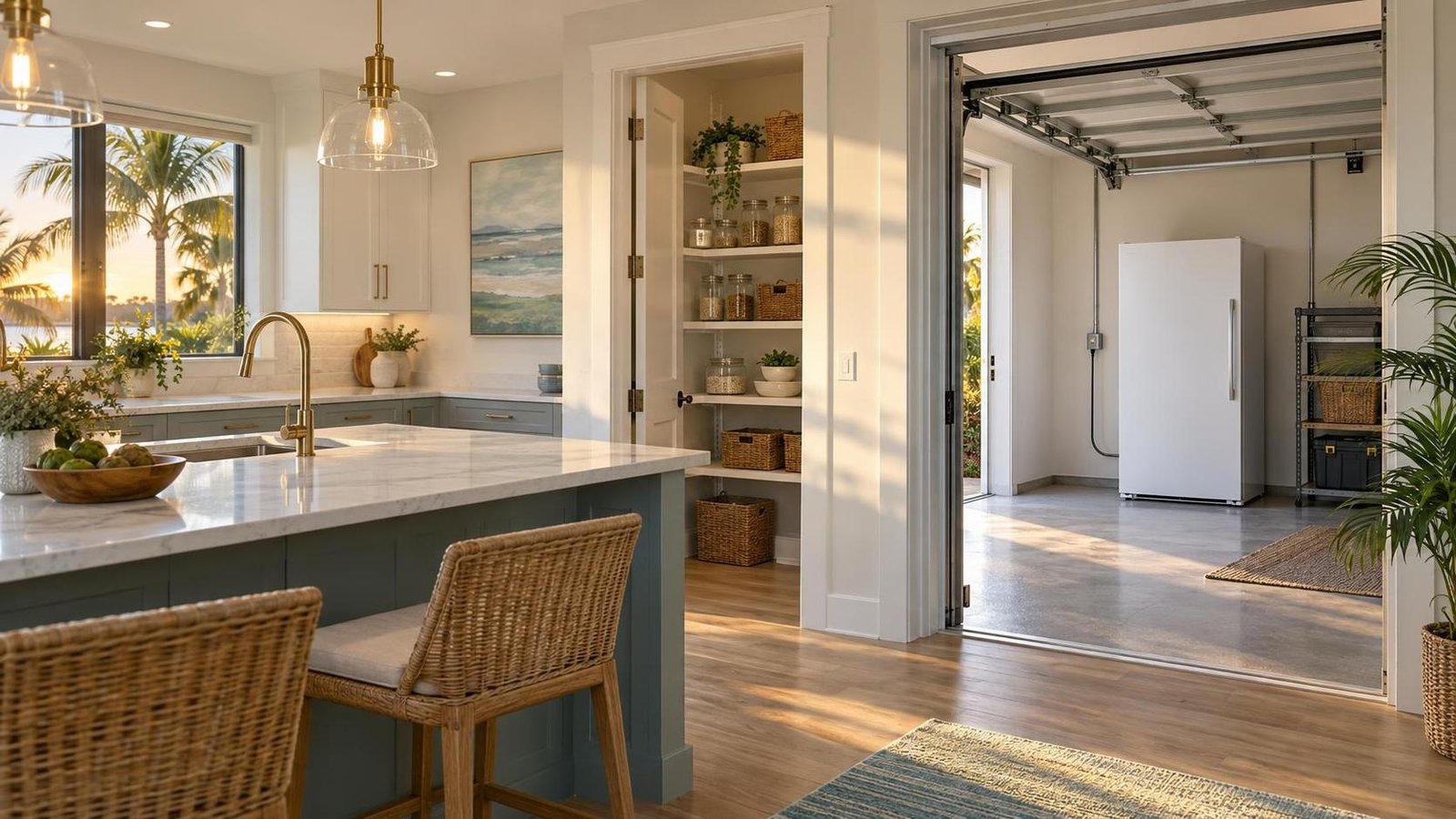
Dedicated Garage Freezer Circuit or Better Interior Pantry: What Should Viera Relocators Choose?
By Carrie Liotta, Space Coast REALTOR® with REAL Broker | Published October 1, 2026
For most Viera relocators, I would choose the better interior pantry when it improves every grocery trip and meal, then price a properly designed freezer connection separately. I would choose the garage setup first only when bulk frozen storage is essential and the receptacle, circuit, appliance rating, clearances, and outage plan are all verified.
This is not really a contest between an outlet and a closet. It is a question about which home supports the household’s repeated routine and which missing feature can be added without creating a larger project. A pantry can look generous but function poorly. A garage receptacle can be labeled “freezer” but share loads, lack useful monitoring, or sit where a vehicle door makes the appliance impractical.
When I walk these homes with relocating buyers, I test both promises. We carry an imaginary grocery load from the garage entry to the kitchen. Then we trace the proposed freezer location from the panel to the plug and from the plug to the appliance door. The better choice usually becomes clear when the family stops comparing labels and starts rehearsing a normal week.
Start with the routine, not the feature list
A household that shops in smaller quantities, cooks most nights, packs lunches, and reaches for dry goods throughout the day may benefit more from a pantry beside the kitchen. Good access means more than square footage. Look at shelf depth, visibility, door swing, lighting, ventilation, and whether two people can use the kitchen without blocking the pantry.
A family that buys meat in bulk, meal-preps for long shifts, stores specialty foods, fishes, entertains often, or wants a separate storm-season food plan may place much more value on a garage freezer. In that case, the freezer is not overflow storage. It is part of the household’s food system, so a vague outlet and an unmeasured corner are not enough.
I ask buyers to list what they expect to store in each space. Put weekly cereal, snacks, pet food, small appliances, paper goods, and serving pieces on the pantry list. Put frozen meals, bulk meat, bait or catch if appropriate, and long-term inventory on the freezer list. Then mark how often each item is used. A feature serving ten daily interactions can be more valuable than a larger feature used twice a month.
Prove what “dedicated freezer circuit” means in this house
A panel directory is a clue, not proof. A receptacle marked for a freezer may have been added after construction, may share other outlets, or may no longer match the panel label. Ask for the electrical permit, approved scope, final inspection, invoice, and any photograph taken before wall repair. For a property in county jurisdiction, the Brevard County permit search is a starting point; confirm whether the address is actually under the county or another authority.
Have a licensed electrician identify the breaker, conductor and receptacle, test the observed installation, determine what else is supplied, and compare it with the freezer manufacturer’s instructions. Do not remove a panel cover or perform improvised load tests during a showing. Florida’s current electrical-contractor definitions include work involving wiring, appliances, raceways, and conduit, and the Florida DBPR license search lets a buyer verify regulated licenses.
The protective devices matter too. The current Florida residential code’s power and lighting distribution chapter contains requirements the electrician and permitting authority must apply to the actual installation. A buyer should not ask someone to bypass required protection because a nuisance trip could spoil food. Instead, ask why a device tripped, correct any defect, confirm the proper protection, and add a practical temperature or power-loss alert.
The appliance has to fit the garage, not just the floor plan
Measure the freezer model, not an empty rectangle. Confirm the manufacturer’s permitted ambient conditions, required side and rear clearances, ventilation, leveling, cord and receptacle location, door or lid clearance, and whether the unit is intended for the observed garage environment. “Garage ready” should come from the exact model documentation, not from a salesperson’s memory or an old appliance left by the seller.
Now test the room around it. Can both vehicles park without touching the freezer? Can a car door, golf cart, bicycle, ladder, or overhead rack strike it? Can the lid of a chest model open below the rack? Can an upright door open far enough to remove drawers? Is the path from the kitchen dry and unobstructed during heavy rain?
This is where buyers sometimes discover that the more impressive setup is less usable. A circuit in the far corner behind parked vehicles can turn every grocery unload into a squeeze. A freezer next to the main passage can narrow the route and invite impact damage. If overhead storage, an EV outlet, and attic access are already competing for the same garage wall, my guide to documenting Viera garage racks, EV wiring, and attic access shows why those systems should be drawn together instead of evaluated one by one.
Do not treat food loss as only an electrical question
A working circuit does not tell you that the freezer is holding the right temperature. The U.S. Food and Drug Administration’s food-storage guidance recommends keeping a freezer at 0°F and using an appliance thermometer. It also says a full unopened freezer can maintain an adequate temperature for about 48 hours during an outage. Those facts make monitoring, inventory, door discipline, and an outage response part of the buyer’s plan.
Ask where an alert can be heard or sent and who will check the freezer when the owners travel. If backup power matters, have qualified professionals confirm the load and connection method; do not assume a generator or battery supplies this circuit.
Operating cost belongs in the comparison, but use model information rather than a generic estimate. ENERGY STAR’s freezer guidance recommends checking the EnergyGuide label to compare energy use and estimated annual operating cost. It also explains that an upright model generally offers easier shelf organization, while a chest model uses more floor area and is usually more efficient because less cold air escapes when the top opens. That tradeoff can change which footprint actually works in the garage.
A pantry deserves the same level of inspection
Buyers often give the pantry a quick glance because nothing mechanical appears to be involved. I slow down. Deep fixed shelves can hide food and waste usable volume. A narrow door can make it difficult to carry larger items. Wire shelving may be awkward for small containers. An interior corner can create dead space, while a door that conflicts with the refrigerator can interrupt the busiest part of the kitchen.
Stand where groceries enter the home and walk the route. Open the refrigerator, dishwasher, oven, and pantry doors. Imagine school mornings, two cooks, a large grocery delivery, and guests. Check whether frequently used food can remain visible without filling the kitchen counters. Look for an outlet if small appliances are intended to operate there, but do not assume a shelf makes the space an approved appliance station.
A useful pantry can reduce daily friction even when it is not enormous. Adjustable shelves, a clear opening, lighting, and a short route from the garage entry may outperform a walk-in pantry with awkward corners. This is the same practical test I use when comparing an upstairs laundry with leak protection against a downstairs laundry: the winning location depends on the routine, but the supporting details determine whether that location truly works.
Price the missing feature as a complete project
If the pantry wins and the buyer still wants a freezer, do not budget only for a receptacle. Ask an electrician for a written scope covering the panel capacity, circuit route, required protection, permit, wall access, patching, labeling, testing, and final inspection. Add the chosen freezer, delivery clearances, floor or wall protection where appropriate, monitoring, and any storage that must move.
If the garage setup wins but the pantry is weak, obtain a cabinet or remodeling scope. It may include removal, framing, electrical or lighting work, ventilation decisions, shelving, door changes, flooring and paint repair, and loss of another storage function. A pantry expansion near plumbing, structural elements, or a post-tension slab can become more complicated than adding adjustable shelves inside an existing enclosure.
Do not price either project from a neighbor’s renovation. Panel routes, wall cavities, cabinet dimensions, permit authority, and finishes belong to this house. Compare written estimates that include restoration and documentation.
This is also why a larger garage does not automatically settle the issue. My article on a three-car Viera garage versus a lower payment with better storage planning addresses the broader size decision. Here, the buyer is evaluating one food-storage appliance and one high-frequency kitchen space. The right answer can differ even in two homes with the same garage count.
Use one inspection-period worksheet
I would put these questions in writing:
- What exact freezer model and capacity fit the household’s inventory?
- Does its manual allow the observed location and temperature conditions?
- Which breaker supplies the receptacle, what else is on it, and do records match?
- What protective devices are required, present, tested, and properly labeled?
- Can the appliance open, ventilate, and be serviced with vehicles and storage in place?
- How will the owners monitor temperature and respond to a trip or outage?
- Which pantry items are reached daily, weekly, and seasonally?
- Do shelf depth, door swing, lighting, and grocery route support that routine?
- What is the complete written cost to add the missing feature and restore finishes?
Score each home on daily convenience, technical confidence, and correction cost. A pantry can win convenience while losing capacity. A garage freezer can win capacity while losing confidence until the circuit and model are verified.
My decision rule for Viera relocators
I would prioritize the pantry when it serves the household every day, the kitchen cannot be changed easily, and a suitable freezer circuit can be added with a clear written scope. I would prioritize the garage setup when frozen storage is central to the household, the appliance location works with parking and access, and a licensed electrician has verified the circuit and protection against the exact installation.
I would pause when “dedicated” exists only on a handwritten label, the freezer model is unknown, the garage footprint conflicts with vehicles or storage, the pantry’s apparent capacity comes from unusably deep shelves, or either correction estimate omits wall and cabinet restoration. Those are not automatic reasons to reject a home. They are reasons to replace assumptions with documents and prices.
Relocating buyers do not need every feature to be perfect on closing day. They need to know which inconvenience they will feel repeatedly and which improvement can be completed responsibly after closing. If you are comparing Viera homes, reach out for a no-pressure conversation with Carrie Liotta, Space Coast REALTOR® with REAL Broker, about layout, inspections, records, and the full ownership budget. You can also join my private Facebook group, Moving to Brevard County Florida. Your next chapter starts here.
