

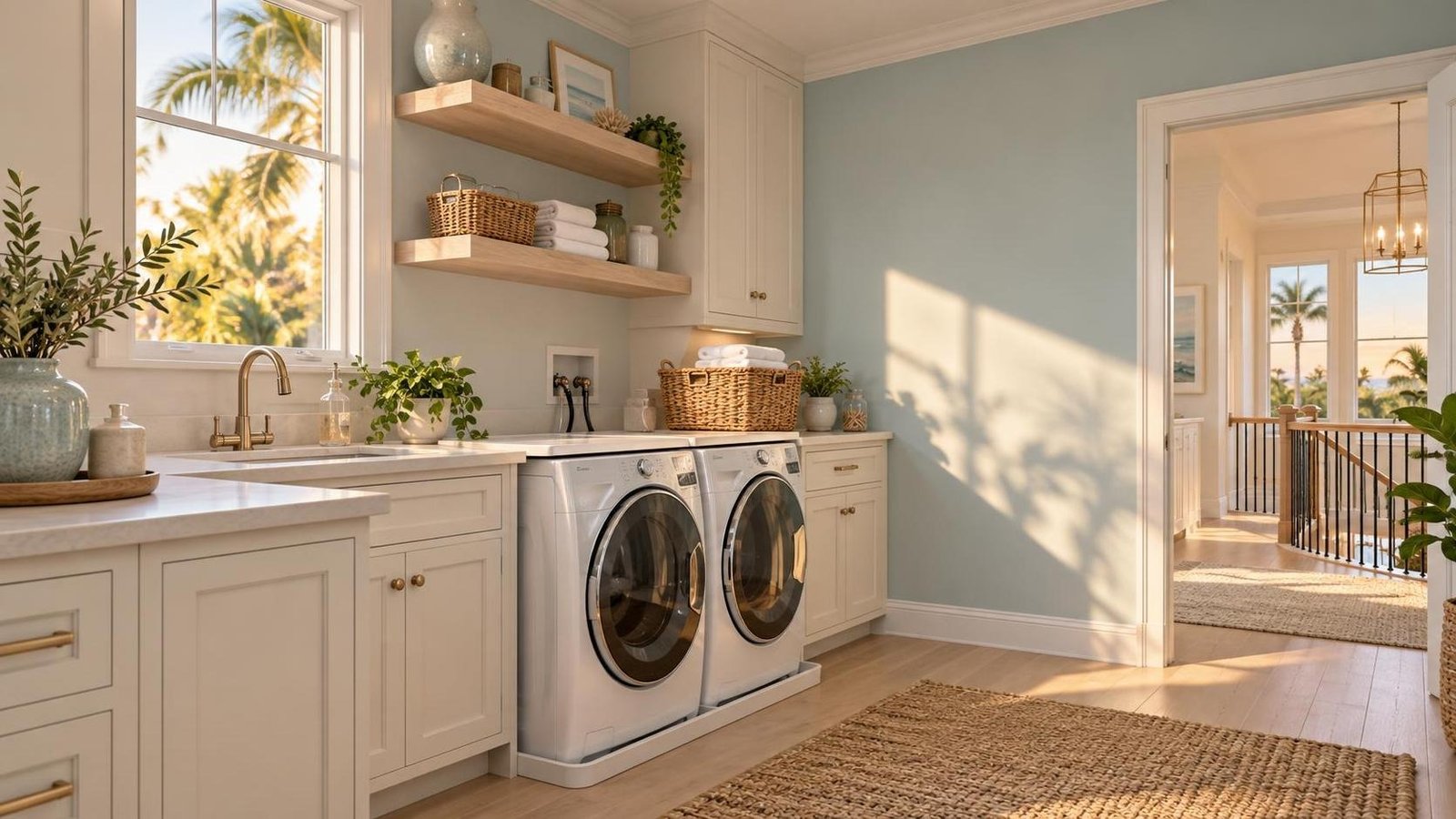
Upstairs Laundry With Leak Protection or Downstairs Laundry: What Should Viera Relocators Choose?
By Carrie Liotta, Space Coast REALTOR® with REAL Broker | Published September 30, 2026
If most bedrooms are upstairs, I would usually choose the upstairs laundry—but only when the water connections, drain path, dryer vent, shutoff access, and leak protection are documented and easy to inspect. A downstairs room is the better choice when the upstairs installation is improvised, noisy, difficult to service, or positioned over a space where a leak would be especially disruptive.
This is not really a contest between carrying baskets and worrying about water. Either location can work well. The useful comparison is between two complete systems: how laundry moves through the household, what happens if a hose or drain fails, how the dryer exhausts, how much noise reaches bedrooms and calls, and whether a plumber or appliance technician can reach everything without damaging finished surfaces.
Start with the household route, not the laundry-room photo
Relocating buyers often see an upstairs laundry beside the bedrooms and call it an automatic upgrade. For a household doing several loads each week, that convenience is real. Clothing, towels, and linens usually begin and end upstairs, so the trip is short and baskets do not have to cross the stairs. That can matter for parents managing bedtime, buyers with mobility concerns, or anyone who wants the main level to stay clear of laundry traffic.
But the floor-plan label does not tell me whether the room works. I want to see whether the door can open while both machines are usable, whether a front-loader has room to swing, whether a basket blocks the hallway, and whether shelving interferes with shutoffs or dryer connections. A narrow closet may be upstairs and convenient while still being frustrating every day.
The downstairs room deserves the same practical test. Walk the full route from the bedrooms with a basket in both hands. Count the turns, doors, and stair landings. Notice whether the route passes through the kitchen, garage entry, or a work-from-home area. If the laundry sits beside the garage, it may double as useful household storage; if it is isolated at the far end of the first floor, the attractive cabinet wall may not compensate for the daily trip.
I use this same routine-first approach when helping buyers evaluate garage capacity and storage planning in Viera. Square footage matters, but circulation and access determine whether the space actually helps.
What “documented leak protection” should mean
A pan visible under a washer is a starting point, not proof that the room is protected. Ask where the pan drains, whether that route is open, and who installed it. Look for accessible hot- and cold-water shutoff valves, supply hoses in good condition, secure drain-hose placement, and evidence of prior leaks around the baseboards, flooring, wall, and ceiling below. If a leak sensor or automatic shutoff is part of the sales story, ask for the manufacturer, model, installation information, app or hub requirements, and a live demonstration.
The U.S. Environmental Protection Agency’s current WaterSense leak-detection guidance explains that leak-detection and flow-monitoring devices can alert homeowners to irregular water use and help reduce water waste and damage. That makes a sensor useful evidence of preparation, but I would not treat it as a guarantee. A device may need power, connectivity, maintenance, correct valve sizing, or an active service account. A simple puck sensor that sounds locally is different from a whole-home device that can close the water supply.
For an upstairs room, I also look below. Is the laundry over a garage, hallway, kitchen, office, or finished bedroom? A leak is undesirable anywhere, but its likely path changes the consequences. Ceiling stains, patched drywall, uneven flooring, swollen trim, or a musty odor deserve questions. If the seller says there was a prior incident, ask for the plumber’s invoice, drying or remediation records, repair scope, and any related insurance documentation available to the seller.
Do not assume a newer Viera home answers every installation question
Viera includes different generations of neighborhoods, builders, floor plans, and later owner improvements. A newer-looking laundry does not prove the plumbing, electrical work, venting, or cabinetry is original. Machines may have been stacked, moved, replaced with larger models, or enclosed after construction. A downstairs utility space may also have been converted from another use.
When work appears to have changed the room, ask for invoices and permits rather than guessing. The Brevard County building permit search is one official starting point for property records in county jurisdiction. The exact authority and permit requirements depend on the address and work, and older records can be incomplete, so a clean search is not a substitute for inspection or seller documentation.
The dryer route matters as much as the washer location
Buyers naturally focus on water upstairs, but the dryer deserves equal attention. Identify whether it is electric or gas, where the electrical receptacle or gas connection sits, and where the exhaust leaves the house. A short, accessible route with a proper exterior termination is easier to understand and maintain than a long concealed route with several turns. Look for crushed flexible material behind the dryer, lint accumulation, a missing exterior flap, or cabinetry that pushes the appliance too close to the wall.
Ask the inspector to evaluate visible conditions and recommend the right specialist when the route cannot be confirmed. If the seller has a recent dryer-vent cleaning invoice, keep it in the property file, but do not treat one receipt as proof that the concealed route is ideal. Upstairs placement may require a longer run depending on the plan; a downstairs room can also have a poor route if it sits deep inside the house.
Vent access belongs in the ongoing ownership budget. So do supply hoses, shutoff hardware, appliance clearances, and any connected leak device. The location that is easiest to maintain can be more valuable than the one that looks most polished during a ten-minute showing.
Listen from the bedrooms and the workspace
An upstairs laundry may shorten the basket route while adding spin-cycle sound near bedrooms. Run the machines if the seller allows it, or at least ask for a second showing when a load can be demonstrated. Close the laundry and bedroom doors. Listen from the primary bedroom, nursery, guest room, and any proposed office. Notice vibration through the floor as well as sound through the wall.
Noise becomes more important when someone works remotely, sleeps during the day, or runs laundry after children go to bed. A large room at the end of the hall may be quieter than a compact closet sharing the primary-bedroom wall. Conversely, a well-built upstairs room with a solid door, reasonable appliance clearances, and balanced machines may be less noticeable than a downstairs laundry beside the kitchen or office.
Compare the machines the room can actually accept
Measure width, depth, door swing, hookups, and the path from the exterior door to the laundry. A machine that fits the opening may still project far enough to block a door or prevent access to the shutoffs. Stacked units can preserve floor area, but they change reach, service access, and replacement choices. Pedestals may interfere with shelves or make controls too high for some users.
ENERGY STAR’s current clothes-washer guidance tells shoppers to consider placement and capacity, compare the yellow EnergyGuide label, and review the Integrated Modified Energy Factor and Integrated Water Factor. It also reports that current certified full-size washers use 14 gallons per load compared with 20 gallons for a standard machine. Those numbers can help compare replacement appliances; they do not tell you whether a particular upstairs installation is protected against leaks.
Before assuming you can buy a preferred model after closing, verify the space and delivery path. Tight stair turns, narrow doors, built-in counters, and shallow closets can reduce the practical choices. Include any necessary pan, hoses, vent elbow, electrical work, shelving change, or door modification in the comparison.
Price the correction, not the fear
I would not reject every upstairs laundry because water damage is possible, and I would not pay a premium for one because a listing says “leak sensor.” Turn each concern into a scope.
- Simple ownership items: replacing aging supply hoses, adding an accessible local sensor, labeling the shutoff, or adjusting shelving.
- Professional evaluation: an unclear drain-pan discharge, a long or inaccessible dryer route, evidence of movement or leakage, weak flooring, or shutoffs that do not operate normally.
- Larger projects: moving plumbing, adding a whole-home shutoff, opening finished surfaces, changing electrical or gas service, or relocating the laundry.
Obtain written estimates during the inspection period when a correction affects the purchase decision. Do not assign a generic allowance before someone confirms the cause and access. A modest repair may make the upstairs room the clear winner. An undocumented installation above finished living space may justify choosing the downstairs home, renegotiating, or walking away if the uncertainty exceeds the household’s budget.
Put the result into the same multi-year worksheet as the home’s other obligations. If one property has the ideal laundry but also an older roof, near-term HVAC replacement, higher district assessments, and less reserve cash after closing, convenience should not control the purchase. My comparison of Viera floor-plan utility and lower annual assessments uses the same principle: price the complete home, not one room label.
My showing and inspection checklist
- Carry a loaded basket from the bedrooms to each proposed laundry location.
- Measure the appliance opening, door swing, hookups, shelving, and delivery path.
- Locate and operate accessible shutoffs with permission; note supply-hose condition.
- Identify the pan, its discharge route, the washer drain, and any leak sensor or automatic valve.
- Inspect flooring, trim, walls, and the ceiling below for signs of a prior water event.
- Trace the visible dryer-exhaust route and ask how concealed portions are maintained.
- Listen from bedrooms and workspaces while appliances operate if a demonstration is available.
- Request permits, invoices, prior repair records, device manuals, and transfer instructions.
- Have the appropriate inspector, plumber, electrician, or appliance professional define unresolved issues.
- Compare the correction cost with the home’s total payment and near-term system budget.
Which Viera laundry location would I choose?
I would choose the upstairs laundry when most bedrooms are upstairs, the room has useful clearances, noise is acceptable, the plumbing and dryer route are understandable, and leak protection can be demonstrated and maintained. That combination turns convenience into a durable feature.
I would choose the downstairs laundry when it has better service access, a simpler exhaust and plumbing path, less risk to finished space below, and a route the household can realistically live with. I would also favor it when the upstairs alternative depends on undocumented alterations or technology that no one can operate.
The best answer is not “upstairs is modern” or “downstairs is safer.” It is the location whose daily benefit and failure plan you can both explain. If you are relocating to Viera, I can help you compare that practical fit along with assessments, association documents, major systems, commute, and resale. Reach out for a no-pressure conversation about Viera and Brevard County homes for sale with REAL Broker, or join my private Facebook group, Moving to Brevard County Florida. Your next chapter starts here.
