

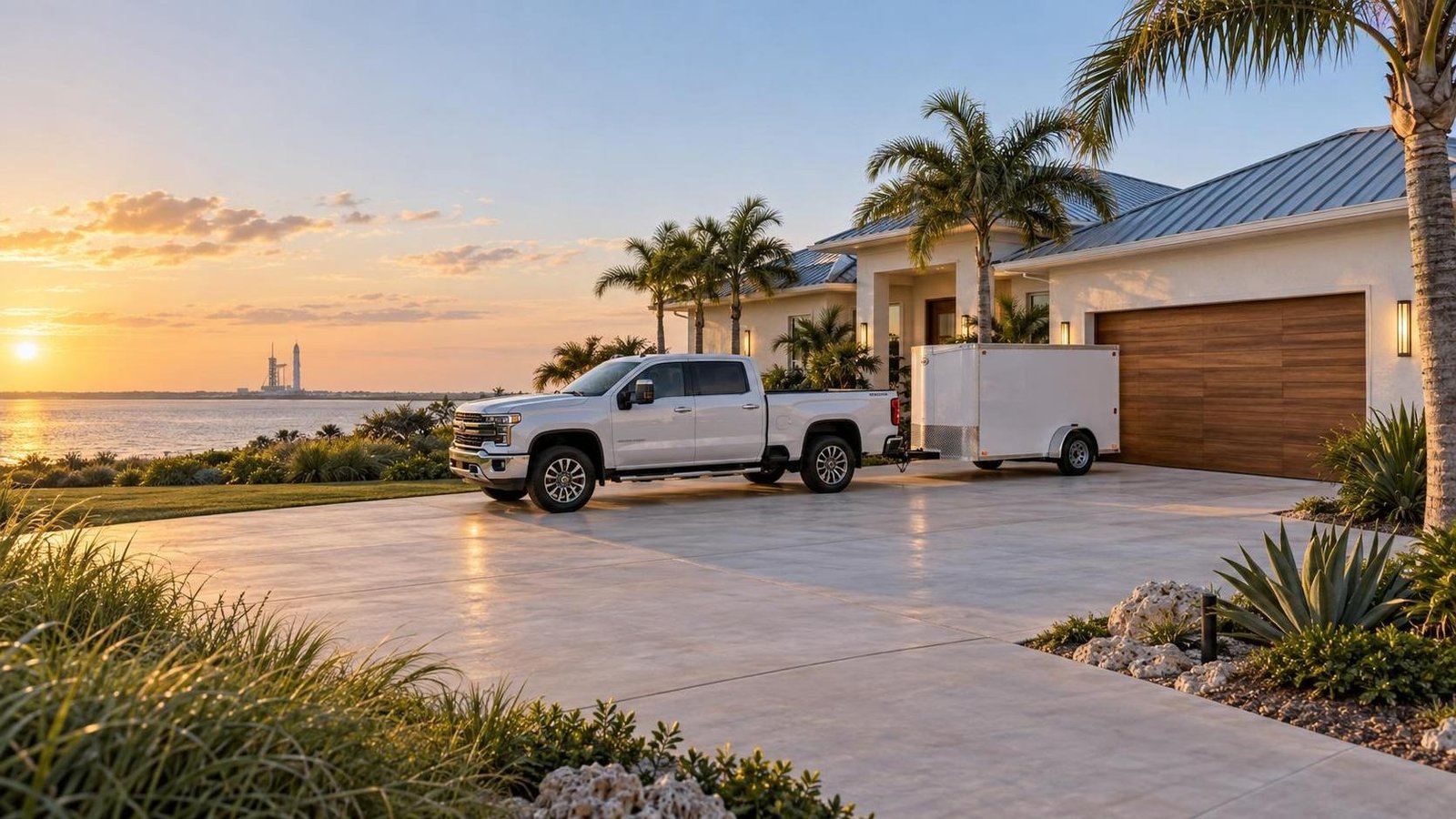
Work-Truck Driveway but Restrictive Trailer Rules: What Should Titusville KSC Buyers Verify?
By Carrie Liotta, Space Coast REALTOR® with REAL Broker | Published September 27, 2026
A wide Titusville driveway is not enough if your work truck, utility trailer, boat trailer, or company vehicle violates governing rules or cannot turn, charge, load, and leave safely. Before offering, verify the actual documents, local requirements, employer restrictions, driveway permits, vehicle dimensions, and off-site alternatives. Test the route at the shift times you will use it.
This question comes up with engineers, technicians, tradespeople, contractors, launch-support workers, and households that own both a daily vehicle and a trailer. The listing may advertise “plenty of parking,” but that phrase can mean only that several ordinary cars fit on the concrete. It does not answer overnight restrictions, commercial markings, trailer screening, street parking, garage requirements, surface rules, or how a long vehicle navigates the neighborhood.
I separate the decision into four tests: permission, physical fit, work routine, and resale.
Permission comes from more than one place
Start with the recorded restrictions and current association documents if the property is in a mandatory HOA. Review the declaration, amendments, rules, architectural standards, enforcement history available through the transaction, application procedures, and any written vehicle policy. Do not rely on a seller’s statement that “nobody cares” or on the sight of another trailer three streets away.
Florida’s current Homeowners’ Association Act, Chapter 720 defines governing documents and association powers, addresses official records and architectural controls, and includes presale-disclosure provisions. It does not turn every community into one standard rulebook. The recorded documents and law must be read together for the property, and legal questions belong with a Florida attorney.
Next, confirm the applicable city or county rules. Ask about vehicle type, trailer location, pavement, setbacks, visibility, right-of-way obstruction, driveway expansion, carports, gates, and any home-occupation issue created by how you use the property. A house with a Titusville mailing address may still require careful jurisdiction confirmation.
Finally, check employer policy. A company vehicle may have security, equipment, decal, passenger, charging, take-home, or storage requirements that are unrelated to neighborhood permission. A rule allowing pickup trucks does not guarantee your employer allows tools or controlled equipment to remain in one overnight.
Measure the actual equipment, not a generic truck
Bring the truck and trailer dimensions to the showing. Measure total length, width with mirrors, height, hitch projection, door clearance, turning radius concerns, and the space needed to connect or disconnect. Include ladders, racks, toolboxes, tailgates, charging cables, and the working room needed to open compartments.
Then measure the driveway from the usable curb cut, not the apparent edge in a wide-angle photo. Locate irrigation heads, mailboxes, utility equipment, drainage swales, sidewalk, gates, roof overhang, trees, AC equipment, and sightline obstacles. Check whether a parked trailer blocks garage access or forces a daily vehicle into the street.
Look at slope and drainage. A trailer jack or heavy truck may interact poorly with a steep apron, soft shoulder, swale, or low spot. If pavement appears widened, patched, or extended, request permit and final records where applicable. The Brevard County permit search is a starting point for county-jurisdiction records; verify the actual authority for the address and read final status rather than assuming every online entry proves completion.
Test the route as part of the house
A vehicle can fit on the lot and still be frustrating to use. Drive the route from the expected gate or reporting point at a realistic shift time. Notice school traffic, construction, lane changes, turning movements, low branches, narrow entries, speed humps, gate queues, and places where a trailer cannot easily recover from a missed turn.
Do not publish or trust one universal KSC commute number. NASA describes Kennedy Space Center as a multi-user spaceport with about 100 private-sector partners and more than 10,000 people. Different employers, work sites, gates, shifts, and launch operations create different trips. Test your reporting point, not the center of a map pin.
A slightly farther home with an easy truck route can be more practical than a closer home that requires repeated tight turns or puts school pickup between you and the causeway. My article on shorter KSC routes versus quieter shift-worker bedrooms uses the same routine-first decision method.
Read trailer language literally
Rules may distinguish a work truck from a commercial vehicle, a trailer from the equipment it carries, temporary loading from overnight storage, driveway placement from rear-yard placement, and screened storage from visible storage. Ask for the exact definitions and enforcement procedure. A board member’s casual email is not a substitute for governing documents or formal approval.
If the rule appears to allow a trailer behind a fence, verify that the gate width, side-yard width, AC location, grade, utilities, easements, and turning angle make that physically possible. Also confirm whether the fence, pad, or driveway extension requires architectural or government approval. Do not base the purchase on a future change that has not been evaluated.
Electrical and ventilation questions can follow the parking decision
Some work vehicles bring batteries, chargers, refrigeration, inverters, or other equipment home. Identify what must run overnight, the load, receptacle type, circuit, panel capacity, cord route, weather exposure, and employer requirements. A standard garage outlet should not be described as work-truck charging infrastructure without qualified review.
Storage and charging can also affect heat, noise, and ventilation in an attached garage. Have the relevant professionals evaluate the proposed use; do not improvise around fuel, batteries, chemicals, or combustion equipment. My guide to choosing between garage ventilation and a second work-truck charging outlet explains why the safe operating plan comes before the extra receptacle.
Price off-site storage before calling it a backup
If the rules prohibit the trailer, identify real alternatives during due diligence. Call facilities, confirm current availability and terms, measure access hours against your shift, calculate the extra drive, and ask about vehicle type, security, power, and storm procedures. A theoretical storage lot that is full or closed when you report for work is not a plan.
Add the recurring charge, fuel, time, and duplicate loading to the ownership budget. Then compare that amount with a non-HOA or less restrictive home that costs more upfront. The lower-priced house can become the more expensive routine if every job or weekend starts with a storage detour.
Off-site storage may still be the cleaner answer when it protects equipment, reduces neighborhood conflict, or keeps the home visually flexible for resale. The point is to choose it intentionally rather than discover it after an enforcement notice.
Inspect the paperwork behind “truck-friendly” improvements
Request records for widened driveways, paver aprons, gates, fences, carports, detached garages, workshops, exterior lighting, cameras, and electrical work. Compare the records with the current layout. An attractive parking solution can become a buyer problem when a setback, easement, swale, or unfinalized permit is unclear.
Look for surface damage, oil or chemical staining, drainage changes, cracked edges, fence impact, and repairs where a heavy vehicle repeatedly turns. None of those findings automatically disqualifies a home, but they help price the actual use.
Sellers should also document their storage story. My post on Titusville driveway storage and launch-traffic documentation shows what a careful future buyer may request when you eventually sell.
Build a truck-and-trailer contingency checklist
- Photographs, dimensions, registration class, commercial markings, and intended use for every vehicle and trailer.
- Recorded restrictions, current HOA rules, amendments, written architectural standards, and formal approval path.
- Applicable municipal or county parking, driveway, right-of-way, and improvement requirements.
- Employer rules for take-home vehicles, tools, batteries, fuel, security, and charging.
- Measured driveway, garage, gate, side yard, turning path, and loading area.
- Permit and final records for pavement, gate, fence, carport, workshop, and electrical changes.
- Actual route test by shift and reporting point.
- Verified off-site storage option and full monthly cost if home storage is not allowed.
Which home is the better relocation choice?
Choose the wide-driveway home when the actual equipment is permitted, fits without blocking safe use, has a clean improvement file, and makes the work routine easier. A practical driveway can be a meaningful advantage for a KSC household even when the kitchen or yard is modest.
Choose the more restrictive home only when the rule genuinely fits your equipment or a verified off-site plan still works financially and logistically. Do not assume enforcement will remain casual, a future board will agree, or a seller’s exception transfers.
If neither option fits both current work and likely resale, widen the search. Titusville includes different neighborhood types, and nearby North Brevard areas may offer another balance of commute, storage, insurance, and monthly cost.
Bottom line
A work-truck driveway has value only when the truck, trailer, rules, route, and property all agree. Verify the written permissions and physical routine before you let a wide slab of concrete decide the purchase.
I help aerospace and contractor households compare homes around the way their workdays actually function, including storage, insurance, inspection, and resale. Reach out for a no-pressure conversation about Brevard County homes for sale, or join my private Facebook group, Moving to Brevard County Florida. Your next chapter starts here.
