

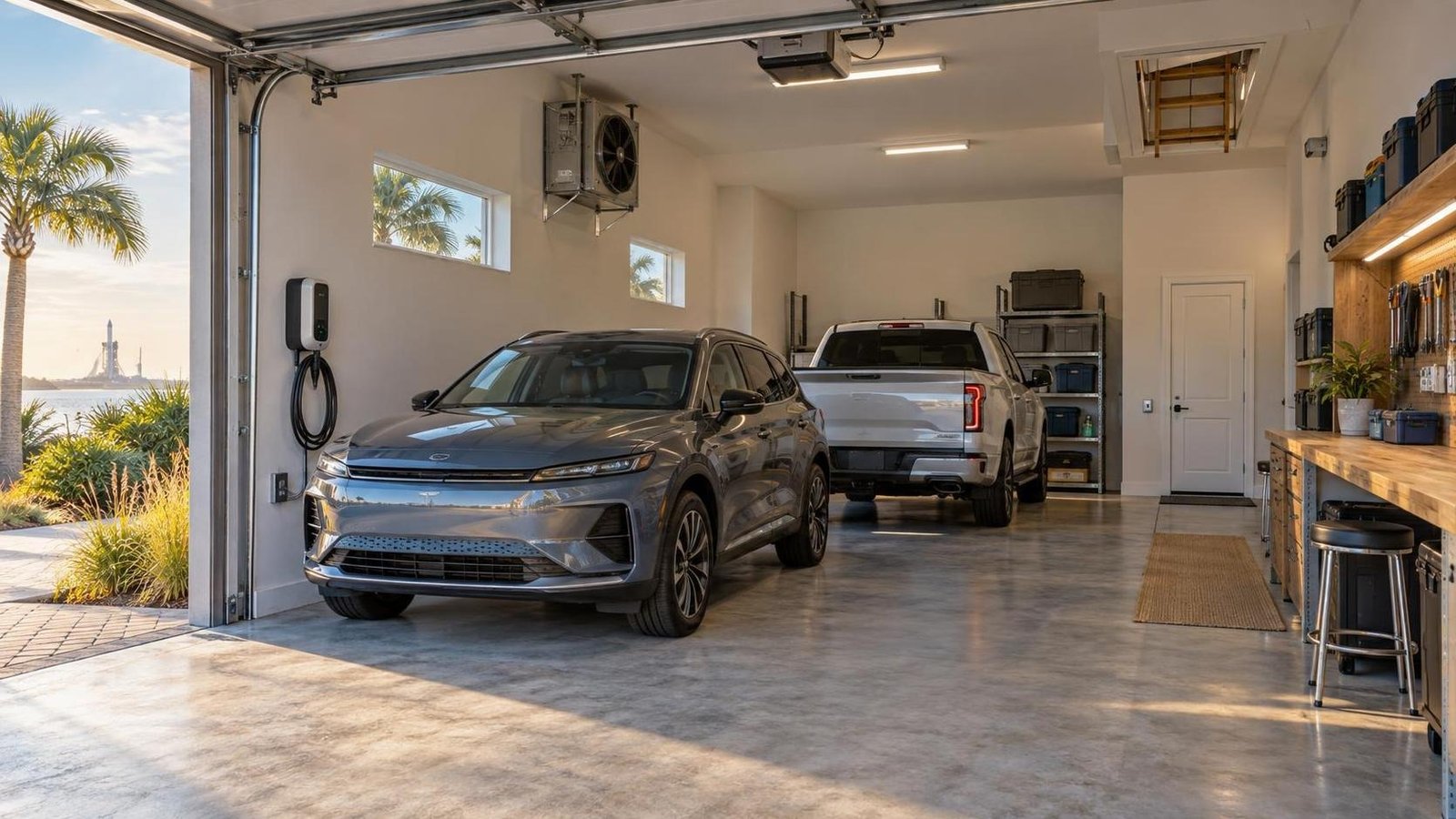
Garage Ventilation or a Second Work-Truck Charging Outlet: What Should Titusville KSC Buyers Prioritize?
By Carrie Liotta, Space Coast REALTOR® with REAL Broker | Published September 26, 2026
If the garage will function as a daily workspace, gear room, or enclosed staging area, I would usually prioritize documented ventilation and safe separation from the house before a second charging outlet. If two electric work vehicles genuinely need overnight charging, the second outlet can matter more—but only after an electrician confirms panel capacity, permits, equipment, and cable layout.
The features are not substitutes. Ventilation does not make it safe to idle a truck or run a generator in the garage. A second outlet does not prove the electrical system can support two vehicles together. The right choice starts with how a KSC or Cape-area household will use the space during real shifts.
Define “garage ventilation” before assigning value
Some listings use ventilation to describe a passive wall vent, powered exhaust fan, mini-split, attic fan, ridge vent, or simply a garage door that opens. Those are different systems with different purposes.
Ask for the equipment model, installer invoice, permit and final record where applicable, control information, vent and duct route, power source, service history, and a written explanation from the appropriate professional of what the system is designed to do. Then inspect the door between garage and living space, penetrations, weatherstripping, attic access, visible moisture, stored chemicals, and any combustion equipment.
Do not let a fan create false confidence. The CDC’s carbon-monoxide guidance says CO is odorless and colorless and specifically warns never to use a generator inside a home or garage, even with doors and windows open. The same caution applies to idling vehicles: ventilation documentation is not permission to create exhaust indoors.
What should a work-truck charging outlet file show?
First identify the vehicle and charging plan. A plug-in vehicle, tool-battery station, auxiliary battery charger, and shore-power connection are not the same load. The buyer should not rely on an outlet shape or a seller’s nickname for it.
Collect the electrician invoice, permit and final record where applicable, panel and breaker information, conductor and receptacle details, equipment make and model, safety certification, mounting location, and any load-management documentation. Confirm whether the charger itself stays with the home or only the circuit and receptacle convey.
The U.S. Department of Energy’s home EV charging guidance explains that many drivers use Level 1 or Level 2 equipment, that a qualified electrician can evaluate available capacity, and that local permits may apply. It also notes that outdoor installations require outdoor-rated equipment. Use the page to frame questions, then have the actual Titusville property and vehicle reviewed.
Two outlets do not automatically mean two simultaneous charges
A garage may have two charging points while the panel, service, load-management settings, or household routines limit how they are used together. Ask the electrician to explain simultaneous use, charging priorities, large household loads, and whether smart controls or schedules are part of the design.
Also inspect the physical layout. Can both vehicles park without stretching cables across a walking path? Do doors open? Is the workbench accessible? Can the garage door close? Will a truck’s length or height change the plan? Does charging block the attic ladder, storage racks, water heater, electrical panel, or hurricane panels?
Florida’s DBPR licensee search is the official starting point for checking regulated professionals. Match the name on the charging invoice to the documented work rather than treating a wall-mounted box as self-proving.
Build the decision around the KSC workday
A household with two electric vehicles, long commutes, changing shifts, and limited workplace charging may value the second circuit every night. A household with one electric vehicle and one gasoline work truck may get little benefit from it. A buyer who stores heat-sensitive tools, uses the garage as a staging area, or arrives from night shift and needs a quieter indoor transition may care more about the garage environment.
Test the commute and charging rhythm together. How many miles does each vehicle travel? How long are both vehicles parked at home? Can one charge earlier and one later? Is a public or workplace option dependable enough to count? Does a launch-day shift or call-in schedule reduce the available charging window?
My comparison of a shorter KSC route and a quieter bedroom wing uses the same principle: the work schedule, not a generic commute map, should decide which feature matters.
Inspect the garage as part of the house, not a detached utility room
Garages influence indoor comfort, air quality, security, storage, and insurance conversations. Look at the shared wall and ceiling, door condition, penetrations, attic access, visible staining, pest activity, drainage at the garage door, and whether equipment crowds required access.
If ventilation was added after the home was built, ask how wall or roof penetrations were sealed and whether the work changed fire separation, weather resistance, or attic airflow. Those are technical questions for the qualified inspector and contractor, not conclusions to draw from a quiet fan.
Check whether the garage stays hot because of west exposure, an uninsulated door, attic conditions, vehicle heat, or limited air movement. A powered fan may address one factor while leaving others. Likewise, a mini-split may cool the garage but introduce condensate, maintenance, and questions about how the space is used.
Tool charging is part of the electrical plan
A work-truck household may charge vehicle batteries, power-tool packs, radios, lights, laptops, compressors, and other equipment in the same bay. Inventory the actual devices and their locations before deciding a second vehicle outlet solves the garage.
Ask the electrician to evaluate the whole load and the condition of ordinary receptacles, not only the newest charger. Avoid permanent extension-cord workarounds, crowded power strips, or chargers sitting where water, heat, or vehicle movement can damage them. Follow each manufacturer’s instructions for storage and charging.
Panel capacity and permit history should be verified through the correct jurisdiction. The Brevard County permit search is a county starting point, but buyers should confirm which authority handled the address and work.
Think about five-year resale flexibility
A second charging point can broaden appeal as more households arrive with multiple plug-in vehicles, but its value depends on compatibility and documentation. A buyer should not pay a large premium for proprietary equipment, awkward cable placement, or capacity that needs additional upgrades.
Documented ventilation can appeal to buyers who use garages for storage, hobbies, equipment, or workouts, but it also needs a clear purpose. If the system exists because the garage had a past moisture, heat, or odor issue, investigate the underlying history rather than treating the fan as the entire solution.
For buyers expecting another move in about five years, storage, commute, insurance, utility costs, and ordinary garage depth may matter more than either feature. My article on Titusville property tradeoffs for a five-year KSC buyer shows why resale starts with the broad ownership story.
Compare the unresolved costs
For the ventilation home, budget professional evaluation, fan or control service, duct or penetration repairs, door sealing, insulation, moisture correction, and any work identified at the shared wall or attic. For the charging home, budget service or panel upgrades, load management, charger equipment, cable protection, outlet replacement, permits, and vehicle-specific adapters only after professional advice.
Do not use national installation averages to decide the offer. Panel location, conduit route, service capacity, garage finish, outdoor exposure, utility requirements, and the exact equipment can change the scope. Obtain a property-specific estimate during due diligence when the answer affects your purchase.
Add roof, HVAC, plumbing, insurance, flood, and other major systems before calling one garage feature the winner. A beautifully wired garage cannot compensate for a weak whole-house file.
My garage test for relocating KSC buyers
- Park the real vehicles. Confirm length, door swing, charger reach, walking paths, and storage access.
- List every electrical load. Include vehicles, tools, appliances, HVAC equipment, and household systems.
- Verify records. Match invoices, permits, panel labels, equipment, and contractor information.
- Inspect ventilation purpose and condition. Ask what it is designed to do and what problem led to installation.
- Test the shift schedule. Compare overnight dwell time, commute mileage, workplace charging, and call-in needs.
- Keep exhaust safety nonnegotiable. Never plan to idle vehicles or run generators in the garage.
- Price the incomplete system. Obtain estimates for the specific home before assigning a premium.
Seller records can reveal how thoughtfully the garage was changed. This guide to documenting shift-work improvements in a Titusville home is a useful companion when bedroom comfort and garage systems both support an aerospace schedule.
Who should choose each feature?
Choose documented ventilation first when the garage is an active workspace or gear room, its connection to the living area is clear, the system has a legitimate design and service record, and only one vehicle needs regular charging. It may also be the better starting point when the second outlet would require broader electrical work.
Choose the second charging outlet when two plug-in vehicles truly need it, the household schedule makes sequential charging impractical, the equipment and panel are verified, and the cable layout works with both vehicles. The value is strongest when load management and transfer of charging equipment are easy to explain.
Bottom line
For many Titusville KSC buyers, a documented, well-understood garage environment is the more foundational feature. You can add charging only after the electrical system and vehicle needs are known. But a two-EV household with irregular shifts may reasonably prioritize a professionally designed second charging point.
Do not choose from outlet count or a fan switch. Choose from records, professional evaluation, vehicle fit, shift timing, and the total ownership reserve.
If you are relocating to Titusville for KSC, the Cape, or another Space Coast employer, I can help you compare garages, commutes, storage, insurance, and systems around the workday you will actually live. Reach out for a no-pressure conversation with Carrie Liotta, Space Coast REALTOR® with REAL Broker, through 321 Coastal Living. Your next chapter starts here.
