

Selling a Merritt Island Canal Home? Document the Generator, Drainage Pump, and Pool-Heater Corridor Together
By Carrie Liotta, Space Coast REALTOR® with REAL Broker | Published September 26, 2026
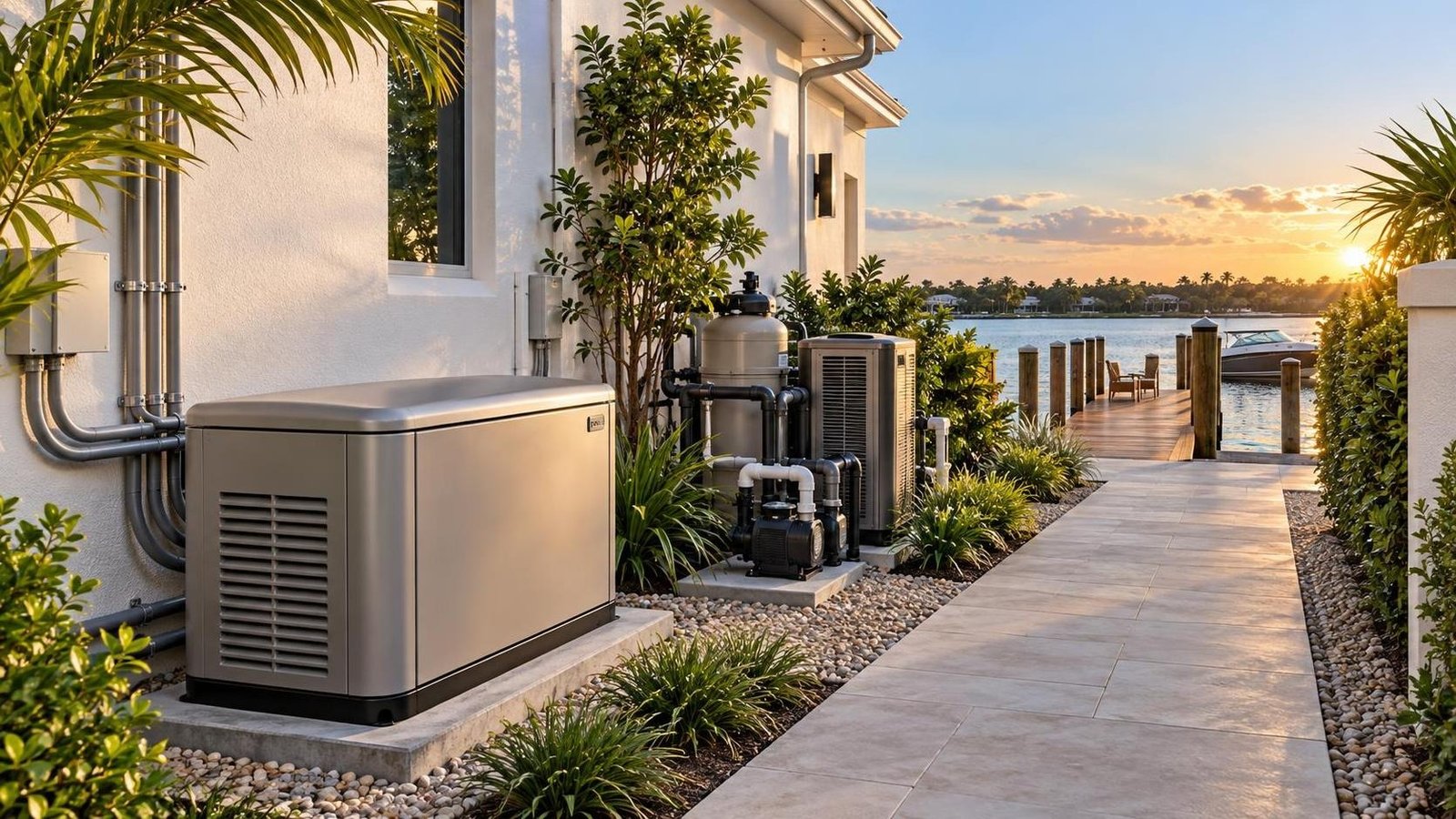
If a generator fuel line, seawall drainage pump, and pool heater share one narrow equipment corridor, document them as one connected system before listing. Separate receipts are not enough. Buyers need to understand the route, service access, shutoffs, permits, drainage flow, and whether one repair could block or disturb another.
This is a classic waterfront-home issue: every component may work, yet the arrangement still creates questions. A generator technician needs one kind of access. A pool contractor needs another. A seawall or drainage crew may need to move equipment through the same side yard. The seller’s job is not to promise perfection; it is to replace confusion with a usable record.
Make a corridor map before you make a marketing claim
Start with a simple site-plan sketch. Mark the house wall, fence and gate, pool enclosure, generator or generator connection, fuel source and visible route, pool heater, pumps, drainage discharge, seawall, dock, electrical equipment, hose bibs, and the clear walking width through the corridor.
Then walk the route with the contractors who service those systems. Ask where they need to stand, which panels or covers must open, what cannot be blocked, and how replacement equipment would enter or leave. A listing photo cannot answer those questions.
My recent article on preserving a dock service path instead of maximizing a pool deck explains why access should be treated as an ownership asset. The same idea applies to a side yard full of equipment.
Gather the generator records as a complete package
Collect the purchase and installation invoice, manufacturer and model information, warranty, fuel-system records, electrical permit and final inspection where applicable, transfer-switch documentation, startup and maintenance reports, service provider details, and operating instructions. If components were added in different years, create a timeline.
Do not describe fuel type, tank ownership, capacity, runtime, or whole-home capability from memory. Verify those details in the equipment and supplier records. If a tank is leased or serviced under an agreement, identify what transfers and what the buyer must establish after closing.
FEMA’s generator safety guidance identifies carbon-monoxide, fire, and electrocution hazards and recommends qualified installation of appropriate home transfer equipment. That guidance is written broadly, but it supports an important seller principle: never turn generator marketing into casual safety advice. Give buyers records and access to qualified professionals.
Explain the seawall drainage pump without overstating it
A seller may know the pump “keeps the yard dry,” but that phrase leaves too much unanswered. Identify what area the pump serves, where water enters, where it discharges, how it is powered, who installed or serviced it, and what maintenance has been performed. Include invoices, photos, replacement dates, control information, and any permit or engineering record tied to the work.
Do not claim the pump solves flooding, protects the seawall, or guarantees drainage. Heavy rain, groundwater, tide, grading, pool discharge, roof runoff, seawall condition, and power loss can interact. A qualified drainage or marine professional should explain the specific system.
Florida DEP says its Environmental Resource Permitting program regulates activities in, on, or over surface waters and wetlands and certain activities that alter surface-water flows. The DEP program overview is a useful starting point, but sellers should verify the actual property and work with the appropriate local, state, or water-management authority rather than guessing from a general page.
Give the pool heater its own service history
The pool heater file should include installation and permit records where applicable, equipment labels, warranty, fuel or electrical information, controller instructions, service invoices, and any plumbing changes. If the pool system shares controls, power, fuel routing, or physical space with the generator equipment, show that on the corridor map.
Before listing, have the system operated by the appropriate professional if service is overdue or the seller cannot explain its condition. Do not advertise exact remaining life or operating cost. The buyer’s temperature preferences, energy source, pool cover, pump schedule, season of use, and maintenance habits will influence the experience.
Find the conflicts before the inspection period
Walk through ordinary service tasks. Can the generator cover open fully? Can a pool technician remove the heater panel? Can the drainage pump be lifted or replaced without disconnecting unrelated equipment? Can a worker carry a large component through the gate? Is the fuel route protected from storage and landscaping work? Does standing water collect around electrical or mechanical equipment?
Also look above and below. Roof runoff, low branches, irrigation spray, buried utilities, drain lines, and roots can matter even when the walking surface looks clear. If you do not know what a pipe, cable, or box serves, label it as unknown and call the right professional. Do not invent an explanation for a buyer.
This is where a seller can gain leverage before listing. A modest repair, new label, updated panel schedule, trimmed planting, or relocated storage item may make the corridor much easier to understand. A major reroute should be evaluated against cost, permit requirements, and actual buyer benefit rather than done for appearance alone.
Match every invoice to the physical equipment
Waterfront owners often inherit folders that contain receipts for equipment no longer at the house. Match model and serial numbers, contractor names, installation dates, and locations. Put superseded documents in a separate historical section so the buyer does not mistake them for the current system.
Use the Brevard County building permit search as a starting point for county records. Depending on jurisdiction and work, other agencies may hold relevant information. A missing online record is not proof that work was improper, and a permit entry is not a warranty of present condition. Resolve discrepancies with the correct authority and licensed professional.
If dock electrical or waterfront work lacks a clear paper trail, address that question separately. My guide to handling unclear dock-electrical records before a Merritt Island sale explains why an estimate is not always a substitute for correction.
Separate storm readiness from flood certainty
A generator and drainage pump can support preparedness, but neither changes the property’s official flood map or guarantees uninterrupted protection. The FEMA Flood Map Service Center is the official public source for National Flood Insurance Program flood-hazard information. Buyers should check the address and obtain property-specific insurance guidance.
Sellers should gather any elevation certificate, flood-policy information they are willing and able to share, drainage reports, prior repair invoices, and known history requested through the disclosure process. Do not market the generator or pump as a substitute for flood insurance, evacuation planning, or professional evaluation.
Also document what happens if utility power is lost. Is the drainage pump connected to backup power? If so, how was that designed and tested? If not, say so clearly. Never imply the generator backs up equipment merely because the devices sit near each other.
Photograph access, not just equipment
For the seller file, take wide photos from both ends of the corridor, then closer photos of labels, shutoffs, service clearances, gates, drainage inlets and outlets, and the waterfront edge. Photograph after removing loose personal items, fuel containers, hoses, toys, and landscaping tools that hide the layout.
Keep safety and privacy in mind. Do not publish security codes, account numbers, detailed fuel-supply vulnerabilities, or unnecessary close-ups of controls. The detailed file can be shared appropriately during the transaction; the listing should communicate organized maintenance without exposing sensitive information.
My article on pool drainage, seawall weeps, and dock conduit records is a useful companion because it shows how several waterfront systems can meet at one edge without being interchangeable.
Repair, disclose, or obtain an estimate?
Repair active safety problems, leaks, damaged wiring, failed equipment, or known defects through qualified professionals. Disclose material facts accurately. Obtain estimates when the seller is not completing a non-emergency project and a realistic scope will help buyers evaluate it.
An estimate is most useful when the contractor can access the area, identify assumptions, separate required correction from optional improvement, and explain whether other equipment must move. A vague allowance based on a photo can create more disagreement than clarity.
There is also a point where the seller should stop adding upgrades. If every system functions, records are clear, access is practical, and the remaining issue is cosmetic, organizing the file may deliver more value than rebuilding the side yard to look cleaner.
My Merritt Island seller packet
- One corridor map with equipment, fuel route, drainage path, shutoffs, gates, and waterfront access.
- A dated timeline of generator, pool-heater, pump, seawall, and electrical work.
- Invoices, permits and finals where applicable, warranties, model information, and service contacts.
- Redacted fuel-supplier or equipment-ownership records and clear transfer instructions.
- Professional notes for any unknown line, shared control, or unresolved condition.
- Wide and close photographs that show both equipment and working clearance.
- Flood and elevation records kept separate from claims about pumps or backup power.
- A list of fixtures and controls that convey with the property.
- Written estimates for known work the seller will not complete before closing.
Bottom line
When three important systems share one narrow corridor, buyers are not only evaluating whether each one turns on. They are evaluating whether the house can be serviced safely and predictably after they own it.
Show them the route, the records, the access, and the limits of what you know. Correct active problems, avoid sweeping performance promises, and present the equipment as one coordinated ownership story. That preparation can keep a complicated waterfront feature from overwhelming an otherwise strong Merritt Island listing.
If you are preparing to sell a Merritt Island canal home, I can help you organize the property file, identify the professionals who need to answer technical questions, and present the improvements without overpromising. Reach out for a no-pressure conversation with Carrie Liotta, Space Coast REALTOR® with REAL Broker, through 321 Coastal Living. Your next chapter starts here.
