

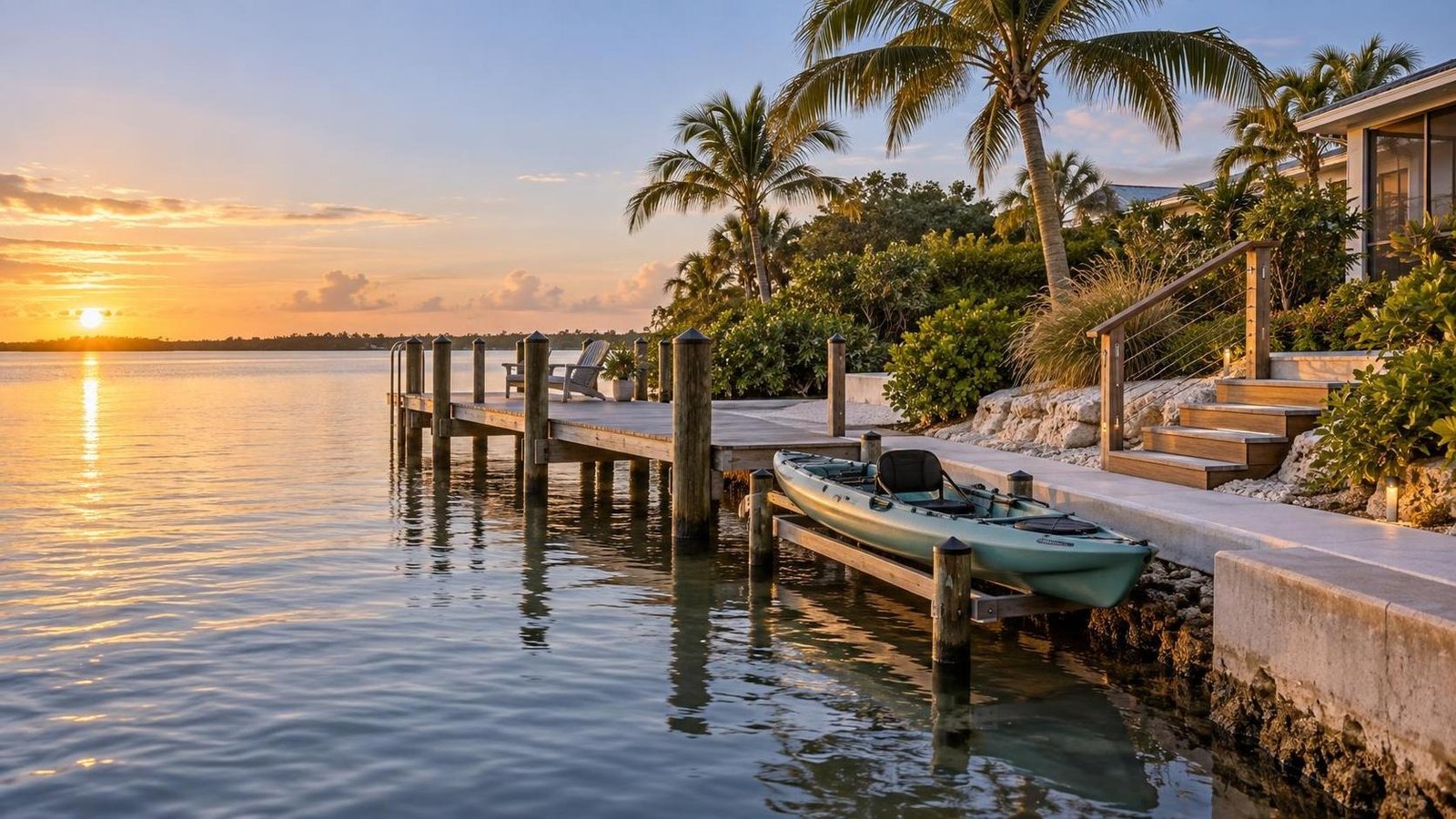
Private Kayak Launch or Shared Seawall Steps: What Should Merritt Island Canal Buyers Pay For?
By Carrie Liotta, Space Coast REALTOR® with REAL Broker | Published September 21, 2026
I would pay more for a private kayak launch only when it is permitted or clearly lawful, safe at the water levels you expect, and easy to reach with the kayak you actually own. Well-documented shared steps can be the better value, but only if access, maintenance, liability, and replacement duties are recorded and practical.
This is not simply a choice between “private” and “shared.” A sloped launch may look ideal but be slick, steep, unpermitted, or unusable at low water. Shared seawall steps may be sturdy and convenient but create conflict if the owners never agreed who replaces a corroded handrail or controls access. A dock ladder can work beautifully for swimming and still be awkward for launching a fishing kayak.
On Merritt Island, I want canal buyers to evaluate the entire trip from storage to water: how you carry the boat, where you stage it, how you step down, what happens at different water levels, and whether the legal paperwork matches the physical setup.
Start with the kayak and the person launching it
A lightweight recreational kayak is a different problem from a wide fishing kayak with a pedal drive, battery, crate, rods, and electronics. A paddleboard is different again. Before assigning a premium to any launch, imagine one person moving the fully rigged craft from the garage or side yard to the water.
Measure the narrowest gate, the turns around pool equipment, the drop at the seawall, and the staging area beside the canal. Look for a place to set the kayak without blocking a shared walkway. If the launch requires lifting the bow over a fence, crossing pavers that become slippery, or balancing equipment on seawall steps, the feature may not serve the lifestyle promised in the listing.
I also ask who will use it five years from now. A vertical ladder may be fine for an athletic owner today but less practical for aging knees, a child, or a guest. The best access is not the most elaborate structure; it is the route your household can use repeatedly without improvising.
A private launch must be more than private-looking
“Private” should mean the buyer controls lawful access from the parcel, not merely that the structure sits behind the fence. Ask for the survey, permits, plans, final approvals, contractor invoices, and any shoreline or submerged-land authorization. Compare the drawing with what is physically present.
Florida’s Environmental Resource Permitting program covers activities that alter surface-water flows and describes agency review for docking facilities, boat ramps, dredging, and related water work. DEP or a water management district may process an application depending on the activity and operating agreement. That is why “the neighbor built one” is not permit evidence for your parcel.
The state’s ERP-focused Map Direct can be a research lead, but a map result should not be treated as a complete approval file. Confirm the structure with the relevant state, water-management, county, and—when applicable—association records before relying on future repair or replacement rights.
Shared steps need a written operating system
A shared ladder or seawall stair can be perfectly workable when two owners have a clear agreement. I want that agreement to answer ordinary questions before they become expensive ones:
- Which parcels have the right to use the steps, landing, ladder, and approach?
- Where is the access route, and may either owner gate or block it?
- Who inspects, cleans, repairs, and replaces each component?
- How are routine and emergency costs divided?
- Who selects the contractor and approves the scope?
- What insurance or indemnity language applies?
- Does the agreement bind future owners?
- What happens if one party refuses necessary work?
The Brevard County Clerk’s Official Records resources provide access to an index that includes deeds, contracts, subdivision plats, and other real-estate-related instruments. The Clerk cautions that the online information is a public service and not a substitute for official records. For a purchase, have the title professional and, when needed, a Florida real estate attorney determine what is recorded and how it affects the property.
A friendly handshake between current neighbors is not the same as a durable right. The buyer needs to know what transfers with the home.
Inspect the seawall connection, not just the launch surface
Any step, ladder, platform, or ramp is attached to something. Look at the seawall cap, anchors, fasteners, brackets, nearby cracks, erosion, and drainage. Rust stains or movement do not diagnose the problem, but they tell you where a marine contractor or engineer may need to look.
If the access is shared, clarify whether a repair to the seawall cap supporting the steps is treated as a seawall expense, an access expense, or both. That distinction can matter when one owner needs the steps and the other cares only about shoreline integrity.
Watch the canal at more than one water level
A photo taken at an attractive water level may hide the hardest part of launching. Return at a different time if access is central to the purchase. Note where the lowest step sits relative to the water, whether the kayak can float parallel to the seawall, and whether wind pushes the boat beneath the dock or against pilings.
Do not accept a casual promise of depth or tide range. Canal conditions vary, and a kayak needs less water than a powerboat but still needs a safe entry path. Ask the seller how the access behaves through seasons and weather, then verify material claims with appropriate local professionals and your own observations.
The route beyond the backyard matters too. A perfect launch does not fix a canal that is unpleasant for the places you want to paddle. Consider boat traffic, wake, turns, bridge or culvert constraints, exposure to wind, and the distance to wider water. My broader Merritt Island public-ramp versus private-dock comparison helps put backyard access in the context of the overall boating routine.
Price safety and maintenance before paying the premium
For the private launch, ask a qualified marine contractor what routine cleaning, non-slip treatment, hardware replacement, and eventual rebuilding may involve. For shared access, ask the same question and then apply the written cost split. A fifty-fifty agreement is not reassuring if the structure is already near replacement and no money has been reserved.
Lighting, handrails, electrical sources, and trip hazards deserve attention. Do not run extension cords to the water or assume a nearby outlet is appropriate. If dock or landscape lighting serves the access, have the electrical work and shutoff arrangement evaluated. Salt air, moisture, and outdoor connections are not places for guesswork.
Insurance should be part of due diligence. Describe the private or shared structure accurately to the insurance professional and ask whether the carrier wants inspections, photographs, permits, or specific liability information. Do not promise yourself that an umbrella policy solves unclear ownership or deferred maintenance; coverage and legal responsibility are separate questions.
When shared access is the smarter buy
I would favor the shared steps when they are solid, safely configured, clearly shown on the survey, supported by a recorded agreement, and paired with cooperative maintenance history. Shared access can preserve more yard, avoid duplicate structures, and reduce the buyer’s acquisition premium.
The strongest shared setup has more than a document. It has invoices, consistent cost sharing, a designated access path, and owners who can explain how repairs were handled. Read the details of due diligence when waterfront access comes through an easement before treating any shared feature as equivalent to ownership.
I would discount shared access when the right is vague, the path crosses private entertaining space, the gate depends on one neighbor’s permission, costs have never been discussed, or the ladder serves only a use that does not match your kayak routine. Conflict risk is part of value.
When a private launch earns the extra money
A private launch can justify a premium for an owner who paddles several times a week, rigs a heavier fishing kayak, wants independent dawn access, or cannot safely use vertical steps. It becomes especially valuable when the path from storage to water is short, level, and wide enough for a cart.
I would still cap the premium at the value of the actual convenience plus the difficulty of creating a comparable lawful feature. If the structure needs rebuilding, lacks records, or consumes the only useful side yard, it may be a project disguised as an amenity.
Compare the launch against the home’s seawall, roof, flood and insurance profile, canal route, and major systems. A private ramp should not make a buyer overlook a weak shoreline file. The principles in my guide to recorded shared-lift and dock-maintenance agreements apply here too: access value is strongest when the physical condition and legal responsibilities tell the same story.
My offer-period checklist
- Carry or roll the actual kayak route from storage to water.
- Measure gates, turns, steps, landing width, and lifting height.
- Review the survey, title commitment, recorded easement, and maintenance agreement.
- Match permits and plans to the structure in the yard.
- Inspect the seawall cap, attachments, handrails, decking, and lighting.
- Observe access at a second water level or weather condition when possible.
- Obtain marine-contractor input on condition and likely repair scope.
- Give the complete file to the title, legal, and insurance professionals.
Put any material unanswered question into the contract and due-diligence plan rather than hoping it resolves after closing. The goal is not to eliminate every future repair. It is to understand the right, the condition, and the cost you are buying.
Buy the access you will confidently use
A private kayak launch is worth more when it provides verified, independent, safe convenience. Shared seawall steps can be the smarter value when the right is recorded, the maintenance system works, and the physical access suits your craft. Neither arrangement wins by label alone.
If you are comparing Merritt Island canal homes, I can help you organize the survey, permit, access, seawall, insurance, and practical-use questions before the view takes over the decision. I’m Carrie Liotta, Space Coast REALTOR® with REAL Broker, and I publish 321 Coastal Living for buyers and sellers who want the complete waterfront picture. Reach out for a no-pressure conversation. Your next chapter starts here.
