

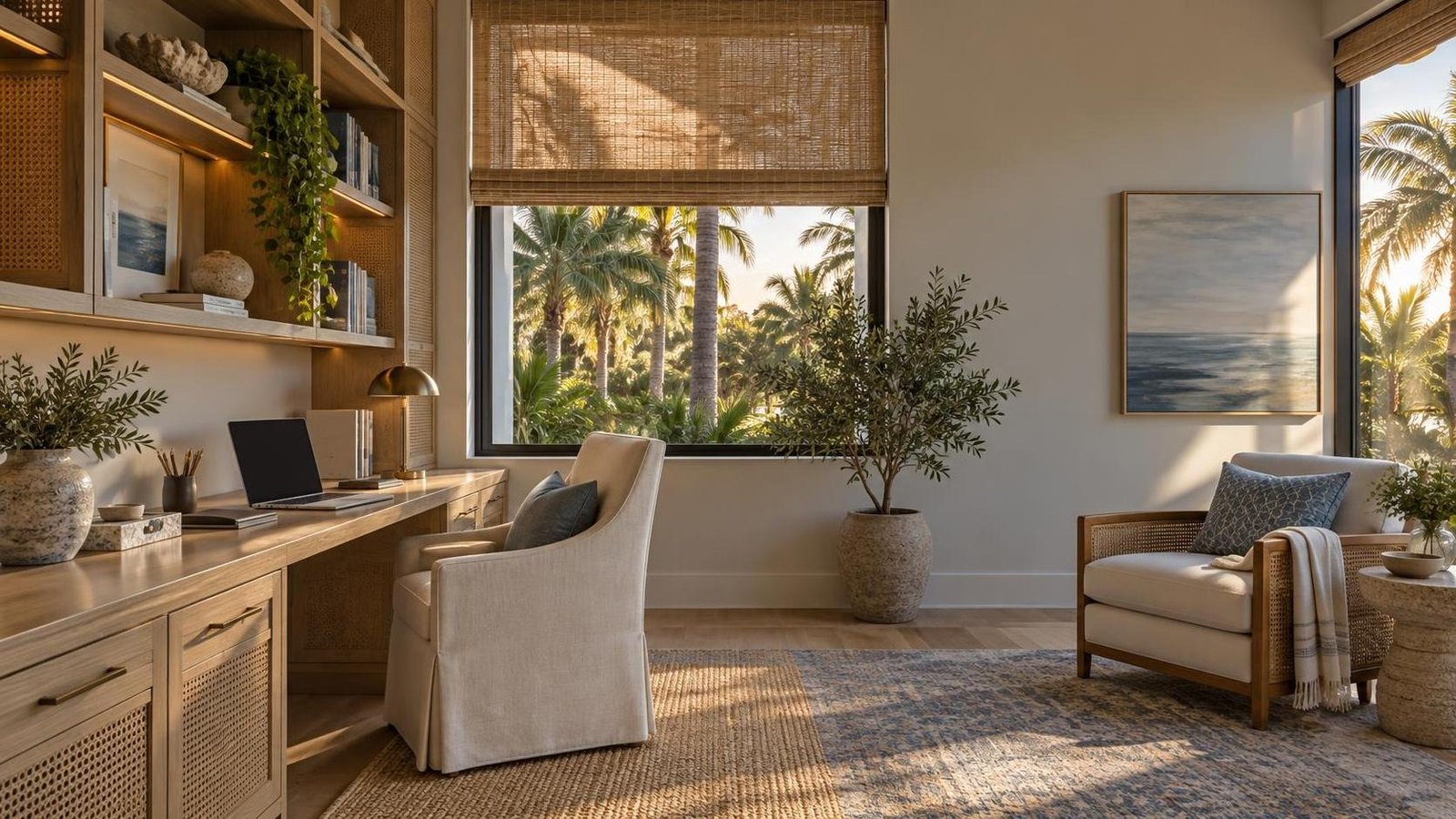
Shaded Office or Brighter Corner Room: Which Viera Home Is Better for Remote Work?
By Carrie Liotta, Space Coast REALTOR® with REAL Broker | Published September 21, 2026
If both rooms function well, I would usually choose the Viera home with the office that stays comfortable, quiet, and controllable through the afternoon—not automatically the room with the most glass. Natural light is valuable, but glare, heat, noise, and an overworked HVAC zone can cost more attention than a bright corner view adds.
This is one of those choices that looks simple in listing photos and becomes much more personal when you spend eight hours a day in the room. A shaded south-facing office may feel calm and consistent, while a corner office with two exposures may feel open and energizing. The better choice depends on when you work, how the windows perform, what shades or overhangs already exist, and whether the room is on the same HVAC zone as the rest of the house.
When I help remote-work buyers compare Viera homes, I do not reduce the decision to compass direction. I compare the whole workday: morning light, late-afternoon temperature, video-call glare, household noise, internet service, door placement, storage, and the cost of correcting whatever the room does poorly.
Start with the room you will actually use, not the one staged as an office
A builder plan may label a front room “study,” but that does not make it the best office for your job. A corner bedroom may give you two windows and a better background. A den near the kitchen may have a door but too much household traffic. An upstairs flex room may be visually perfect and noticeably warmer at 4 p.m.
Before comparing orientation, decide what your work requires. Do you spend the day on confidential calls? Do you need two monitors that cannot face glare? Will two adults be working from home at the same time? Is the office also expected to hold guests, exercise equipment, or school supplies? A shaded room with one well-placed window can outperform a dramatic corner room if it gives you a closable door, an uncluttered wall, and separation from the main living area.
If two dedicated workspaces matter more than the view from either one, my guide to choosing two separated Viera offices instead of one lower-cost flex room is the more useful starting point.
Why “south-facing” does not settle the cooling question in Florida
Orientation matters, but it is only one part of the heat equation. The size and number of windows, roof overhang, exterior shade, glass specifications, interior coverings, air leakage, ceiling height, duct design, and surrounding landscaping all affect how a room feels.
The Florida Solar Energy Center’s window guidance explains three useful ratings. Solar heat gain coefficient, or SHGC, describes how much solar heat a window allows inside. U-factor addresses heat transfer through the assembly. Visible transmittance describes how much daylight passes through. FSEC specifically notes that controlling solar heat gain is especially important in Florida, while visible transmittance helps explain why two windows can feel very different even when both provide a clear view.
That is why I want buyers to look beyond “impact glass” or “new windows” in a listing description. Ask for the permit, invoice, product approval, or window label if available. Impact resistance is important for storm protection, but it does not by itself tell you how much solar heat the glass admits. A corner office with two low-SHGC windows and effective exterior shade may stay more comfortable than a single-window room with older clear glass and no overhang.
Test both rooms during the hardest part of the day
If remote work is central to the purchase, try to schedule a second showing during the hours when you expect the problem to appear. For many rooms, that means the late afternoon. Do not rely only on the thermostat in the hallway. Stand in the proposed office for ten minutes with the shades in their normal position. Notice whether the glass radiates heat, whether the supply vent has strong airflow, and whether the temperature feels different near the desk location.
I also listen. Can you hear school pickup, pool equipment, a basketball goal, lawn crews, traffic, or the television from the main room? In Viera, the difference between a courtyard-facing office, a corner lot, a preserve edge, and a home near an amenity can change the sound pattern even when the floor plans are nearly identical.
Bring a simple checklist rather than turning the showing into a laboratory. Note the room temperature, glare on a laptop screen, window covering, exterior shade, vent location, door, nearby noise, and cell signal. Take the same notes in both homes. You are looking for a practical pattern, not trying to certify the building from one visit.
Compare correction costs before you pay a premium for the brighter room
Some weaknesses are inexpensive to fix. A properly chosen shade, desk repositioning, task lighting, or improved Wi-Fi access point may solve the problem. Other weaknesses can become real projects: replacing windows, correcting duct imbalance, adding a separate HVAC zone, upgrading insulation, or converting an open flex area into a private office.
I ask buyers to divide changes into three groups:
- Move-in adjustments: shades, curtains, lighting, a ceiling fan, desk placement, acoustic panels, or a mesh Wi-Fi node.
- Contractor evaluation: uneven airflow, a persistently hot room, noisy returns, suspected air leakage, or windows with missing performance documentation.
- Structural or association-dependent changes: adding a window, exterior awning, mini-split, new wall, or other visible alteration that may require permits and HOA architectural approval.
A brighter corner office is not a bad choice because it may need shades. The concern is paying a large purchase premium for light and then discovering that the room needs an expensive comfort solution. Price the correction before deciding the feature is worth more.
Use utility history as context, not as a promise
Ask for recent electric bills when the seller is willing to provide them, but interpret them carefully. The current owner may keep the thermostat warmer, travel frequently, charge an electric vehicle, heat a pool, or occupy fewer rooms than you will. A low bill does not prove that one office is efficient, and a high bill does not prove the room is the cause.
Use utility history to identify seasonal patterns and questions. Did consumption jump after a pool heater or EV charger was added? Does the seller use a fan because the office stays warm? Florida Power & Light offers Energy Manager and Home Energy Survey information for customers analyzing energy use and improvements. Confirm current details with FPL.
I would not try to assign a precise monthly dollar amount to “the corner window.” Too many systems interact. Instead, use bills, HVAC records, window specifications, and an inspection to decide whether the home has an explainable energy profile or an unresolved comfort problem.
The office should not make the rest of the house uncomfortable
A common workaround is lowering the thermostat until one warm office feels acceptable. That can leave bedrooms or living areas too cold and increase runtime for the whole system. During due diligence, ask the home inspector to note obvious temperature differences and visible duct or insulation concerns. If one room remains significantly different, an HVAC contractor can evaluate load, airflow, return-air pathways, equipment sizing, and whether zoning is appropriate.
Do not assume that a newer air conditioner automatically fixes room-by-room balance. The equipment can be young while a duct is restricted, a return path is weak, or a sunny room has more load than the original plan anticipated. Conversely, an older system with thoughtful shade and balanced airflow may keep the office comfortable. The records and actual performance matter more than one installation year.
Verify the digital side of remote work at the exact address
A beautiful office is not useful if the available internet service cannot support the household. Check the exact address on the FCC National Broadband Map, then confirm availability, plan terms, installation timing, and upload performance directly with the provider. The map is a screening tool, not a substitute for an order confirmation.
Inside the home, ask where service enters, where the router sits, and how many walls separate it from the office. Concrete block construction, a second floor, metal-backed insulation, and the distance from the equipment can all affect the network you experience at the desk. If both adults work remotely, test how the proposed rooms relate to each other and to the router location.
For a broader relocation framework, read my guide to Viera remote-work homes, exact-address internet checks, and airport access.
How I would choose between the two Viera homes
I would give the shaded office the advantage when it already provides privacy, consistent comfort, useful wall space, and enough natural light to prevent the room from feeling closed in. That choice becomes stronger if the brighter corner room has hard afternoon glare, weak airflow, traffic exposure, or a costly window problem.
I would choose the brighter corner office when the glass has appropriate solar performance, the shade is controllable, the HVAC keeps up without freezing the rest of the house, and the extra light genuinely improves the workday. A photographer, designer, or buyer who dislikes artificial light may value that room far more than someone who spends the day reading spreadsheets on two monitors.
Then I would step back from the office. Compare the complete monthly payment, district assessments, HOA obligations, roof and HVAC condition, insurance file, commute, and resale flexibility. An office is important, but it should not persuade you to ignore a materially weaker house. The same whole-property discipline applies when comparing Viera outdoor orientation and afternoon comfort.
A practical remote-work inspection plan
- Visit during the likely hottest or brightest work period.
- Place a laptop where the desk would go and check screen glare and video background.
- Look for window labels, permits, invoices, coverings, overhangs, and exterior shade.
- Compare airflow and temperature with nearby rooms without changing the thermostat.
- Listen for street, amenity, pool-equipment, kitchen, and household noise.
- Confirm exact-address internet and the equipment path to the office.
- Review utility history and HVAC service records for patterns, not guarantees.
- Price the likely fix before treating the room as a premium feature.
This process also helps sellers. If your Viera home has a bright office that stays comfortable, have the window and HVAC documentation ready. If the room depends on a particular shade schedule or smart thermostat setting, explain it honestly. Buyers respond better to a well-understood feature than to vague claims about “energy efficiency.”
The better office is the one you can live with every weekday
Between a shaded south-facing office and a brighter corner room, I would choose the space with the best combination of comfort, controllable light, privacy, connectivity, and correction cost. Direction is a clue; it is not the verdict.
If you are relocating to Viera and remote work shapes the home search, I can help you compare floor plans at the hours that matter, ask for the right records, and keep one beautiful room from distracting you from the total ownership picture. I’m Carrie Liotta, Space Coast REALTOR® with REAL Broker, and I publish 321 Coastal Living to help buyers make these decisions with local context. Reach out for a no-pressure conversation about Viera homes. Your next chapter starts here.