

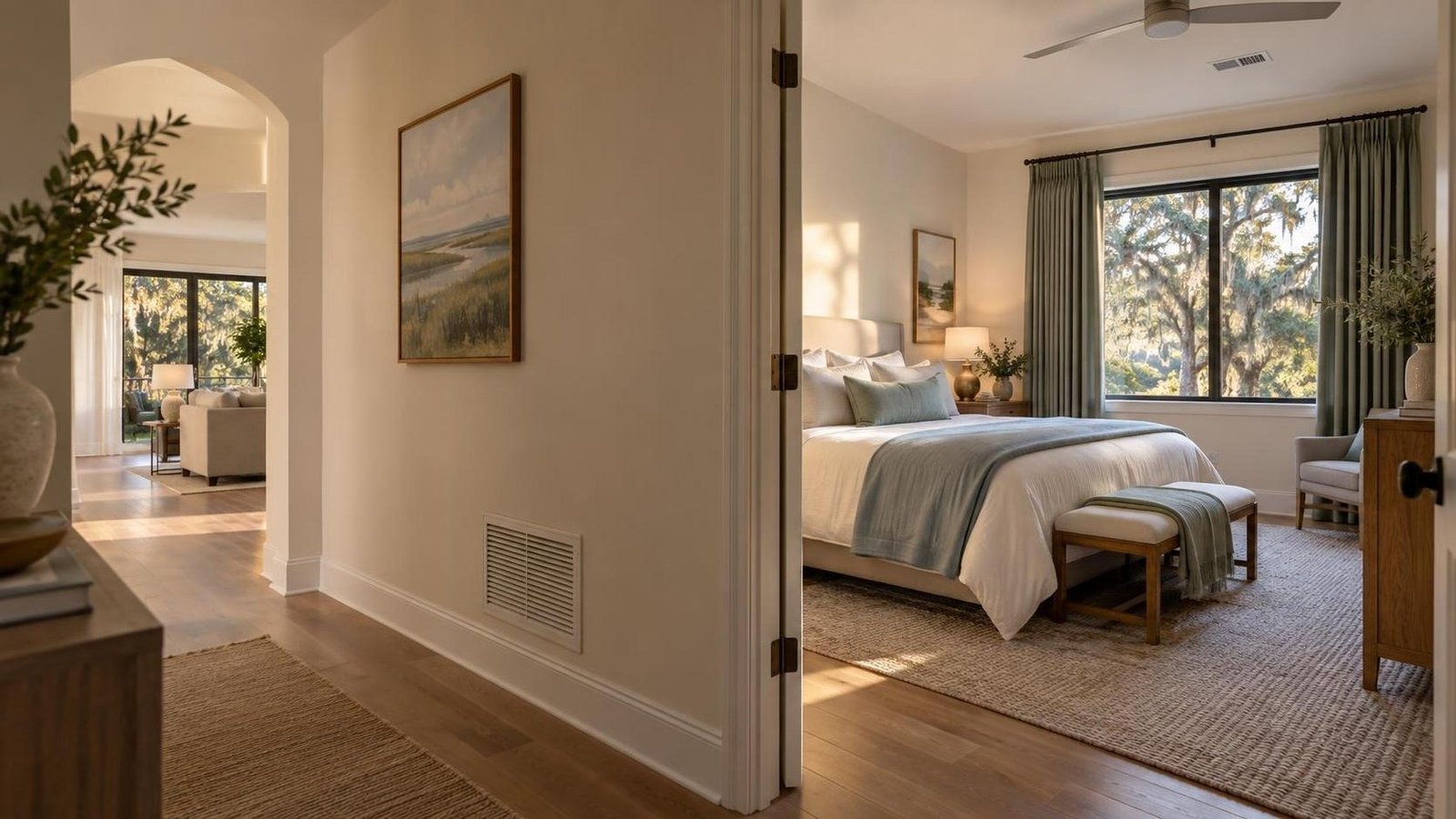
Split-Bedroom Layout or Quieter Rockledge Lot With Duct Repairs: Which Should Shift Workers Choose?
By Carrie Liotta, Space Coast REALTOR® with REAL Broker | Published September 19, 2026
Choose the quieter lot when outside noise cannot be corrected and the duct repairs are clearly scoped, affordable, and unlikely to reveal a failing HVAC system. Choose the split-bedroom home when household noise is the bigger sleep problem. For dual-shift households, I would pay for the quiet that is hardest to create after closing.
This comparison is more subtle than “better layout versus better condition.” A split-bedroom plan can separate one sleeper from kitchens, laundry, children, guests, and another adult’s routine. A quiet interior lot can reduce traffic, commercial, school, or I-95-related noise. Duct defects may be repairable, but they can also point to comfort, moisture, installation, or equipment issues that deserve professional review.
The winning home is the one that protects sleep without turning the monthly budget into an HVAC surprise.
Map both adults’ sleep and work cycles
Write the schedule for a normal week. Who leaves before sunrise? Who returns after midnight? When does each person sleep? Who cooks, showers, runs laundry, opens the garage, takes calls, or gets children ready while the other sleeps? A floor plan should be tested against these collisions.
On the split-bedroom home, trace the primary bedroom’s distance from the garage, kitchen, laundry, living room, front door, guest bath, pool equipment, outdoor condenser, and neighboring driveways. Separation from other bedrooms is helpful, but it does not guarantee separation from the loudest household functions.
On the quiet-lot home, identify why it feels quiet. Is it an interior street, deeper setback, masonry construction, mature landscaping, fewer rear neighbors, or simply a low-traffic showing time? Some advantages are permanent; others disappear at school pickup, lawn-service hours, weekend sports, or a nearby construction schedule.
Visit when the neighborhood is actually awake
Tour each home at the buyer’s sleep time and commute time. Sit silently in the intended bedroom with the HVAC on and off. Listen for road noise, aircraft, dogs, pool pumps, garage doors, landscaping equipment, basketball, delivery traffic, school routes, and mechanical vibration. Close doors, windows, shutters, and interior doors as they would be during sleep.
A phone sound meter can help you compare the same rooms consistently, but it is not a professional acoustic study. Weather, wind direction, furnishings, and one unusual vehicle can change the result. I care more about repeated observations than a dramatic single reading.
My article on quiet Rockledge streets versus faster I-95 access for healthcare shift workers explains why route convenience and daytime sleep should be tested together rather than treated as separate lifestyle questions.
Understand what “needs duct repairs” means
Duct repairs can range from accessible sealing and insulation corrections to damaged, undersized, disconnected, contaminated, poorly routed, or difficult-to-reach ductwork. The listing phrase is not a scope. Ask for the report, photos, contractor estimate, system age, service history, comfort complaints, moisture history, and any prior repairs.
A licensed HVAC professional should evaluate the complete system: equipment condition, airflow, supply and return design, static pressure where appropriate, temperature differences, duct leakage, insulation, condensate management, filter setup, accessible attic conditions, and room-by-room comfort. The goal is to learn whether the ducts are an isolated repair or part of a larger system problem.
ENERGY STAR’s heating and cooling guidance emphasizes professional evaluation, proper equipment, duct sealing, insulation, maintenance, and installation quality. For buyers, that means a newer air handler does not automatically make neglected ducts unimportant.
Do not confuse quiet air with poor airflow
A bedroom may seem peaceful because little air reaches it. That is not a comfort advantage. Spend enough time in each bedroom to notice temperature, humidity, airflow, odors, and cycling. Ask whether the seller uses supplemental fans, portable dehumidifiers, space heaters, blackout curtains, or closed vents to compensate for uneven performance.
Also listen for return-air noise, whistling grilles, rattling ducts, banging at startup, and vibration through walls. A repaired duct system should support sleep, not replace exterior noise with mechanical noise.
If the home has one HVAC system serving separated bedroom wings, ask how balancing works. If there are two systems or zones, verify that they are truly independent and documented. The comparison I recently wrote about a Rockledge split-bedroom layout and older HVAC offers a useful framework: floor plan and mechanical condition need one combined decision.
Check permits and insurance-sensitive systems together
Look for HVAC replacement, duct, addition, and renovation records through the appropriate jurisdiction. The Brevard County permit search is a starting point for county records, but a City of Rockledge address may require municipal records. Confirm jurisdiction and final status rather than assuming an online gap means no record exists.
The HVAC system also belongs in the broader insurance picture. The Florida Department of Financial Services four-point inspection guide explains why HVAC is reviewed alongside roof, electrical, and plumbing. A buyer should not spend the repair reserve on ducts before understanding whether another major system may require attention.
Price the repair with uncertainty included
Obtain a written scope from a qualified contractor during due diligence. Ask what is included, what remains concealed, whether attic access is adequate, whether drywall or insulation work is likely, whether equipment capacity is appropriate, and what testing confirms completion. Clarify permit needs, timeline, warranty, and whether the home can remain occupied.
A seller credit may help, but it does not create contractors, solve access, or guarantee the first estimate covers concealed conditions. Build a contingency into your reserves. If the quote assumes easy attic access but the system runs through tight chases or an addition, ask what happens when the work is opened.
Compare that repair cost with the cost of improving sleep in the split-bedroom home. Better windows, door seals, solid-core doors, rugs, landscaping, and schedule changes can reduce some noise. They cannot relocate a highway, school entrance, active recreation area, or neighbor’s driveway.
Test the commute without sacrificing recovery
Dual-shift households often choose a convenient Rockledge route and then discover that the home is loud exactly when one person sleeps. Drive from the actual worksite at shift-change times, then spend time at the house during the intended sleep window. Include daycare, school, groceries, and Viera medical or service trips.
For some buyers, the split-bedroom house wins because it separates household schedules and preserves a shorter route. For others, the quiet lot wins because the duct work has a defined price while exterior noise has no practical cure. My Suntree guide to split-bedroom layouts and shift-work commutes reinforces the same lesson: count the full day, not just minutes behind the wheel.
Think about resale without pretending every buyer works shifts
A split-bedroom plan has broad appeal for guests, older children, multigenerational households, and private offices. A quiet lot also has broad appeal, especially when the home’s systems are documented and comfortable. Neither feature guarantees a premium.
The stronger resale file explains both the permanent advantage and the resolved risk. For the split-bedroom home, show how the layout functions without overselling quiet. For the quiet-lot home, retain duct invoices, permits, testing, warranties, and service records after repair. Future buyers will trust measured facts more than “completely silent” or “all new air.”
My decision checklist
- Map each adult’s work, sleep, cooking, laundry, garage, and childcare schedule.
- Visit during sleep hours, commute times, school traffic, and neighborhood activity.
- Test the intended bedroom with HVAC, doors, and windows in normal positions.
- Have a licensed HVAC professional evaluate equipment, ducts, airflow, moisture, access, and comfort.
- Review permits, service history, four-point concerns, and the other major systems.
- Obtain a written repair scope with contingency for concealed conditions.
- Drive every critical route at the time the household will use it.
- Choose the home whose hardest-to-fix problem is already solved.
Bottom line
If outside noise is the concern and the quiet lot genuinely performs across several visits, I would accept a clearly scoped duct repair over a permanently noisier location. If the neighborhood is quiet enough in both homes but household schedules collide, the split-bedroom layout may deliver more daily value. The answer depends on which noise follows you after closing.
I am Carrie Liotta, a Space Coast REALTOR® with REAL Broker, and I publish 321 Coastal Living to help relocating households compare the home they will actually live in, not just the listing sheet. If two Rockledge homes solve different parts of your shift-work routine, reach out for a no-pressure conversation about inspections, routes, repair scope, and resale. Your next chapter starts here.