

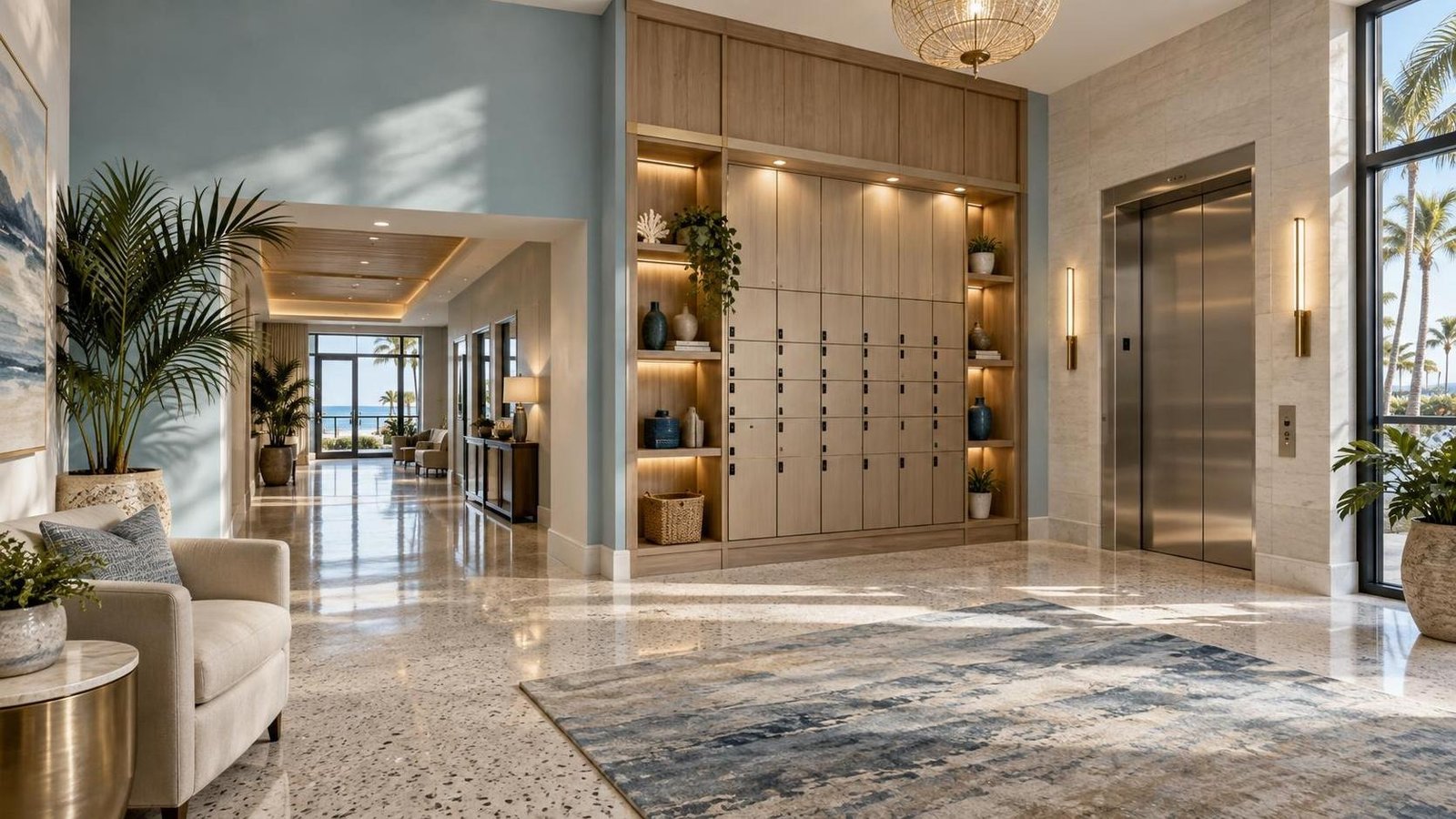
Storm-Protected Package Room or First-Floor Access: What Should Cape Canaveral Condo Buyers Choose?
By Carrie Liotta, Space Coast REALTOR® with REAL Broker | Published September 18, 2026 on 321 Coastal Living
Choose easier first-floor access when stairs, elevator downtime, groceries, pets, or frequent arrivals shape daily life. Choose the better package room when you are away often and the building has documented delivery, security, flood, and storm procedures. Do not pay for “storm-protected” until the association explains exactly what that phrase means.
This decision is less glamorous than choosing an ocean or port view, but it can define whether a Cape Canaveral condo feels easy to own. The package room solves absence: deliveries arrive when you are traveling or seasonal. First-floor access solves movement: you reach the unit without depending on an elevator. Both features can be valuable, but the building’s procedures matter more than the listing label.
Start with how often the condo will be occupied
A full-time owner who walks a dog several times a day may value a direct first-floor route. A seasonal owner who is gone for months may value controlled package acceptance, notifications, hold limits, and an authorized pickup process. A frequent traveler may need both but should decide which failure would create the larger problem.
Map one week of ordinary use. Count groceries, deliveries, mobility equipment, beach gear, luggage, pet trips, and visitors. Then map one month away. Who monitors the unit? What happens to packages after several days? Can a local contact enter under association rules? Does management accept refrigerated, oversized, high-value, or signature-required items?
The better feature is the one supported by a clear operating plan. A beautiful package room with strict short hold times may not help a snowbird. A first-floor unit with a long outdoor route may not feel convenient in wind-driven rain.
Ask what “storm-protected” actually means
The phrase might refer to interior location, impact-rated openings, elevated equipment, backup power for access controls, or simply a room away from exterior doors. Those are different facts. Request building plans or permits when available, door and window documentation, flood-elevation information, backup-power scope, and the association’s written storm procedure.
No package room should be marketed as a safe place for people or as guaranteed protection for property unless a qualified authority has made that designation. Ready.gov’s hurricane guidance emphasizes evacuation routes, official alerts, emergency plans, protected documents, and household supplies. A delivery amenity is not a substitute for personal storm preparation.
Ask what the association does before a named storm: Does it suspend deliveries? Move unclaimed items? Disable certain entrances? Require owners to retrieve packages? How are notices sent? The answer should come from current written policy, not a resident’s memory of the last event.
Trace the delivery from carrier to owner
Walk the complete route. Where does a carrier enter? Is staff present or is access automated? Are packages scanned, photographed, shelved, placed in lockers, or left in one room? Who handles overflow? Is there video coverage, and how long are recordings retained? What responsibility does the association accept for loss or damage?
Review the rules for guest authorization, third-party pickup, service providers, and emergency contacts. If an owner plans to rent the unit, verify whether tenants and guests can use the system and whether rental minimums or registration procedures affect access.
Do not photograph or publish access codes, security camera angles, staff schedules, or detailed vulnerabilities. The buyer needs to understand operations without compromising the building.
First-floor convenience has its own tradeoffs
A first-floor unit reduces elevator dependence and can simplify groceries, luggage, dogs, mobility needs, and move-in day. It may also offer faster access to parking, bike storage, beach exits, or amenities. Test the actual route; “first floor” does not mean “short walk.”
Then evaluate privacy, noise, lighting, foot traffic, gate sound, pool proximity, delivery traffic, and the relationship between windows and common walkways. Check door thresholds and whether the route is covered. For accessibility, measure rather than assume: parking space, curb cuts, door widths, elevator dimensions if still used, bathroom layout, and steps.
My guide to rideshares, guest parking, and gate access in Cape Canaveral condos explains why the curb-to-unit path deserves its own review.
Flood review should cover the unit and common areas
Do not reduce flood analysis to the unit’s floor number. Look at the building site, garage or surface parking, electrical and mechanical equipment, elevators, lobbies, storage, package room, stairs, and routes out. Use the FEMA Flood Map Service Center for official flood hazard products, then ask an insurance professional and the association about the exact building.
A higher unit may keep interior living space above some hazards while common systems remain exposed. A first-floor unit may have easier daily access but require more careful review of elevation, openings, flood-resistant materials, and insurance. Neither conclusion should be assumed from the floor label alone.
Read the condo documents for responsibility and authority
The declaration, bylaws, rules, budget, insurance records, meeting minutes, reserve information, management contract, and emergency procedures should explain who controls and maintains common areas. Florida Statute 718.111 addresses association powers and duties, common-element management, official records, insurance, and access. The property’s declaration and current records still control many practical details.
Search minutes for package theft, locker failures, water intrusion, elevator outages, access-control projects, lobby renovation, generator work, and rule changes. Ask whether the package room or first-floor route is part of a pending project or assessment. A new amenity can be attractive while its operating cost is still being learned.
When the package-room building is the better fit
I favor it for seasonal owners, frequent travelers, remote investors within permitted rental rules, and households that receive medication or frequent deliveries, provided the written process matches their absences. Strong operations include prompt notifications, reasonable hold procedures, controlled access, overflow planning, and a clear contact when something goes wrong.
The room deserves more weight when it is interior or otherwise thoughtfully protected, its access controls have a documented backup plan, and the association has tested storm and outage procedures. It deserves less when packages routinely spill into the lobby or management disclaims every practical responsibility.
Compare the amenity with the building’s financial file. A polished room cannot offset weak reserves, unresolved concrete work, inadequate insurance, or a major elevator problem. My June guide to Brevard beach condo financeability explains why the documents must support the lifestyle.
When first-floor access should win
The first floor is stronger for a buyer with mobility concerns, multiple daily pet trips, heavy beach gear, young children, or little tolerance for elevators. It can also help a full-time resident who wants a direct relationship to parking or outdoor amenities.
It should not win automatically. Test noise on a weekday and weekend. Stand in the bedroom while lobby doors, gates, elevators, carts, and pool areas are active. Review window treatments, walkway lighting, camera placement, and how close passersby come to the glass. Ask about pest service, drainage, prior water intrusion, and exterior-door maintenance.
If the first-floor unit still requires stairs from parking or the accessible route is indirect, the advertised convenience may be overstated.
Build a remote-ownership plan before closing
Seasonal owners need more than a package room. Identify an emergency contact, unit-check procedure, water shutoff plan, thermostat and humidity management, insurance requirements, storm preparation, vehicle rules, and access for contractors. Confirm what the association does and what remains the unit owner’s job.
Ask whether smart locks, leak sensors, door cameras, or remote thermostats are permitted. Document keys, fobs, parking credentials, and vendor authorization. If the building changes access systems while you are away, know how replacements are issued.
A quiet building farther from the busiest route may also matter. This comparison of a quiet Cape Canaveral condo and faster SR 528 access helps buyers place operations in the larger location decision.
My building-tour checklist
- Walk from every assigned parking space to the unit, package room, stairs, and elevator.
- Read package acceptance, notification, hold, overflow, and pickup rules.
- Verify what “storm-protected” means through documents and qualified explanations.
- Review backup power for doors, elevators, lighting, gates, and communications without assuming whole-building coverage.
- Check flood information for the site and common systems, not just the unit.
- Read recent minutes for elevator, access-control, lobby, package, and water-intrusion issues.
- Test first-floor noise, privacy, lighting, thresholds, and pedestrian traffic.
- Confirm guest, tenant, vendor, and emergency-contact procedures.
- Compare reserves, insurance, assessments, and financing along with the amenity.
Buyers who need secure storage and highway access should also review my guide to Cape Canaveral condo practicality for relocation buyers. Package handling is only one part of living well in the building.
The bottom line
A strong package room is a remote-ownership tool. First-floor access is a daily-mobility tool. Choose the package room when written operations protect your deliveries while you are away. Choose the first floor when reducing dependence on elevators improves nearly every day. In both cases, verify flood exposure, emergency procedures, common-element condition, and association finances.
I am Carrie Liotta, Space Coast REALTOR® with REAL Broker, and 321 Coastal Living helps buyers ask the practical questions before a Cape Canaveral condo becomes home. Reach out for a no-pressure conversation about Cape Canaveral condos. Your next chapter starts here.