

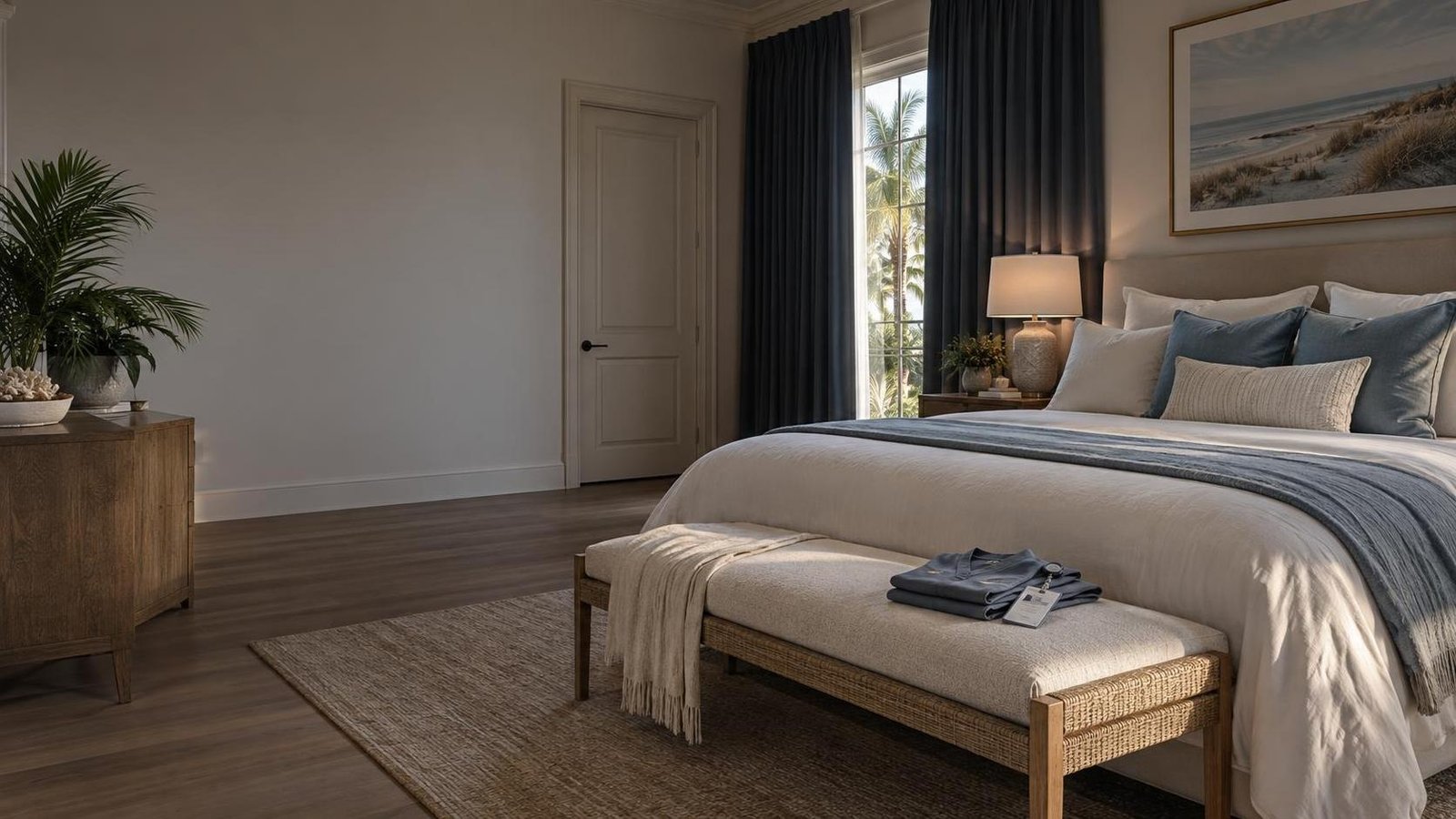
Dark, Quiet Suntree Bedroom or Shorter Hospital Route: What Should Shift Workers Choose?
By Carrie Liotta, Space Coast REALTOR® with REAL Broker | Published September 16, 2026
A Suntree healthcare relocator should usually prioritize the home that protects daytime sleep, provided the hospital route remains reliable and reasonable for the actual shift. A shorter drive cannot compensate for a bright, noisy bedroom every day. But a perfect sleep room is not a bargain if the post-shift commute is exhausting, unpredictable, or difficult for the rest of the household.
I compare both parts together: the route after a demanding shift and the room where recovery must happen. The right house may not be the closest to the hospital or the darkest during a ten-minute showing. It is the one that performs across a 24-hour schedule, including lawn crews, school traffic, deliveries, household noise, afternoon heat, and the drive home.
Start with the exact reporting point and shift
“I work for Health First” is not a complete commute description. Confirm the hospital, medical office, clinic, outpatient site, employee entrance, parking area, and reporting time. A Suntree buyer assigned to Viera Hospital has a different route pattern from someone reporting to Holmes Regional Medical Center near downtown Melbourne, and a rotating role may use more than one campus.
Use current employer location information, including Health First’s official pages for Viera Hospital and Holmes Regional Medical Center, then drive from the actual home at the shift change. Include neighborhood exits, parking, employee access, and the return trip. Do not rely on one midday navigation result.
Night shifts can avoid some daytime traffic and encounter other problems: dark roads, road work, reduced visibility, wildlife, event traffic, or a long quiet drive after fatigue sets in. Day shifts may overlap school and commuter traffic. On-call work adds the need for a route that feels simple when leaving unexpectedly.
Why sleep deserves equal weight
Shift-work fatigue is not merely an inconvenience. The Occupational Safety and Health Administration’s worker-fatigue overview explains that long hours and irregular shifts can contribute to fatigue and increase safety and health risks. OSHA also points healthcare workers to the NIOSH training for nurses on shift work and long work hours.
I am not giving medical advice or claiming that a particular bedroom solves shift-work fatigue. I am saying the home should not make a difficult schedule harder. A room that is dark, quiet, cool, and separated from household activity can support the sleep routine the worker and healthcare professional have chosen.
That value repeats every workday. A slightly shorter route may save a few minutes per shift; a poorly placed bedroom can expose the sleeper to hours of doors, voices, appliances, landscaping, pool pumps, traffic, and direct sun.
Test the primary bedroom at the time it will be used
A 6 p.m. showing does not reveal a 10 a.m. bedroom. Return during the expected sleep window when possible. Stand quietly with the HVAC cycling. Listen for Wickham Road, I-95, golf-course maintenance, school traffic, pool equipment, nearby construction, aircraft, dogs, delivery vehicles, and garage doors.
Look at window orientation and shade. East-facing glass may brighten early sleep; west-facing glass can add afternoon heat. Mature trees can help, but their condition, storm maintenance, and seasonal sun angle matter. A covered patio or adjacent room may buffer noise and heat, while a bedroom beside the driveway, kitchen, laundry, or living room may not.
Close the bedroom door and have another person move through the house. Run the shower, kitchen faucet, television, garage door, and laundry. In a split-bedroom plan, confirm whether the separation is meaningful or whether plumbing and common walls carry sound. My comparison of a split-bedroom Suntree home versus a shorter commute goes deeper into that layout question.
Darkness can be improved, but not every noise source can
Blackout shades, lined curtains, window film that complies with HOA rules, door seals, rugs, soft furnishings, and careful lighting can improve a room. Impact-rated windows or properly installed secondary window solutions may help with sound and storm protection, but they are significant projects that require product, permit, insurance, and association review.
Room-darkening is usually easier than changing the bedroom’s relationship to a busy road, neighbor’s pool, community gate, sports field, or early-morning maintenance route. Sound machines and ear protection may help some people, but buyers should not assume they will overcome a structural noise problem.
HVAC matters too. A bedroom can be visually perfect and still uncomfortable if it runs warmer than the rest of the house or the system cycles loudly. Ask the inspector and HVAC professional about supply and return air, insulation, duct condition, thermostat location, humidity, and the impact of closing the door for long periods.
Suntree varies more than the label suggests
Suntree includes established single-family neighborhoods, golf-oriented settings, villas, townhomes, and condo communities with different ages, associations, tree cover, road relationships, and floor plans. Two homes a short distance apart can perform very differently for a daytime sleeper.
An interior lot may be quieter than a home near a main entrance but add minutes to every departure. A golf-course view can feel open and serene in the afternoon while maintenance begins early. Mature shade can reduce glare and heat while adding tree-care questions. A villa may reduce exterior tasks but place bedrooms closer to shared walls or community activity.
This is why I avoid a blanket recommendation for “Suntree.” The buyer must test the address, room, association schedule, and route. My broader Suntree guide to Pineda access and night-shift quiet explains how two careers can pull the household toward different streets.
The shortest commute may still be the safer household choice
There are situations where the route deserves priority. A clinician with frequent on-call returns, unpredictable overtime, or multiple consecutive shifts may place exceptional value on a simple drive. A household with one car, daycare deadlines, or a second spouse commuting in the opposite direction may need the location more than the ideal bedroom.
A shorter route can also preserve time for sleep, meals, exercise, and family. The point is not that the bedroom always wins. It is that the commute should be measured door to reporting point, and the sleep room should be tested when the worker sleeps. Compare real burdens on the same weekly calendar.
For healthcare and aerospace households comparing several central Brevard zones, read my guide to neighborhoods near Health First and major Melbourne employers. It broadens the choice beyond Suntree when the route becomes the controlling factor.
Do a 24-hour household map
Write each person’s schedule in one column. Include the night worker’s arrival, meal, shower, sleep block, wake time, and return to work. Add the partner’s work, children leaving and returning, pets, deliveries, cleaning, lawn service, pool service, school buses, television, cooking, and garage use.
Then place the proposed bedroom within that movement. A room near the front door may receive every package. A room over or beside the garage may hear departures. A room behind the kitchen may catch dishes during the first sleep hour. A room near children’s bedrooms can help family connection on days off but increase daytime interruptions.
If two people work different shifts, look for two retreat spaces. The night worker may need the primary suite for daytime sleep while the day worker needs a separate bathroom, closet, and preparation area. A split floor plan, guest bath, pocket door, or secondary entrance can reduce friction more than an additional 300 square feet of open living space.
Budget the sleep improvements before making the offer
Create a realistic list: blackout window treatments, solid-core door, weatherstripping, soft flooring or rugs, sound control, HVAC balancing, smart thermostat or room sensor if compatible, landscaping for privacy, and any window replacement. Separate easy décor from permitted exterior work.
Ask the HOA about window appearance, film, exterior shutters, landscaping, fencing, and visible equipment. A buyer should not assume a bedroom can be changed in a way the community prohibits. If the solution depends on replacing windows, obtain insurance and contractor guidance during the inspection period.
Compare that project budget with the price premium for a house that already has a quiet, dark bedroom. Sometimes a less expensive, shorter-commute home can be improved easily. Sometimes the noise source makes the apparently cheaper home the worse long-term fit.
Protect resale flexibility
A quiet bedroom, practical commute, split layout, and documented storm protection appeal beyond healthcare workers. Future buyers may include remote workers, families with opposite schedules, retirees, or frequent travelers. The feature should be explained as flexible livability, not a room designed for one profession.
A house beside a busy road may trade at a discount even after sound improvements. A home with extreme blackout treatment can look closed-in during showings if natural light is not easy to restore. Choose improvements that can switch between daytime sleep and normal daylight use.
Commute resilience matters too. A buyer assigned to one campus today may change roles. A Suntree location with reasonable access to Viera, central Melbourne, Pineda Causeway, and I-95 can protect that flexibility better than a home optimized for one employee entrance.
My showing and route checklist
- Confirm the exact campus, employee entrance, parking, shift, call schedule, and likely future sites.
- Drive both directions at actual shift-change periods more than once.
- Visit the bedroom during the expected daytime sleep window.
- Test light, heat, HVAC, doors, plumbing, garage, laundry, and household sound paths.
- Identify outside noise that cannot be controlled by the owner.
- Price realistic blackout, sound, window, and HVAC improvements.
- Review HOA rules and service schedules that affect daytime quiet.
- Map the partner, children, pets, deliveries, and vendors across 24 hours.
- Keep a second quiet retreat available when schedules overlap.
- Consider resale to buyers who are not hospital shift workers.
Bottom line
For most Suntree healthcare relocators, I would choose the darker, quieter primary bedroom when the hospital route is still dependable. Restorative daytime sleep is a daily housing function, not a luxury finish. If the route becomes materially harder after a long shift or complicates the entire household, choose the shorter drive and confirm that the bedroom can be improved.
I can help you test both parts before the offer: the route at shift change and the room during the sleep window. Reach out to Carrie Liotta, Space Coast REALTOR® with REAL Broker, through 321 Coastal Living for a no-pressure conversation about relocating to Suntree and central Brevard. Your next chapter starts here.