
How Can a Remote Buyer Inspect a Brevard Waterfront Home With Confidence?
By Carrie Liotta, Space Coast REALTOR® with REAL Broker | Published September 14, 2026
You can inspect a Brevard County waterfront home remotely, but a standard inspection report and a quick FaceTime tour are not enough. The safest process combines a live, buyer-directed property walk-through; independent home and marine specialists; permit, survey, title, flood, and insurance review; waterway testing; and a final verification before your contract deadlines expire.
I treat remote waterfront due diligence as a team project with a written record. Every person has a specific role, every important condition gets photographed or recorded, and every unanswered question has an owner and a deadline. That does not eliminate risk, but it prevents distance from turning assumptions into facts.
Decide what must be true before the first showing
Before I walk a property for a remote buyer, I want a short list of nonnegotiables. Is the boat’s length, beam, draft, height, and loaded weight known? Is direct ocean access essential, or is the lagoon lifestyle enough? Must the dock, lift, pool, garage, or first-floor living space work on day one? What monthly insurance range keeps the home affordable?
Those answers tell me where to spend time. A buyer who owns a tall center-console needs different video and route questions than a paddleboarder. Someone relocating with pets may care about fencing and outdoor access as much as the seawall. The goal is not a generic tour; it is evidence tied to the way you plan to live.
Use live video, but control the route
A recorded listing video is marketing. A remote due-diligence walk-through should be slower, interactive, and imperfect. Ask to see the approach to the street, neighboring shoreline edges, drainage, roofline, exterior equipment, meters, electrical panels, under-sink areas, ceilings, windows, attic access, garage corners, pool equipment, seawall, dock, lift, and the view in both directions.
During the call, ask for close-ups and then wide context. A crack means little if you cannot tell where it is. Ask the person holding the phone to pause so the camera can focus, read model plates aloud, and capture still photographs separately. Note date, time, weather, tide or water condition, and any area that could not be accessed.
Sound matters too. Stop talking for a minute outside and inside. Listen for road, aircraft, boat, pump, HVAC, neighbor, or bridge noise. Open exterior doors and windows where appropriate. A remote buyer should hear the home rather than receive a running sales narration.
Keep the inspector independent from the tour
A licensed home inspector should perform the professional inspection even if I have documented the property carefully. The inspector evaluates the house; I help make sure your questions reach the right person and that scheduling happens before deadlines. Use Florida’s DBPR license verification service to confirm regulated professional credentials where applicable.
Attend the inspection by live video if the inspector permits it, but do not force the inspector to narrate every minute while working. A better arrangement is a focused video conference near the end: major findings, inaccessible areas, immediate safety issues, insurance concerns, and follow-up specialists. Request the written report and original-resolution photographs, not screenshots forwarded through text messages.
Add waterfront specialists based on the property
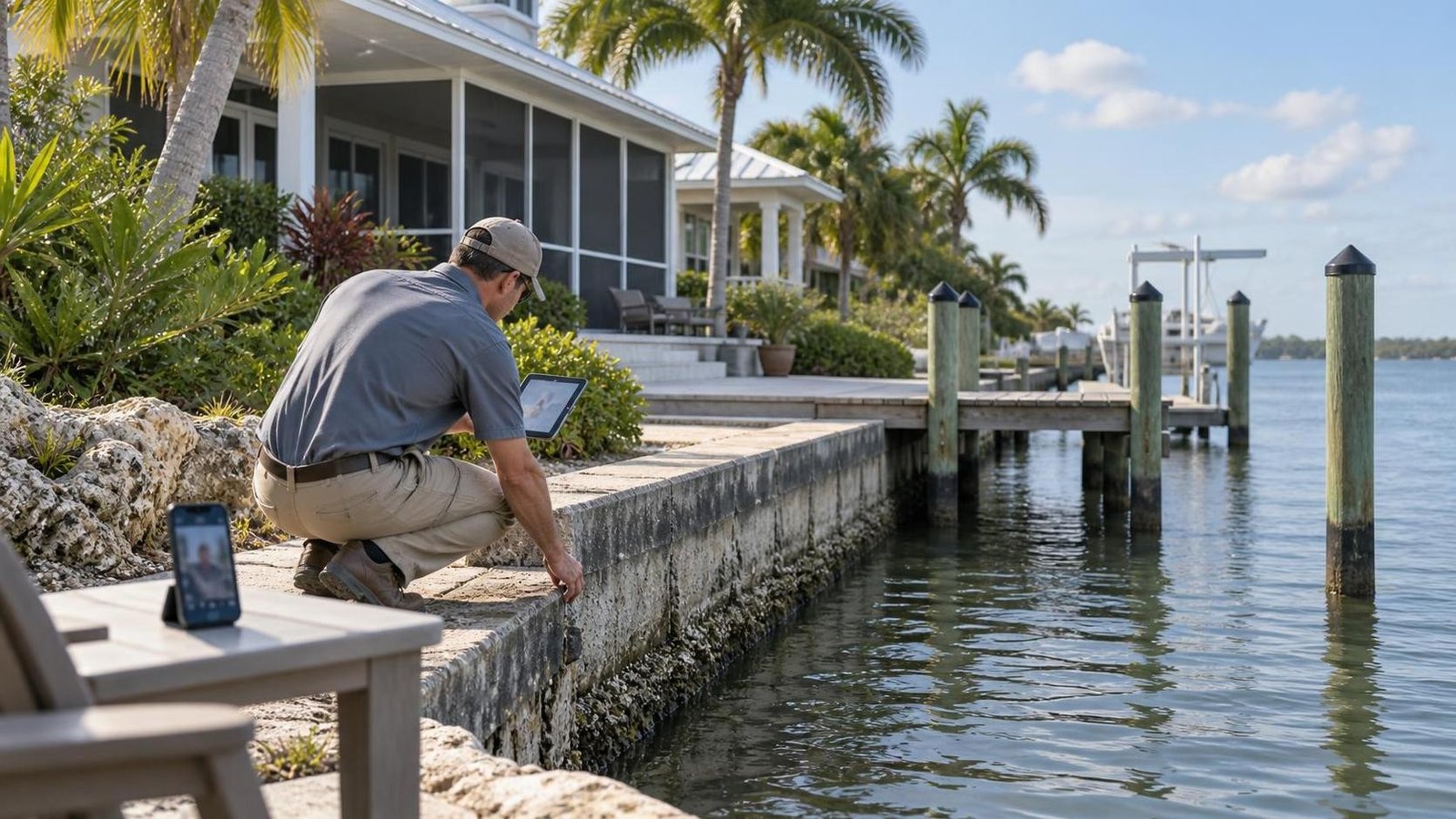
A general home inspection rarely answers every question about a seawall, dock, lift, shoreline, pool, or navigable route. Depending on the home, bring in a marine contractor or engineer, dock-and-lift specialist, electrician, pool professional, surveyor, roofer, plumber, septic contractor, or HVAC technician.
Ask each specialist for a written scope. For a seawall, that may include alignment, cap, panels, joints, tiebacks, drainage, soil loss, returns, and visible submerged conditions. For a dock, review pilings, framing, decking, hardware, utilities, and permitted configuration. For a lift, confirm rated capacity, installation, electrical work, operation, service history, and fit for the actual boat.
If the finishes are dated but the marine infrastructure is central to the price, read my guide to prioritizing a current marine inspection over interior updates. Remote buyers especially benefit from pricing big, location-specific components before debating cosmetic work.
Verify the water, not just the waterfront
A dock does not prove that your boat can use the route. Ask for available depth information, bridge and overhead constraints, canal width, turning room, lock or gate issues if relevant, no-wake zones, and the time to the water you actually intend to reach. Then have a qualified local captain or marine professional test the route when boating utility is essential.
Water conditions change, so no one should promise a permanent depth from one trip. Record the date, tide or water level, weather, route, vessel details, and observed limitations. My Merritt Island guide to bridge clearance and deeper-water needs explains why the boat’s real dimensions belong in the property search from the beginning.
Build a digital document room
Create one organized folder for the seller disclosure, survey, elevation certificate, title documents, permits, flood information, insurance quotes, prior claims information if provided, inspection reports, repair estimates, warranties, dock and lift records, seawall engineering, pool records, and association documents if applicable. Name files by date and source so you can tell a contractor estimate from a permit final.
Use the Brevard County building permit search as a starting point for county-jurisdiction records; properties inside a city may have municipal records instead. Missing online results do not settle the issue. Ask the correct jurisdiction about older files and have title, survey, and specialist findings reconciled with what physically exists.
Make an unresolved-items list next to the documents. If the dock plan shows a shorter platform than the current dock, assign that question. If the roof invoice and permit dates conflict, assign that question. Remote buying becomes risky when a thick folder creates the illusion that someone has compared the documents to the property.
Price flood and insurance before the inspection window closes
The FEMA Flood Map Service Center is the official public source for NFIP flood-hazard information. Use the exact address and save the effective map information, but do not stop there. Ask for an elevation certificate when available and obtain property-specific homeowners, wind, and flood guidance from licensed insurance professionals.
Send insurers the roof age and permit, wind mitigation, four-point information when relevant, opening protection, construction details, elevation documentation, occupancy plan, and the inspection issues that could affect underwriting. A quote based on incomplete information is not a dependable monthly budget.
If direct-water ownership is stretching the insurance range, consider whether nearby access can deliver the lifestyle with less infrastructure. I compare that alternative in my guide to kayak access, flood maps, and waterfront-adjacent homes.
Inspect the neighborhood at more than one hour
A remote buyer needs context outside the lot. Have someone drive the route at a workday commute time and again on a weekend. Record causeway approaches, school or launch traffic, low sections of road, nearby public access, boat ramps, commercial activity, and how vehicles are parked. Walk the street after rain when practical and legal.
Use maps for orientation, not judgment. Camera angle can make neighboring homes disappear and wide-angle lenses can exaggerate yard size. Ask for a continuous curb-to-water video and a slow 360-degree view from the front, back, dock, and main living areas. Confirm compass direction so sunrise, sunset, and afternoon heat claims make sense.
When I would tell a remote buyer to travel
If boating fit, shoreline condition, a renovation plan, neighborhood noise, or a hard-to-reverse lifestyle tradeoff remains uncertain, a short trip before the contingency expires can be money well spent. I would rather see a buyer spend on travel than close on a home that cannot support the boat, feels exposed to noise, or needs a marine repair they never understood.
If travel is impossible, consider narrowing the acceptable property type or keeping stronger contract protections instead of asking video to do more than it can. Distance should make the process more conservative, not more casual.
My remote waterfront inspection sequence
- Write the must-be-true list for house, water use, monthly cost, and neighborhood.
- Complete a live, buyer-directed walk-through and save full-resolution evidence.
- Schedule the home inspection and a focused end-of-inspection video conference.
- Add marine, pool, septic, roof, electrical, or other specialists based on findings.
- Test boating utility with the actual vessel profile and documented conditions.
- Reconcile permits, survey, title, seller records, and what exists on site.
- Obtain insurance and flood guidance using the real property information.
- Review the neighborhood at relevant times and in relevant weather.
- Price immediate work, near-term reserves, and ownership logistics.
- Hold a final decision call before every contractual deadline.
The bottom line
A remote Brevard waterfront purchase can be careful and well documented. The key is refusing to let one person, one video, or one report stand in for the complete investigation. Verify the home, shoreline, dock, boat route, legal records, flood context, insurance, and neighborhood as separate parts of one decision.
I help relocating buyers coordinate that process without pretending a camera can replace every specialist or every in-person impression. Reach out for a no-pressure conversation about Brevard County waterfront homes for sale with REAL Broker. We will build a clear inspection plan around your deadlines, your boat, and the life you are moving here to enjoy. Your next chapter starts here.