

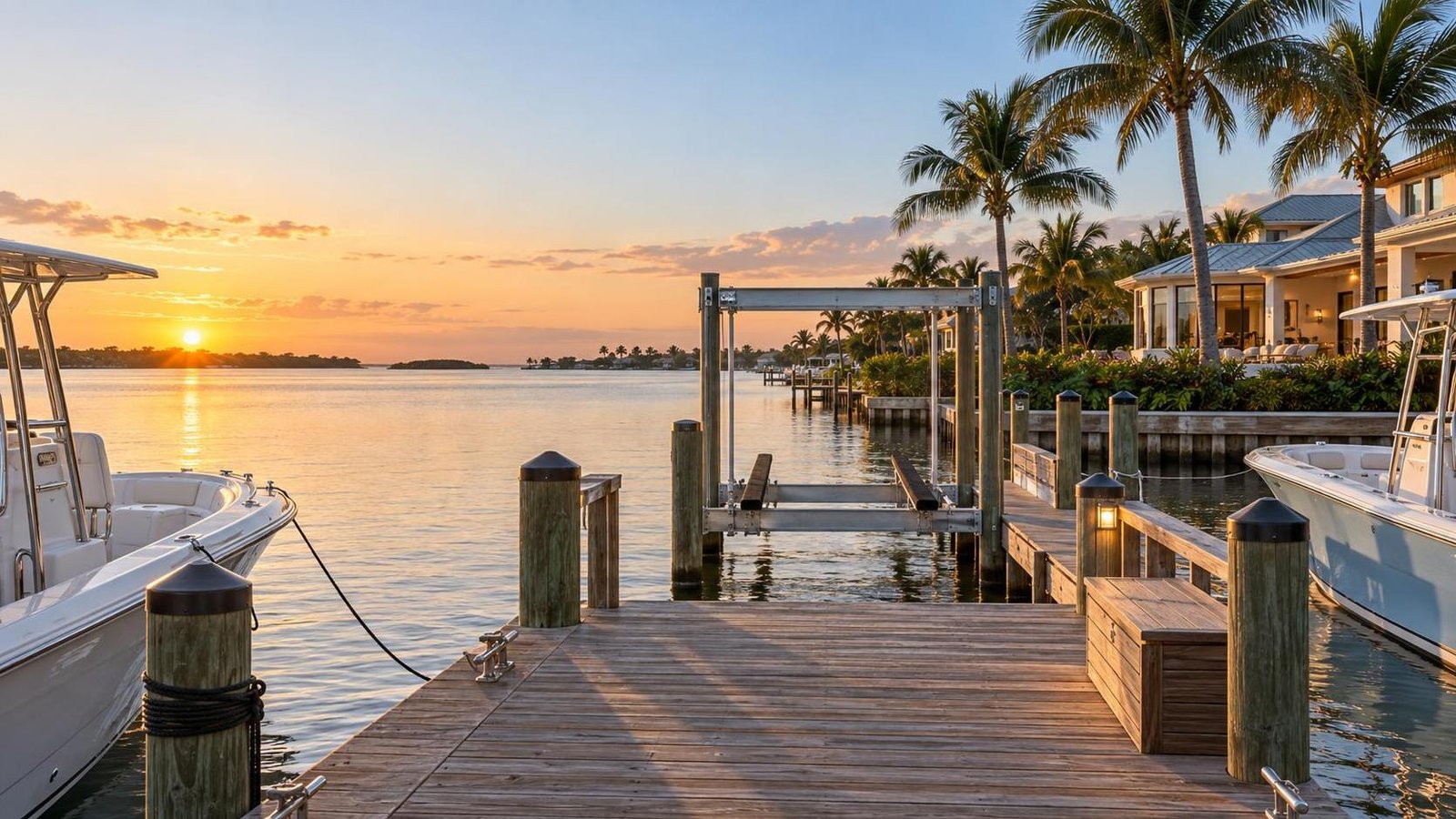
Should Merritt Island Canal Buyers Pay More for a Recorded Shared-Lift Agreement?
By Carrie Liotta, Space Coast REALTOR® with REAL Broker | Published September 13, 2026
Yes, a recorded, well-written dock-maintenance agreement can justify paying more for a Merritt Island canal home with a shared lift—but only after the buyer confirms that the agreement matches the deed, survey, permits, physical layout, and boat they intend to use. The paper does not make a worn-out lift valuable. What it can do is replace a fragile handshake arrangement with clearer rights, expenses, and decision rules.
When I help buyers compare canal properties, I treat shared waterfront infrastructure as a small partnership attached to the real estate. You may love the protected canal, the sunset angle, and the quick walk from the kitchen to the dock. Yet your experience after closing will depend on another household every time the motor needs service, a piling shifts, an electrical issue appears, or a storm changes the repair schedule. The premium belongs to certainty and usability, not simply to the words “shared boat lift” in a listing.
First separate ownership, access, and permission
These are three different things. A buyer may own an interest in the dock or lift, hold an easement allowing defined use, or merely have a neighbor’s current permission. Only the actual recorded instruments and title work can show what runs with the property. A seller’s long history of friendly cooperation is helpful context, but it is not a substitute for a right that survives a sale.
I start with the deed, title commitment, survey, recorded easements, any maintenance agreement, and any association declaration that affects the canal edge. The Brevard County Clerk’s Official Records page explains that the county records and indexes deeds, contracts, plats, surveys, condominium declarations, liens, and other real-estate documents. Its online index is a useful research starting point, but the Clerk warns that online records are not the official public records and that users are responsible for evaluating accuracy. For a purchase, I want the title professional and, when language is unclear, a Florida real-estate attorney involved.
A clean agreement should identify the benefited properties and the shared improvement precisely. If the description says “dock” but the lift was installed later, do not assume the lift is automatically covered. If the survey draws an easement but the actual pilings or lift extend outside it, that mismatch deserves attention before the inspection period expires.
What should the agreement actually answer?
The strongest agreement is not necessarily the longest. It is the one that answers ordinary questions before they turn into neighbor disputes. I look for practical language covering:
- Who may use what: which slip, lift cradle, walkway, utilities, and access path belong to each parcel or are shared.
- How costs are divided: equal shares, percentage shares, or user-specific expenses for routine service, insurance, electricity, storm preparation, and capital replacement.
- Who can authorize work: whether both owners must approve a contractor, what happens in an emergency, and whether one owner can perform necessary work after notice.
- What standard applies: licensed contractors, permits, marine-grade electrical work, insurance certificates, and documentation of completion.
- How scheduling works: access for service, haul-out timing, storm preparation, and temporary loss of use.
- How disagreements are handled: notice, estimates, mediation, attorney fees, or another stated process.
- Whether obligations bind future owners: the critical difference between a durable property arrangement and a personal promise between today’s neighbors.
Do not skim only for a 50/50 sentence. A cost split without a decision process can still leave both owners stuck. One person may want to patch a motor while the other wants replacement. One may own a heavier boat that accelerates wear. One may be absent for hurricane season. The agreement should tell you how those real situations are managed.
The lift still has to fit your boat and the canal
Legal clarity cannot fix a poor boating match. Confirm the lift manufacturer, rated capacity, cradle and bunk arrangement, beam clearance, motor and controls, piling configuration, available electrical service, and service history. Then compare those facts with the wet weight and geometry of the boat you own or realistically expect to buy. Fuel, batteries, engines, water, equipment, and accessories all affect actual load.
Next, look beyond the lift. Canal width, turning room, typical water conditions, bridge clearance, and the route to larger water can determine whether the property serves your boating life. My guide to Merritt Island canals for boats needing bridge clearance and deeper water explains why I never promise navigability from listing photos or a neighbor’s boat alone.
Have a qualified marine contractor inspect the shared components. I want separate observations on decking, fasteners, pilings, lift cables, cradle, motors, limit switches, electrical disconnects, receptacles, bonding, water lines, and signs of movement or corrosion. The general home inspector may identify visible concerns, but specialized waterfront infrastructure deserves specialized review.
Permits and records matter even when the lift works today
A shared lift that operates smoothly can still carry permit or boundary uncertainty. Ask for the original dock and lift permits, approved drawings, final inspections, contractor invoices, repair permits, warranties, and electrical records. Compare the approved configuration with what exists now. Added decking, a relocated lift, roof structure, utility line, or extra piling may not appear in the first permit file.
The Florida Department of Environmental Protection’s Environmental Resource Permitting page says DEP generally reviews docking facilities and attendant structures that are not part of a larger residential or commercial development, while operating agreements determine when DEP or a water management district processes a particular application. Federal review can also matter. The U.S. Army Corps of Engineers Jacksonville District Regulatory Division directs property owners to its Regulatory Request System to determine whether work in regulated waters needs authorization.
That does not mean every maintenance task requires the same approval. It means a buyer should not assume that replacing or enlarging a shared structure will be simple. Identify the jurisdiction and confirm the specific proposed work with the appropriate agencies before relying on a future project.
How I compare a documented agreement with an informal arrangement
Imagine two otherwise similar canal homes. Home A costs more and has a recorded agreement, a survey showing the access area, matching permits, recent lift service, and a reserve estimate for eventual replacement. Home B costs less and the seller says, “We have always split everything with the neighbor.”
Home A may deserve the premium because the buyer can evaluate an actual obligation. Home B is not automatically a bad purchase, but the discount must compensate for uncertainty. The neighbor can sell. Memories can differ. A repair can cost more than expected. A future lender, insurer, appraiser, or resale buyer may ask for documents that do not exist.
I would build a simple five-year ownership comparison. Add the purchase premium, expected routine service, near-term repairs, probable replacement reserve, insurance considerations, and legal cost if the agreement needs clarification. Then place a value on reliable access. A bargain shared lift that you cannot confidently use is not cheaper in any meaningful lifestyle sense.
For a related issue, read what to verify when Space Coast dock access comes through an easement. That article focuses on the right to reach and use the dock; this decision adds the ongoing partnership of operating and paying for a lift.
Write the offer around the uncertainty you still need to resolve
The offer should leave enough time to receive title materials, review recorded documents, examine the survey, obtain permits, inspect the marine improvements, verify boat fit, and request insurance feedback. If the agreement needs attorney interpretation, schedule that review early. A short inspection window disappears quickly when several offices and specialists are involved.
Possible outcomes are not limited to “buy” or “walk away.” The buyer might request missing records, negotiate a price adjustment, ask the seller to service a failing component, require a licensed estimate, or condition the decision on a written clarification executed by the affected owners. Any new or amended agreement needs proper legal drafting and recording; it is not a clause I would improvise in a showing.
Electrical condition deserves particular attention because water and improvised wiring are a dangerous combination. My comparison of documented dock electrical work versus a newer lift motor explains why visible equipment age is only one piece of a safer, insurable setup.
Red flags that should slow the decision
- The seller cannot identify who owns the lift or the landward access path.
- The recorded language refers to a dock but not the current lift.
- The survey, permit drawing, and physical structure do not align.
- One owner controls the electrical meter but no reimbursement method is stated.
- There is no process for emergency work or storm preparation.
- Service records show recurring problems, or there are no records at all.
- The neighbor describes the arrangement differently from the seller.
- The lift capacity is close to the boat’s claimed weight with no comfortable engineering margin.
- A planned replacement depends on unverified permits or both owners contributing immediately.
None of those facts automatically kills a deal. They change the price, terms, timing, and professional advice the buyer needs.
My bottom line
I would rather pay a rational premium for a shared lift supported by clear recorded rights, a matching survey, clean permit history, sound marine and electrical inspections, and workable cost rules than save money on a handshake that may not survive the next repair or sale. But I would not pay extra for paperwork alone. The agreement and the physical waterfront must work together.
If you are comparing Merritt Island canal homes, I can help you organize the right questions for the title company, attorney, surveyor, marine contractor, insurance professional, and permitting offices before your deadline. Reach out for a no-pressure conversation about Brevard County waterfront homes with REAL Broker. Your next chapter starts here.
