

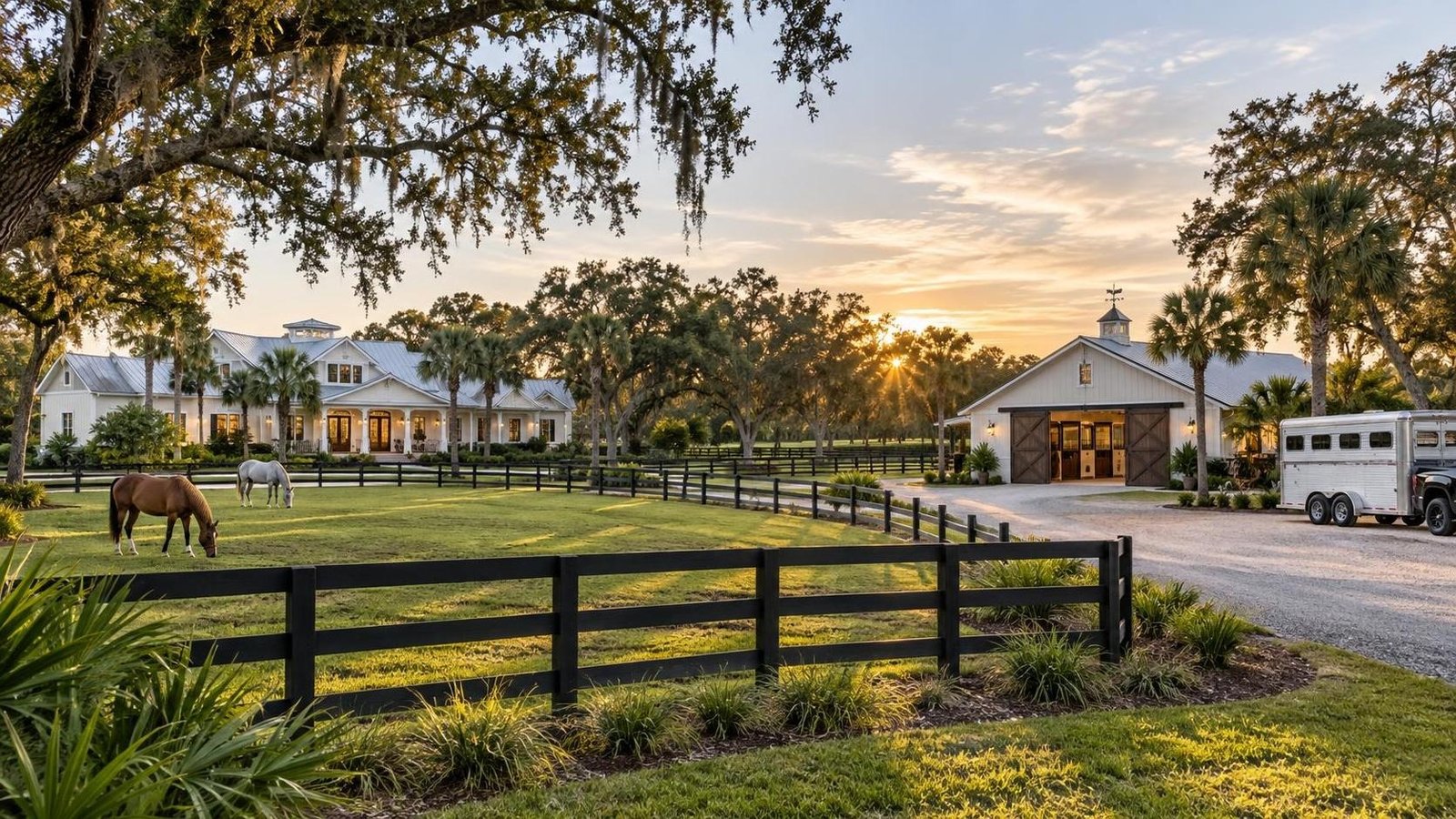
What Should Grant-Valkaria Horse-Property Buyers Verify Before Offering?
By Carrie Liotta, Space Coast REALTOR® with REAL Broker | Published September 12, 2026
Before buying a Grant-Valkaria property for horses, verify that the parcel legally supports your intended use, the fencing and shelters match permits and boundaries, the well can meet household and animal demand, and a loaded trailer can enter, turn, park, and leave in wet conditions. Acreage alone does not answer any of those questions.
I tell equestrian buyers to evaluate the property as an operating system. The house, pasture, drainage, water, septic, fencing, access, outbuildings, feed storage, manure plan, and emergency route must work together. A beautiful field can become an expensive compromise if the gate is too narrow, the dry lot holds water, or the workshop occupies the only practical trailer turn.
Confirm the horse use at the parcel level
Start with the property’s current zoning, future land-use designation, lot size, legal description, and recorded restrictions. Review the Grant-Valkaria Code of Ordinances and confirm the current interpretation with the town for the exact parcel and number of animals you intend to keep.
Ask about setbacks for barns, shelters, arenas, manure storage, fences, wells, and septic components. Determine whether commercial boarding, paid lessons, breeding, events, employees, signs, lighting, or an on-site business would be treated differently from keeping personal horses. Do not assume a neighboring stable proves your use is allowed; that property may have different zoning, acreage, approvals, or a lawful nonconforming status.
Use the Town of Grant-Valkaria’s official site to find current contacts and public information. Get important answers in writing when your offer depends on them, and involve a land-use professional or attorney when the code or history is unclear.
Match every fence and structure to boundaries and records
Order or review a current boundary survey. Walk each line and compare fence location, gates, shelters, barns, sheds, arenas, driveways, drainage features, ponds, wells, and septic components with the survey. Look for encroachments, gaps, shared fencing, utility easements, access easements, and fences that follow an old occupation line instead of the legal boundary.
Ask for permits, approved plans, final inspections, contractor invoices, and repair records for barns, workshops, roofs, electrical service, plumbing, wells, and other permanent improvements. Fence permits and standards can vary by location and design, so confirm the current requirement rather than assuming agricultural-looking fencing was exempt.
Inspect the fence as horse equipment, not landscaping. Check height, wire type, visibility, post spacing, sharp edges, sagging, tree damage, gate latches, corners, separation from roads, and whether adjacent animals can make nose-to-nose contact. A legal fence can still be unsuitable for your horses, and a safe-looking fence can still sit over a boundary.
Test the well for quality, flow, storage, and recovery
One clean glass of water does not prove that a well supports the house, troughs, wash area, irrigation, and summer demand. Ask for the well permit, drilling record if available, depth, pump age, pressure-tank information, treatment-equipment history, repairs, and recent lab results. Identify whether the same well serves household and animal uses or whether separate irrigation or livestock wells exist.
The Florida Department of Health’s private well testing guidance says Florida does not require sampling simply because a private home is sold, but it recommends testing for coliform bacteria, nitrates, and lead, with other tests considered based on location, depth, and condition. It specifically tells Brevard residents to contact the local county health department about local rules.
Use a certified laboratory and a qualified well professional. In addition to water quality, test pressure, flow, and recovery under realistic simultaneous use. Run a household fixture while filling a trough or using the wash rack. Ask how treatment equipment changes flow and what maintenance it requires.
Plan for power outages and fire response
Horses still need water when power is out. Learn how the well pump is powered, whether an existing generator connection is permitted, which loads it can serve, and how much stored water the property can safely maintain. Do not connect a portable generator through improvised wiring.
Ask the fire department, insurer, and appropriate professionals about access, water supply, address visibility, vegetation, and emergency planning. A long private drive can feel peaceful but may need adequate width, surface, overhead clearance, and turning space for emergency vehicles.
Keep the horse trailer accessible during storm preparation. A storage arrangement that requires moving multiple vehicles, equipment, or fallen branches before evacuation is not a reliable plan.
Protect the septic system from horse-property plans
Locate the tank, drainfield, and designated replacement area before deciding where trailers, trucks, barns, arenas, paddocks, or manure storage will go. Heavy vehicles and structures can conflict with septic components and service access. A broad lawn is not necessarily unused space.
Florida’s septic systems guidance explains that onsite systems are managed through design, permitting, inspection, and maintenance, and that local county health departments still handle permitting and inspections in Brevard. Review the approved septic plan and ask a licensed professional whether actual use and future plans fit the system.
My recent guide to saving septic replacement space before adding a workshop or pool applies just as strongly to barns, trailer pads, and arenas.
Drive the trailer test, not just the car test
Measure road width, shoulder, culvert, gate opening, driveway turns, overhead branches, grade changes, soft edges, and the turning area near the barn. Use the dimensions and turning needs of your actual tow vehicle and trailer. A two-horse bumper pull and a larger gooseneck do not use the property the same way.
Confirm that the access is public or supported by recorded private-road and maintenance rights. Ask who repairs potholes, grades the road, replaces a culvert, trims vegetation, and pays after storm damage. Review any weight, trailer, parking, or business-use restrictions.
Return after heavy rain when possible. Look for standing water, soft shoulders, washouts, rutting, pond overflow, blocked ditches, and the route water takes across pasture and driveway. Never drive onto saturated land without permission or damage a seller’s property; observe and hire the right specialist.
Evaluate trailer storage as part of storm and resale planning
Confirm where the trailer may legally sit, whether it is visible from the road, how it affects setbacks and easements, and whether it blocks emergency or septic access. Inspect the surface beneath it and the path to the road. A low grassy corner may be convenient during dry weather and unusable after days of rain.
Covered storage can protect equipment, but verify the carport or pole barn permit, wind design, anchors, roof condition, height, and insurance treatment. Ask whether gates and doors can be opened during a power outage and whether the trailer can leave without backing a long distance.
Drainage is a horse-health and property-value issue
Walk high and low points, pond edges, swales, culverts, roof discharge, barn aprons, gates, water troughs, and feeding areas. Soil that remains wet can affect footing, fence stability, vehicle access, insects, and daily care. Ask where manure and bedding are stored and how runoff is kept away from wells, surface water, neighbors, and septic areas.
Use the FEMA Flood Map Service Center for official flood hazard information, but do not stop at the mapped zone. Flood maps do not replace a topographic survey, drainage review, seller disclosure, insurance quote, or wet-season visit.
My earlier Grant-Valkaria acreage due-diligence guide explains why well, septic, and lagoon-area drainage need to be read together.
Inspect barns and outbuildings beyond the roof
Hire appropriate inspectors for foundations, framing, roof attachment, electrical service, plumbing, ventilation, corrosion, termites, moisture, fire separation, and permitted use. Check stall dimensions, doors, hardware, aisle clearance, kick surfaces, feed-room security, fan wiring, lighting, and hay-storage arrangement against your own safety standards.
Ask the insurance professional which structures and activities can be covered, whether animal liability is excluded or limited, and how replacement value is determined. A standard homeowners quote may not automatically cover every barn, trailer, tack item, business exposure, or animal-related claim.
Use a horse-property inspection team
- A general home inspector for the residence and visible systems.
- A surveyor for boundaries, improvements, easements, and site relationships.
- Well, water-treatment, and laboratory professionals for supply and quality.
- A septic professional for records, condition, location, and future capacity questions.
- Qualified barn, electrical, fence, drainage, and road specialists as the property requires.
- An insurance adviser familiar with acreage, outbuildings, animals, and trailers.
- An attorney or land-use professional when access, zoning, or recorded restrictions are unclear.
Also ask the seller for a maintenance index. My article on Grant-Valkaria seller records for wells, septic, culverts, and accessory buildings shows what a well-prepared file can include.
Bottom line for Grant-Valkaria horse-property buyers
The right horse property is not simply the largest parcel in budget. It is the parcel where legal use, safe fencing, reliable water, protected septic space, dry access, trailer movement, structures, insurance, and daily care all support one another.
If you are looking for acreage in Grant-Valkaria or South Brevard, I can help you organize the parcel questions and coordinate a practical due-diligence plan before your deadlines. Reach out for a no-pressure conversation about Brevard County acreage homes for sale with REAL Broker. Your next chapter starts here.
