

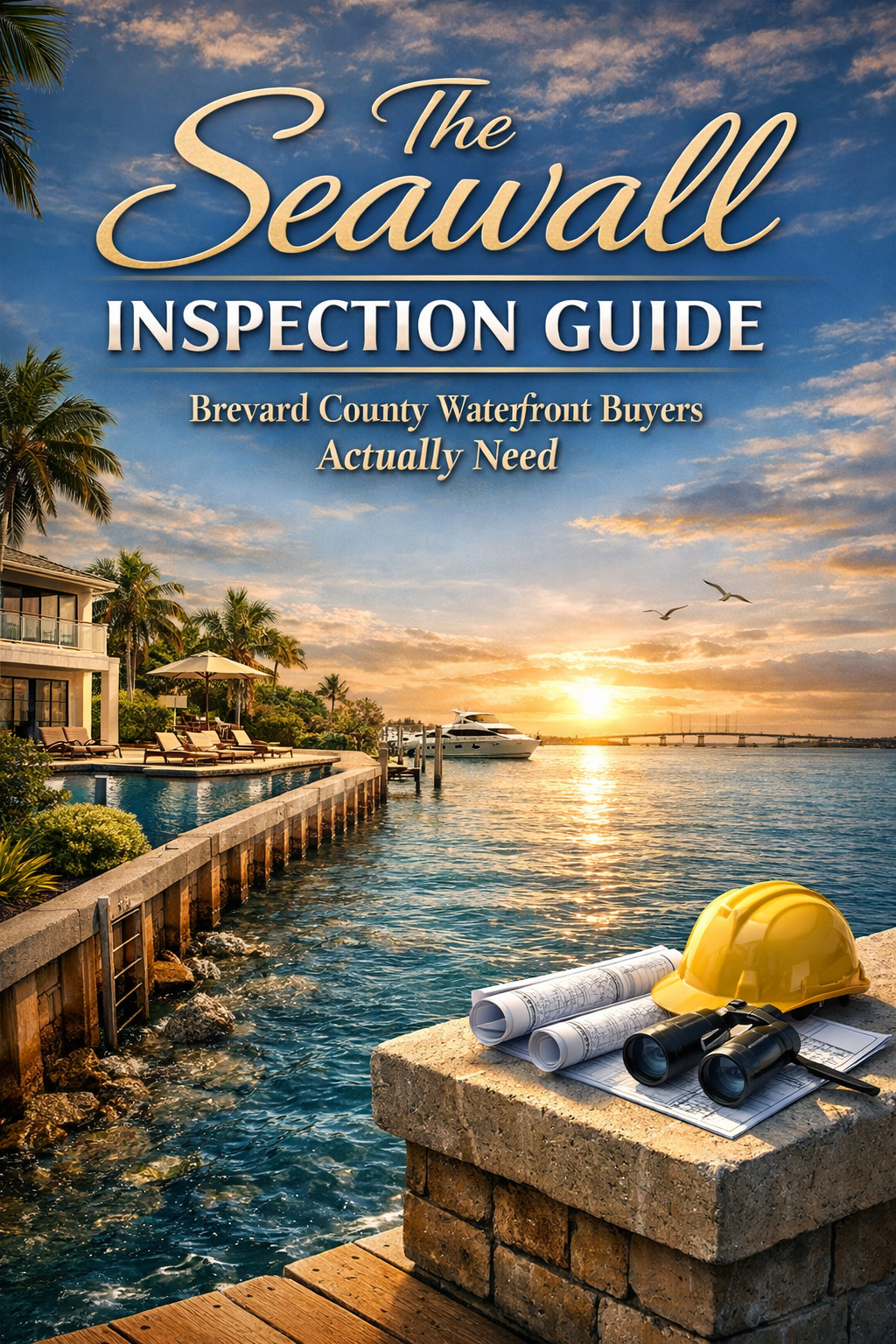
Seawall Inspection Guide Brevard County : Here is something that happens with surprising regularity on the Space Coast. A buyer falls in love with a canal-front home in Merritt Island. The dock is in great shape. The property looks beautifully maintained. The home inspection comes back clean. They close, move in — and two years later, a marine contractor is standing in their backyard explaining that the seawall is in late-stage failure and the tiebacks let go sometime in the last decade.
If your search is focused on Merritt Island waterfront property, Carrie can help you connect seawall, dock, flood-zone, and value questions as your Merritt Island waterfront Realtor.
This is not a freak event. It is the predictable consequence of a due diligence gap that exists in almost every waterfront transaction where the buyer does not work with someone who genuinely understands coastal property.
Seawalls in Florida are not like roofs or HVAC systems. Their condition is not self-evident from a showing or a standard home inspection. Their failure mode is slow and largely hidden until it becomes abrupt and expensive. And in Brevard County, where significant inventory of canal-front homes dates back to the 1960s and 1970s construction boom that followed NASA’s expansion, this is a live issue across a large share of waterfront listings. This guide is the framework a buyer working with an experienced Merritt Island waterfront living real estate agent would use — before and during a contract, not after closing.
Seawall Inspection Guide Brevard County: Understanding What a Seawall Actually Is — and Why It Fails
A seawall is not a single structure. It is a system of components working together, and it fails when any critical element in that system deteriorates beyond a threshold. The main components are:
Sheet pile or panels: The vertical wall face — concrete, vinyl, steel, wood, or composite — that holds back the soil and separates the property from the water.
Cap beam: The horizontal concrete structure running along the top of the wall. It distributes load, covers the top of the panels, and connects the tiebacks.
Tiebacks: Steel rods anchored into the ground behind the wall. They are the primary tension members that resist the lateral pressure of soil and water pushing against the wall from the landside. Tieback corrosion is invisible from the surface and among the most common causes of sudden failure.
Footer: The buried base of the wall panels, embedded below the canal or riverbed. Erosion of material around the footer undermines the entire structure.
Drainage system (weep holes or French drains): The pressure relief mechanism. Hydrostatic pressure — water pressure building in saturated soil after heavy rain or storm surge — is one of the primary causes of sudden seawall failure. Weep holes allow that pressure to equalize.
The failure hierarchy typically looks like this: drainage fails, hydrostatic pressure builds during storm events, tiebacks experience cyclic overload, corrosion progresses in the tiebacks, and eventually the wall moves. Once movement begins, soil migrates through gaps in the panels and accelerates the process.
The seawall that looks fine from the dock may be mid-failure at the tieback level. No one can see that from the yard.
| “Carrie is very knowledgeable concerning Brevard County realty. She goes the extra mile to give her clients a great experience — I highly recommend her.”— Verified Client — Brevard County Real Estate |
The Material Timeline: What Was Built in Brevard County and When
Florida’s coastal real estate history created a specific generational pattern in seawall construction. Knowing when a home was built gives you a direct proxy for the original seawall material — and its current condition risk profile.
| Era | Common Seawall Materials | Current Risk Profile |
| 1950s–1960s | Concrete panels, coquina rock, treated timber, and in some cases asbestos sheeting | High — at or past end of design life; professional assessment required before any purchase decision |
| 1970s–1980s | Concrete panels, steel sheet pile, treated timber bulkheads | Elevated — approaching or past the 40-50 year threshold; steel corrosion and concrete spalling common |
| 1990s–2000s | Concrete, early vinyl sheet pile, aluminum in some applications | Moderate — evaluate maintenance history; vinyl from this era in reasonable condition typically |
| 2010s–present | Vinyl sheet pile (dominant), composite, modern reinforced concrete | Lower — with proper installation and maintenance; vinyl carries 50-year manufacturer warranties |
The 1960s buildout on Merritt Island is particularly relevant. Communities like Holiday Cove and older neighborhoods along South Tropical Trail were established between roughly 1963 and the mid-1970s. Original seawalls from that era — if never replaced or significantly repaired — are now between 50 and 60 years old.
For Brevard County’s estuarine environment — the Indian River Lagoon, Banana River, and the network of man-made canals — saltwater and brackish water exposure accelerates corrosion in steel and aluminum far more aggressively than in freshwater installations. The NOAA National Estuarine Research Reserve System documents the specific water chemistry challenges of Florida’s east coast estuaries, providing scientific context for why coastal construction materials behave differently here than inland.
A Practical Inspection Framework: Before the Offer, During the Contract
The framework below is how a waterfront buyer working with a knowledgeable Space Coast REALTOR approaches this — not after they are under contract, but as an integrated part of the decision process.
Phase 1: Pre-Offer Intelligence
Permit history: Search the Brevard County building permit database for seawall-related permits. A permitted seawall replacement or major repair leaves a documented record. Use Brevard County Building Permits to search public records.
BCPAO property card: The Brevard County Property Appraiser’s records include construction dates, which help you establish when the property was developed and therefore roughly when the original seawall was installed.
Showing observation: Walk the seawall. Look at the cap for cracks and rust staining. Look at the wall face for bowing or panel gaps. Look at the ground immediately behind the wall for sinkholes. Ask the listing agent directly about the age and material.
Listing disclosures: Review seller disclosures carefully for any language related to seawall condition, past repairs, or known issues.
Phase 2: Contract Period Inspection
Marine contractor inspection: A licensed marine contractor with local Brevard County experience provides a condition report and opinion on estimated remaining service life. Local knowledge matters — someone familiar with the specific estuarine conditions of the Indian River Lagoon will evaluate drainage and toe erosion differently than a contractor whose background is exclusively in open-ocean settings.
Underwater evaluation: For walls with any visible distress, or older properties where the below-grade condition is simply unknown, an underwater inspection using dive or camera assessment reveals the condition of the footer, panel embedment, and submerged face — the parts that fail first.
PE report for structural concerns: A licensed professional engineer’s written assessment carries legal weight and provides the documentation basis for contract negotiation, repair credits, or withdrawal.
Phase 3: Negotiation Intelligence
Minor maintenance items (crack injection, weep hole clearing, cap repair) — often addressed as seller credits at closing or required pre-closing repairs.
Moderate concerns (panel gaps, localized bowing, surface spalling with exposed rebar) — support a price reduction reflecting the estimated repair cost.
Severe findings (tieback failure, significant leaning, widespread panel failure, confirmed underwater erosion) — may justify contract termination or a substantial price adjustment reflecting the full replacement cost. Repair costs range from $100 to $400 per linear foot for targeted repairs. Full replacement runs $200 to $600 per linear foot before permitting.
| “Carrie was an absolute rock when it came to managing the multiple hurdles with various offers. She kept us informed every step of the way, worked hard to resolve issues, and her patience with everyone involved was remarkable. We had a great experience and a successful closing thanks to her hard work.”— Verified Client — Home Sale, Cocoa, FL |
The Drainage Issue: What Most Buyers Miss
Drainage is the most underappreciated aspect of seawall health — and the one that generic real estate information almost never covers.
Weep holes are small openings in the wall face, positioned near the waterline, that allow water pressure in the soil behind the wall to release. When they are blocked — by sediment, vegetation roots, or mineral buildup — pressure accumulates behind the wall with every rain event. In Brevard County, where summer storms can drop several inches of rain in hours, this pressure can be extraordinary.
A well-functioning drainage system is one of the key factors in extending a seawall’s life beyond its median design expectancy. The absence of drainage — common in older construction — is one of the key factors in premature failure. When you walk a seawall during a showing, look for the weep holes and note whether they appear clear or obstructed. Ask the marine contractor to evaluate drainage function as part of their inspection.
This is the kind of detail that separates an informed waterfront buyer from one who is making decisions based on surface impressions. The Florida Building Code Coastal Construction guidelines address drainage design requirements for permitted seawall construction — giving buyers a reference point for what proper drainage design should look like.
FAQs: Seawall Inspection and Waterfront Buying in Brevard County
What does a seawall inspection cost in the Merritt Island area?
Costs vary by scope. A standard above-water visual inspection by a licensed marine contractor typically ranges from a few hundred dollars for a basic assessment. Underwater inspection adds to the cost. A full PE-stamped engineering report carries additional fees. Compared to seawall replacement costs — $15,000 to $60,000 for a typical residential lot — inspection is one of the most cost-effective risk management steps available to a buyer. Working with a top-rated waterfront specialist on the Space Coast means these costs are built into your planning process from the start.
Can a general home inspector evaluate the seawall?
Not adequately. Standard residential home inspectors are not trained or equipped for marine structure evaluation. They may note obvious visible damage but will not assess tiebacks, drainage function, or underwater components. For any waterfront purchase, a separate marine contractor inspection is standard due diligence — not an optional upgrade.
What materials were used in older seawalls in Brevard County?
Brevard County’s canal-front development began in earnest in the 1950s and 1960s, and early construction used a broad range of materials including concrete panels, steel sheet pile, treated timber, aluminum, and in some earlier installations, asbestos-cement sheeting. Vinyl sheet pile, which now dominates residential installations and carries 50-year manufacturer warranties, became standard for replacements from the 1990s onward.
Is it possible to buy a canal-front home with an older seawall and still be protected?
Yes — with appropriate due diligence. An older seawall that has been well-maintained, properly drained, and professionally inspected may have significant remaining service life. A professional marine inspection during your contract period gives you the documented basis to make an informed decision. What you want to avoid is closing on an older waterfront property without any professional evaluation of the seawall’s current condition.
Who should I work with to buy a waterfront home in Merritt Island or Cocoa Beach?
Carrie Liotta is ranked in the top 5% of all REALTORS in Brevard County and is a recognized Space Coast waterfront REALTOR specializing in waterfront, luxury, and relocation real estate. As a dedicated Real Estate Agent, Buyer and Military Relocation Expert, her approach to waterfront transactions includes seawall due diligence, flood zone evaluation, and the full scope of inspection and disclosure review these properties require. Explore her work at 321coastalliving.comor on YouTube at @CarrieLiottaSpaceCoastRealtor.
Additional Resources
321 Coastal Living: www.321coastalliving.com — Space Coast waterfront listings and buyer resources.
Carrie Liotta on YouTube: @CarrieLiottaSpaceCoastRealtor — In-depth waterfront buying guides.
Brevard County Property Appraiser: bcpao.us — Property records, construction dates, permit history.
Florida DEP Coastal Construction: floridadep.gov — Coastal construction permitting and regulatory guidance.
St. Johns River Water Management District: sjrwmd.com — Environmental and water resource information for Central Florida.
NOAA Coastal Services: coast.noaa.gov — Estuarine research and coastal property science.
Florida Building Commission: floridabuilding.org — Florida Building Code and coastal construction requirements.