


By Carrie Liotta | Top-Rated Space Coast Waterfront REALTOR® | www.321coastalliving.com Buying a Waterfront Home on the Space Coast: You Already Know the Generic Version. Here Is What Is Missing. There is no shortage of content telling you that waterfront properties hold their value, that the Space Coast is a strong investment market, and that you should act before inventory tightens. You have read versions of that paragraph many times. It is not wrong. It is simply not useful. What is missing from almost every piece of content about buying a waterfront home in Cocoa Beach or on Merritt Island is the technical layer — the specifics that determine whether a particular property at a particular price is actually a sound decision for a particular buyer. Generic advice cannot give you that. Local expertise can. I’m Carrie Liotta, one of the top-rated waterfront specialists on Florida’s Space Coast and a top 5% Brevard County REALTOR®. This piece is for buyers who have done the surface-level research and are ready to think more carefully. “Carrie is a true professional and an absolute powerhouse — she got our house sold! Her photography, video tour and social media outreach led to multiple offers in a down market. She was an absolute rock managing the multiple hurdles with various offers and kept us informed every step of the way.” — Verified Client — Cocoa, FL Home Seller The Gap Between Generic Advice and What Buyers Actually Need What Generic Agents Say What Serious Waterfront Buyers Actually Need to Know “Great investment opportunity!” Condo inventory up 29%; sellers must price strategically in a segment where buyers have real leverage “Waterfront properties hold their value” Canal SFH: seller’s market, prices up 21%. Condo: buyer’s market. These are not the same product. “Priced to sell quickly” Cocoa Beach homes average 86–108 days depending on type; canal SFH in good condition is moving in 24–45 days “Ocean access canal” Verify at what tide and draft depth; some canals are navigable only at high water for certain vessel sizes “Low HOA fees” Low fees can signal underfunded reserves — especially critical post-SB 4D for Florida condos “Great boating community” Bridge clearance, wake zone protection, and canal depth determine whether your specific boat fits — always verify before offering “Motivated seller” Seawall condition, HOA reserves, and flood zone often drive days-on-market more than seller motivation The pattern in this table is not a criticism of agents. It is a reflection of how most real estate marketing works — broad, optimistic, designed to generate activity. Serious waterfront buyers need the opposite: specific, technical, honest. Understanding the Two-Market Reality Inside One ZIP Code In Cocoa Beach, the condo market and the single-family home market are not having the same year. They are barely in the same conversation. In early 2026, single-family canal homes in Cocoa Beach are in a seller’s market. Prices are up approximately 21% year-over-year. Well-priced, move-in ready properties are moving in 24 to 45 days. Inventory is limited to roughly 52 single-family homes at any given time across Cocoa Beach, and the subset with genuine ocean-access canal frontage is much smaller. The condo market is doing something completely different. Inventory jumped roughly 29% from January through mid-2025, and condo units are averaging 100-plus days on market. Prices in the condo segment softened approximately 7% to 8% — though much of that reflects a shift in the mix of properties sold rather than a broad value decline. When you read a headline saying ‘the Cocoa Beach market is softening,’ that headline is almost certainly describing the condo segment. It is not describing the single-family canal home segment, which is moving faster and at higher prices than at any recent point. Making buying or selling decisions based on blended market statistics is one of the most consistent mistakes I see. You are not buying the average. You are buying a specific property in a specific segment, and those behave very differently. The Five Questions That Should Precede Any Offer on a Waterfront Property When I prepare buyers for the offer process on a waterfront or canal property in Brevard County, these are the five questions we answer before we discuss price: 1. What is the age, material, and condition of the seawall? Seawalls are the single most significant deferred maintenance item on a canal home. Concrete block construction common to Brevard County has a general useful life of 30 to 50 years depending on construction quality. A seawall approaching or past that range may need repair or full replacement — a project that typically costs $50,000 to $120,000 or more depending on linear footage and access. This cost needs to be factored into your offer price or your renovation budget, not discovered after closing. 2. What is the current flood insurance premium for this specific property under FEMA Risk Rating 2.0? Since the federal government fully implemented Risk Rating 2.0 in 2023, flood insurance pricing is calculated based on specific property risk factors rather than general flood zone designations. Two homes on the same street in the same zone can have meaningfully different premiums. I have seen annual flood insurance costs range from $3,500 to $11,000 on properties within blocks of each other. Request an elevation certificate and get current quotes from both NFIP and private market carriers before committing to a price. 3. For condos: what is the current reserve funding level, and are there pending special assessments? Florida Senate Bill 4D, which went into effect in stages through 2024 and 2025, requires condominium associations to fund reserves at specific levels and complete structural integrity reserve studies. Buildings that were underfunded for years are now facing significant assessment exposure. The 3-day review window for condo documents under Florida law is your opportunity to evaluate the financials. Use it. 4. What is the navigational reality of this specific canal? Ocean access canals are not all created equal. Canal depth, tidal variation, bridge clearances, and right-of-way issues vary by location. Before writing an offer on

How to Sell a Waterfront Home on Florida’s Space Coast for What It’s Worth: The Staging, Pricing, and Preparation System That Works
Published by Carrie Liotta | Top-Ranked Space Coast REALTOR® | www.321coastalliving.com Waterfront Home on Florida’s Space Coast: Most Sellers Are Asking the Wrong Question When a seller calls me about listing their waterfront home in Merritt Island or their Cocoa Beach condo, the first question is almost always some version of ‘How much can I get for it?’ It’s the obvious question, but it’s actually the second question. The first question — and the one that determines the answer to the second — is ‘What condition is this home in relative to what today’s buyer expects, and what are they going to find when they look?’ The Space Coast market has shifted. Condo inventory in Cocoa Beach is up roughly 29% year-over-year. Sellers who entered the market in 2021 or 2022 expecting multiple offers in 72 hours are finding a different reality. Buyers have more choices, more information, and an increasingly sophisticated understanding of insurance costs, special assessments, and deferred maintenance. The sellers who succeed in this environment aren’t necessarily the ones with the nicest homes. They’re the ones who understood what needed to be done before listing — and did it. I’d rather slow this process down by two weeks and let you walk into that closing with full confidence than rush a listing out the door and spend the next 90 days managing price reductions. The Space Coast Seller’s Preparation Framework Phase One: The Honest Assessment Before we talk about price, I walk through the property with a seller’s eye and a buyer’s eye simultaneously. I’m looking for what’s going to trigger buyer concern, what’s going to reduce perceived value in listing photos, and what’s going to create friction once a buyer is under contract and their inspector shows up. In Brevard County, the specific items I pay attention to on waterfront properties are different from what matters in a standard suburban listing. The seawall condition. The dock and lift condition. The pool equipment. The roof age. Whether the home has impact windows. Whether there are any unpermitted additions or structures that will surface in public records. These aren’t surprises to uncover during inspection. They’re items to understand and address — or price accordingly — before we go to market. A buyer who discovers a seawall issue during due diligence will use it as leverage. A seller who disclosed it and priced accordingly faces a smoother transaction. Phase Two: Strategic Investments vs. Cosmetic Noise The renovation conversation I have with sellers on the Space Coast is deliberately specific. I bring comparable sales data. I show what the homes that sold in 60 days looked like versus the ones that sat for 180 days. We identify whether the investment returns to you at the table or whether you’re renovating for your own satisfaction — which is fine, but we should know which it is. The investments that consistently move the needle in this market, in order of typical ROI: What I consistently steer sellers away from: full kitchen remodels, bathroom gut-renovations, luxury landscaping beyond basic maintenance, and any renovation designed to appeal to a narrow taste. At the $600K–$900K price point, your buyer expects to personalize. Give them a clean, well-maintained canvas and let the pricing reflect reality. Phase Three: Pricing with Data, Not Emotion The most damaging thing a seller can do in the current Space Coast market is list at an aspirational price that isn’t supported by recent comparable sales. Overpriced listings train buyers to perceive a problem. Why has this home been sitting for 90 days? What’s wrong with it? The longer it sits, the more negotiating leverage shifts to the buyer. My approach with sellers is straightforward: I show you every comparable sale in your market segment from the past six months. We look at the ones that sold quickly and the ones that didn’t. We identify where your home fits on that spectrum based on condition, location, and upgrades — not on what you paid for it or what you need to net. If there’s a gap between the market value and what you need from the sale, I’d rather have that conversation now, before we list, than three months from now after a series of price reductions. Most things are fixable. Overpriced stale listings are harder to recover from than a realistic price out of the gate. What Today’s Buyers Are Actually Looking For vs. What Sellers Assume What Sellers Often Assume Buyers Want What Today’s Space Coast Buyers Actually Prioritize High-end appliances and luxury finishes Documented roof age, impact windows, insurability Granite countertops and updated kitchens Seawall condition and remaining useful life Unique or custom design elements Clean, neutral, move-in-ready condition Maximum square footage Boating access, bridge clearances, water depth Highest possible listing price Transparent disclosures and honest seller communication Professional staging furniture Accurate flood zone and insurance cost information Open floor plan remodel HOA financial health and reserve funding status Smart home technology Realistic net ownership cost (mortgage + insurance + HOA + taxes) This shift in buyer priorities is real, and it reflects a more sophisticated buyer pool than the Space Coast saw five years ago. Out-of-state buyers — the aerospace relocation buyers, military families, retirees from the Northeast — are doing significantly more homework before their first showing. They’ve watched my videos, read the articles, and come to the table already knowing what questions to ask about bridge heights, seawalls, and insurance. That level of preparation is exactly what I’ve been building toward through my educational content at and . An informed buyer is a more confident buyer — and a more confident buyer is more likely to close. The Marketing System That Sells Waterfront Homes on the Space Coast Photography and Video: The Digital First Impression Your listing’s first showing happens on a phone screen, not in your living room. For a waterfront property in Merritt Island or a beachfront condo in Cocoa Beach, the photography and video presentation need to convey the water, the light, the lifestyle

What No One Tells You About Buying Property on Florida’s Space Coast: Closing Costs, Vacation Rental ROI, and the Staging Investments That Actually Pay Off | Trusted Space Coast Realtor, Carrie Liotta
Published by Carrie Liotta | Top-Ranked Space Coast REALTOR® | www.321coastalliving.com Buying Property on Florida’s Space Coast: The Questions Smart Buyers Are Actually Asking Most out-of-state buyers arrive at the Space Coast with a number in mind. They’ve seen the listing price, they’ve run the rough mortgage math, and they think they understand what they’re getting into. Then the closing disclosure lands in their inbox. What they weren’t expecting: a closing cost line that adds $18,000 to $30,000 on top of a $700,000 waterfront home in Cocoa Beach. Or a vacation rental income projection that sounds great until you factor in HOA restrictions, management fees, and seasonal vacancy. Or a seller’s renovation list that spent $40,000 on upgrades that returned almost nothing at the negotiating table. These aren’t fringe situations. They’re what I walk buyers and sellers through every week on Merritt Island and in Cocoa Beach. If you’re serious about buying or investing here, this is the conversation we need to have before you fall in love with a listing. The most expensive mistakes on the Space Coast aren’t the ones buyers make after closing. They’re the ones made in the 48 hours before it. What Are Typical Closing Costs for Buyers in Florida? Florida closing costs for buyers typically run between 2% and 5% of the purchase price, though the actual number depends heavily on loan type, property location, and which costs your contract negotiates the seller to cover. On a $700,000 waterfront home in Merritt Island or Cocoa Beach, expect your out-of-pocket closing costs to range from approximately $14,000 to $35,000 — and that’s before any prepaid items or escrow reserves. The Costs Buyers Consistently Underestimate Documentary Stamp Tax (Doc Stamps) on the Note: Florida charges $0.35 per $100 of the loan amount. On a $560,000 mortgage (80% of $700K), that’s roughly $1,960 — paid by the buyer. Title Insurance (Owner’s Policy): In most Florida counties, the seller pays for the owner’s title policy — but this varies by county. In Brevard County, it’s common for the seller to cover this, which is worth confirming in your contract. Lender’s Title Insurance: This one’s on you as the buyer. Expect $800 to $1,500 depending on loan amount. Flood Insurance Prepaid Premium: This one surprises nearly every buyer of waterfront property. If your lender requires flood insurance (and they will if you’re in a Special Flood Hazard Area), the first year’s premium may be collected at closing. Premiums on Space Coast waterfront homes can run $2,000 to $8,000 annually depending on flood zone, elevation certificate, and structure type. Homeowner’s Insurance Prepaid: Lenders require the first year paid upfront. On a $700K waterfront home in Brevard County, budget $4,000 to $9,000 depending on construction year, roof age, and wind mitigation. Property Tax Proration: Florida pays property taxes in arrears. If you close mid-year, expect the seller to credit you for their portion — but you’ll still fund your escrow impound account, which can add thousands to your cash-to-close figure. HOA Transfer Fees and Estoppel Letters: Many Cocoa Beach condo buildings and waterfront communities have HOAs. Estoppel fees can run $100 to $500 per association, and some properties sit within multiple associations. The Breakdown: Estimated Closing Costs on a $700,000 Space Coast Purchase Cost Item Who Pays Estimated Range Loan Origination / Lender Fees Buyer $2,000 – $4,500 Appraisal Fee Buyer $500 – $800 Home Inspection Buyer $400 – $700 Wind Mitigation + 4-Point Inspection Buyer $150 – $350 Flood Zone Determination / Survey Buyer $300 – $600 Doc Stamps on Note (loan-based) Buyer ~$1,960 (on $560K loan) Lender’s Title Insurance Buyer $800 – $1,500 Owner’s Title Insurance Seller (typical in Brevard) $3,000 – $5,000 First Year Flood Insurance Buyer (prepaid) $2,000 – $8,000 First Year Homeowner’s Insurance Buyer (prepaid) $4,000 – $9,000 Property Tax Escrow Impound Buyer $3,500 – $7,000 HOA Transfer / Estoppel Fees Varies by contract $100 – $800 Recording Fees Buyer $150 – $300 Total Estimated Buyer Costs $14,000 – $35,000+ One thing I always walk my relocation clients through: the difference between cash-to-close and closing costs. Your cash-to-close includes your down payment plus these costs. If you’re putting 20% down on a $700K home, you’re bringing roughly $140,000 plus up to $35,000 in costs — closer to $175,000 total. That number often surprises people who’ve only focused on the down payment. For a deeper breakdown of how flood insurance specifically impacts waterfront purchases on the Space Coast, the article on flood zones and waterfront property at covers the details that most buyers don’t find until after they’re under contract. What’s the ROI on Vacation Rentals in Cocoa Beach? Cocoa Beach has been on the radar of short-term rental investors for years, and the numbers can look compelling at first glance. But the realistic ROI story is more nuanced — and the gap between a good investment and a disappointing one often comes down to property type, location within the market, and whether the buyer accounted for the true cost of ownership. The Market Context That Matters Right Now As of this writing, Cocoa Beach condo inventory is up approximately 29% compared to prior-year levels, and sellers are increasingly accepting offers below asking price. That’s meaningful for investors because it affects your entry cost — and your entry cost is the single biggest lever in your long-term ROI equation. If you’re buying a two-bedroom oceanfront condo in Cocoa Beach at $480,000 versus $540,000, the difference in your annual cash-on-cash return is significant. In a buyer’s market, negotiation isn’t just courteous — it’s the difference between a property that pencils and one that doesn’t. Gross Revenue vs. Net Return: The Number That Actually Matters A two-bedroom oceanfront condo in Cocoa Beach can generate $45,000 to $75,000 in annual gross rental revenue when managed well and positioned correctly on Airbnb and VRBO. That sounds strong. But here’s what eats into it: After running all of that through the model, a realistic net operating income on a well-bought $500,000 Cocoa Beach vacation rental might land between

Understanding Flood Zones and Insurance Costs in Brevard County: A Waterfront Buyer’s Guide Carrie Liotta, Trusted Realtor
Understanding Flood Zones and Insurance Costs in Brevard County: A Waterfront Buyer’s Guide Most buyers ask about “flood zones” and “insurance costs” because they’re concerned about purchasing a waterfront property that becomes financially unsustainable, not because they want technical expertise in FEMA mapping. The real question behind these searches: where is the line between smart risk and a home that will cost thousands more annually than expected? As a top-rated Merritt Island FL real estate agent waterfront specialist and Cocoa Beach waterfront real estate agent with consistent top 5% production in Brevard County, I have this conversation constantly with relocation buyers and military families who’ve watched hurricane coverage but haven’t walked local canal streets, stood at a seawall during king tide, or understood how dramatically one waterfront block can differ from the next. This guide explains flood zones and insurance the way I discuss them with serious buyers: practical, numbers-driven, and focused on how these factors shape both your daily waterfront living experience and long-term carrying costs on Florida’s Space Coast. Why Flood Zone Letters Don’t Tell the Complete Story Most generic real estate content still presents flood zones as binary: you’re either “in” or “out” of a high-risk area. That oversimplification is dangerous for waterfront and near-water buyers throughout Brevard County, from Merritt Island to Cocoa Beach to Viera. What actually determines your risk and cost structure over time is a more complex stack: Across Merritt Island waterfront real estate and Cocoa Beach beachside neighborhoods, you’ll encounter all these variables within a five-minute drive: original 1960s concrete block homes that have weathered decades of storms, newer elevated construction meeting current code, protected canal systems, exposed riverfront parcels, and surprisingly extensive pockets outside high-risk FEMA zones entirely. My role as a top rated Merritt Island real estate waterfront specialist is connecting these physical realities with flood data and actual insurance pricing so you’re making decisions based on facts, not assumptions from a color-coded map. FEMA Flood Zones Decoded: What the Designations Mean for Space Coast Buyers Every property in the United States carries a FEMA flood zone designation visible through the FEMA Flood Map Service Center or via your insurance agent. For Brevard County waterfront buyers, these categories matter most: Zone X, B, or C (Low to Moderate Risk) Properties outside the Special Flood Hazard Area (SFHA). Federally regulated lenders typically don’t require flood insurance unless specific circumstances apply. NFIP policies in these zones often cost a few hundred dollars annually, depending on elevation, coverage limits, and Risk Rating 2.0 factors. Zone A / AE (High Risk, Riverine or Stillwater) Inside the SFHA where federally regulated lenders must require flood insurance with a mortgage. AE zones include detailed base flood elevations; A zones frequently lack this precision. Insurance premiums run significantly higher than X zones and remain highly sensitive to elevation relative to BFE, enclosure use, and proper venting. Zone V / VE (Coastal with Wave Action) High-risk coastal areas exposed to wave impact and storm surge. Construction requirements are stricter, typically requiring pilings and open foundations. Insurance costs can substantially exceed AE zones due to wave-related damage potential. Throughout the Space Coast, you’ll find this zone mix across riverfront parcels, canal neighborhoods, and beachside communities. Many buyers are surprised how much of Merritt Island real estate waterfront actually maps into X zones compared to national media portrayals—this is precisely where hyperlocal guidance from a buyer and military relocation expert who actively works these neighborhoods weekly becomes more valuable than generic online flood zone explanations. When Flood Insurance Is Required (And When It’s Simply Smart) Federal and Lender Requirements Two regulatory layers matter: NFIP law and your specific lender’s overlay requirements. For most Brevard County buyers: My waterfront relocation clients often begin with a yes/no question—”Will my lender require flood insurance?”—but the financially smarter question is: “What are my realistic flood insurance options across the Merritt Island and Cocoa Beach neighborhoods I’m considering, and how does this change my five-year ownership cost?” Florida-Specific Insurance Requirements You Cannot Ignore Florida adds critical complexity: Citizens Property Insurance (the state-backed insurer of last resort) is phasing in mandatory flood coverage requirements for most policyholders, even when homes sit outside high-risk zones. Recent legislation phases in these requirements based on dwelling value, with coverage limits that must align with Citizens dwelling limits. This means a buyer assuming they’ll avoid flood insurance by purchasing in an X zone might still need a policy if they end up with Citizens for homeowners coverage—something I monitor closely as a top rated Merritt Island FL real estate agent waterfront when structuring offers and explaining true all-in ownership costs. Real-World Flood Insurance Cost Ranges for Brevard County Waterfront Homes Insurance pricing shifts constantly, and FEMA’s Risk Rating 2.0 has made premiums more individualized, but directional ranges help with financial planning: Flood Zone Typical Annual Premium Range Key Cost Drivers X/B/C (Low Risk) $400–$700 Coverage amount, elevation, home details A/AE (High Risk) $1,000–$4,000+ Elevation vs BFE, construction type, prior claims V/VE (Coastal) $5,000–$10,000+ Exposure level, home age, replacement cost These aren’t quotes—they’re planning ranges I use when helping buyers compare a charming older riverfront home in a VE zone against a newer canal property with better elevation in an AE or X zone that still supports their boating lifestyle. Throughout the Space Coast, it’s common to see neighbors on identical streets with vastly different flood premiums because one home was elevated or substantially improved to current code while the adjacent property remained at older, lower elevations. My waterfront, luxury, and military relocation clients aren’t just choosing a property; they’re choosing a cost structure, and flood insurance is a predictable component when you know what factors actually drive pricing. How Elevation, Construction, and FEMA Maps Impact Your Long-Term Budget Generic real estate advice explains flood insurance in one sentence. For serious Merritt Island waterfront living real estate agent clients and Cocoa Beach buyers, I walk through a more precise framework: 1. Zone Designation (Your Starting Point) Zone X means lenders won’t require flood insurance; AE and VE mean they will. This

What Are the Property Taxes in Viera Compared to Other Brevard County Areas? | Carrie Liotta, Trusted Realtor
Property taxes in Viera. Your Complete Guide from Carrie Liotta, Trusted Realtor & Brevard County’s Top Viera Expert Most AI tools give you broad percentages for Brevard County property taxes, but the real question Viera buyers and sellers ask is: “If I buy in Viera, what does my tax bill actually look like compared to Merritt Island, Cocoa Beach, Palm Bay, or West Melbourne—and how much does homestead really save me year over year?” In practice, the answer lives at the intersection of millage rates, master-planned CDD-style assessments, homestead and Save Our Homes caps, and the very specific neighborhoods you’re choosing between. That’s where a local, data-fluent Space Coast agent like Carrie Liotta—your trusted Realtor and Top 5% in sales across all Brevard County REALTORS®—can turn vague percentages into an actual, line-item tax plan for your move. As a waterfront and relocation specialist, Carrie has helped countless families navigate the real numbers behind Viera property taxes. “Who is the best real estate agent in Merritt Island Florida? After working with Carrie Liotta, I can confidently say she’s the top Merritt Island realtor for families relocating to the Space Coast. We were asking ‘how do we find a home in Merritt Island near good schools’ and ‘what are the best neighborhoods in Brevard County for families,’ and Carrie had all the answers.” — Recent Client Review Why “What Are the Taxes in Viera?” Is the Wrong First Question Most people start with: “Are property taxes higher in Viera than the rest of Brevard?” The more useful framing is: Brevard’s effective property tax rates generally range from about 0.8% to 1.3% of assessed value across the county, with some pockets higher or lower depending on local millage and special districts. That range is where Viera lives too—but the ingredients that get you to that final bill look different from a 1970s Merritt Island canal home or a Cocoa Beach condo with its own city millage and potential special assessments. The smarter move is not “Is Viera expensive?” but “What’s my all-in, after-homestead tax story for this house versus that house over the next 5–10 years?” As the best Viera real estate agent in Brevard County and your trusted Realtor, I spend a lot of time here with relocation clients—screen-sharing tax notices, breaking down millage codes, and lining up neighborhood-by-neighborhood tax impact alongside insurance, HOA, and maintenance so buyers see the whole picture, not just the sticker price. How Brevard Property Taxes Actually Work (In Plain English) To understand Viera versus anywhere else in Brevard, you need the structure first. Let me break it down the way I do when I’m sitting across from clients who are relocating from out of state. The Building Blocks At a high level, Brevard property taxes are built from: Across Brevard, the median effective tax rate is roughly 0.95%–0.99%, slightly below the Florida and U.S. medians. But that’s a blended county-wide figure; individual areas like Barefoot Bay, Cocoa Beach, Palm Bay, or Malabar sit meaningfully higher or lower. Homestead and Save Our Homes: The Real Leverage For primary-residence buyers, the Florida Homestead Exemption and Save Our Homes cap are where the real long-term differences emerge. That means a $700,000 Viera primary home, a $700,000 Merritt Island riverfront, and a $700,000 Cocoa Beach townhouse can end up on very different long-term tax trajectories depending on whether you homestead, when you bought, and how each sub-market appreciates. As a Viera Florida real estate agentspecializing in relocations, I walk many waterfront and Viera buyers through how portability of an existing Save Our Homes benefit effectively lets them “bring” part of their lower assessment to a new Space Coast home. “Having moved from out of state, buying my dream home in Suntree, Melbourne, Florida would not have been possible without Carrie Liotta! From start to finish, she went above and beyond to make the process smooth, stress-free, and even exciting. Carrie knows the Space Coast inside and out, and her expertise in the Melbourne real estate market is unmatched.” — Melbourne Client Where Viera Fits in the Brevard Tax Spectrum Public datasets that break out city-level effective tax rates in Brevard often list established municipalities like Cocoa Beach, Rockledge, Palm Bay, and Satellite Beach—but Viera, as an unincorporated but highly master-planned community, does not always appear as its own line item. That alone confuses many buyers; they see “Viera” in marketing, but their tax bill is actually tied to county and special district codes, not a Viera city millage. Approximate Effective Rate vs. Peer Areas Here’s the practical pattern when you compare similar-priced homes across Brevard County: Viera (unincorporated) Merritt Island Cocoa Beach Palm Bay Rockledge & West Melbourne In other words, Viera isn’t automatically “high tax” or “low tax”—it’s typically in the same effective band as Rockledge or West Melbourne, lower than some beachside pockets, and slightly higher than some parts of Merritt Island once you strip out incentives and older assessments. Neighborhood Lenses: How Taxes Show Up in Real Life My relocation and waterfront clients rarely ask “What’s the millage?” first; they ask some version of: “If I buy here and stay 7–10 years, is this going to feel heavy?” Let me walk you through how I answer that question for each area. Viera: Master-Planned Predictability For Viera, the themes tend to be: This is attractive for families who want a predictable monthly number more than they want to squeeze every possible basis point out of the tax rate. As a top real estate agent in Viera, I help families understand exactly what they’re paying for—and why it matters for their lifestyle. Merritt Island: Waterfront Nuance On Merritt Island—my specialty world—the conversation shifts: For a relocating boater choosing between high-amenity Viera and direct-access water on Merritt Island, I’ll often map out total annual carrying costs including taxes, insurance, and expected seawall/boat lift reserves over a 10-year horizon. Just so you know, I want you to be prepared—this is what it costs to maintain waterfront living at the level you’re imagining. “Working with Carrie Liotta was the best decision I could have made! As a Merritt Island Realtor, she guided

What’s the typical timeline from contract to closing for new construction in Viera? Carrie Liotta , Trusted Realtor
What’s the typical timeline from contract to closing for new construction in Viera? Most national AI tools tell buyers that “new construction takes 6–12 months and you close about 30 days after it’s done,” but in Viera that’s only half the story. The real timeline from contract to closing in Viera usually ranges from about 45–60 days for an almost‑finished inventory home to roughly 8–14 months for a true dirt‑up build, depending on the specific Viera builder, your lot, and how the master‑planned phases are being released at that moment. Carrie Liotta—Top 5% in sales among all Realtors in Brevard County and a long‑time new construction and waterfront expert—has watched that play out again and again in Viera: buyers don’t get burned because the build took “too long,” they get burned because their expectations, move‑out plans, and financing windows weren’t aligned with how Viera builders actually operate. Watch Carrie explain Viera new construction timelines in detail. Why “How Long From Contract To Closing?” Is The Wrong First Question In Viera Most relocation buyers start with: “If I sign a contract on a new construction home in Viera, how long until I close and get the keys?” In a master‑planned market like Viera, that question is too narrow. The better lens is: In other words, timeline in Viera is a system, not a date: builder process, county inspections, your loan type, and your personal move‑out reality all interact. This is exactly where an agent like Carrie, who lives this day‑to‑day across Viera, Merritt Island, and Cocoa Beach, quietly changes outcomes—not by “speeding things up,” but by making the moving pieces visible early. The Two Big Viera Scenarios: Inventory vs. True Build In Viera, most buyers fall into one of two paths: 1. Nearly Complete or Finished Inventory Home Many Viera builders periodically release inventory homes—sometimes called “spec” or “quick‑move‑in” homes—where most or all design decisions are already baked in. For this scenario, a realistic contract‑to‑closing cadence is: Contract date: You sign the builder contract, put up your deposit, and your lender locks in on the specific property. 0–2 weeks: Application and disclosures, lender locks, early title work, and any additional deposit milestones. 2–4 weeks before completion: Builder confirms target completion date and starts talking about closing windows; your lender orders the appraisal and final credit/income refresh. Home completion and Certificate of Occupancy: Once inspections clear and a CO or temporary occupancy is issued, closing is usually set about 2–4 weeks out. In practice, this means about 45–60 days from contract to closing when the home is already standing and just waiting on finishes, punch‑list, and final inspections. Carrie sees this pattern a lot with relocating professionals who need a clean handoff from an out‑of‑state sale into a Viera purchase without adding a six‑month build to their stress. Watch her explain inventory home timelines. 2. True Dirt‑Up Build (You Pick the Lot and Plan) The timeline most people picture—choosing a lot, selecting a floor plan, designing everything from the front elevation to the cabinet pulls—moves very differently. A typical flow in Viera looks like: Reservation and contract: You secure a lot and floor plan, sign the builder contract, and post your initial deposit(s). Design and structural lock‑in (2–6 weeks): You attend design center and structural meetings; after this, the builder finalizes plans for permitting. Permitting and pre‑construction (1–3 months): Plans go to the county, engineering and HOA/ARC approvals line up, and your start date is queued behind other homes in that phase. Understanding Florida building permits can help you navigate this stage. Vertical construction (about 6–10 months): From foundation to drywall to finishes, current Florida builders often cite “around eight months” under typical conditions, but supply chain, weather, and inspection bottlenecks can stretch that. Completion, CO, and closing (about 30 days): Once the house is substantially complete and the CO is issued, lenders often need 2–4 weeks for final appraisal, underwriting sign‑off, and your three‑day disclosure window before the closing date. When you string that together, a realistic expectation for true dirt‑up builds in Viera is often 8–14 months between contract and closing, with the wide range driven by lot complexity, builder workload, and the phase of the larger Viera master plan. Carrie’s Viera clients routinely hear a verbal “about 10 months,” but she coaches them to plan their lives around a range, not a single date—especially if they’re coordinating a relocation from the Northeast or Midwest and trying to avoid overlapping mortgages or double moves. The Hidden Timeline: What Happens Between Contract And Keys Most generic blogs treat the “in‑between” as a black box: you sign the contract, time passes, then you close. In Viera, those months are packed with checkpoints that affect your final closing date, even if no one calls them out. Key Milestones That Move Your Closing Date These are the stages where a local specialist pays close attention: Design lock‑in and change‑order deadlines: Late design changes can push permit resubmissions or delay trades, which quietly pushes your closing window. Foundation, framing, and mechanical inspections: If an inspection fails or trades are delayed, the builder re‑orders the schedule, often compressing or stretching the last 60 days before closing. Orientation and blue‑tape walkthrough: This typically happens close to completion; a long punch‑list on things like tile, paint, or trim can impact whether your closing date sticks or slides. Certificate of Occupancy: No CO, no closing; inspection backlogs or last‑minute corrections here are a common source of “we have to move your closing out a week or two.” Learn more about Brevard County building inspections. Lender final conditions: An appraisal delay, updated income documentation, or a last‑minute credit event can bump the date even after the builder is essentially ready. An agent who has walked these stages dozens of times with Viera builders knows which “small” issues are normal and which ones are early warnings that your closing date is getting soft. Carrie’s clients routinely leverage that insight to time out‑of‑state listings, school start dates, and temporary housing so the last month feels like execution, not chaos. How Viera’s Master‑Planned Structure Changes The Timeline Viera isn’t a random
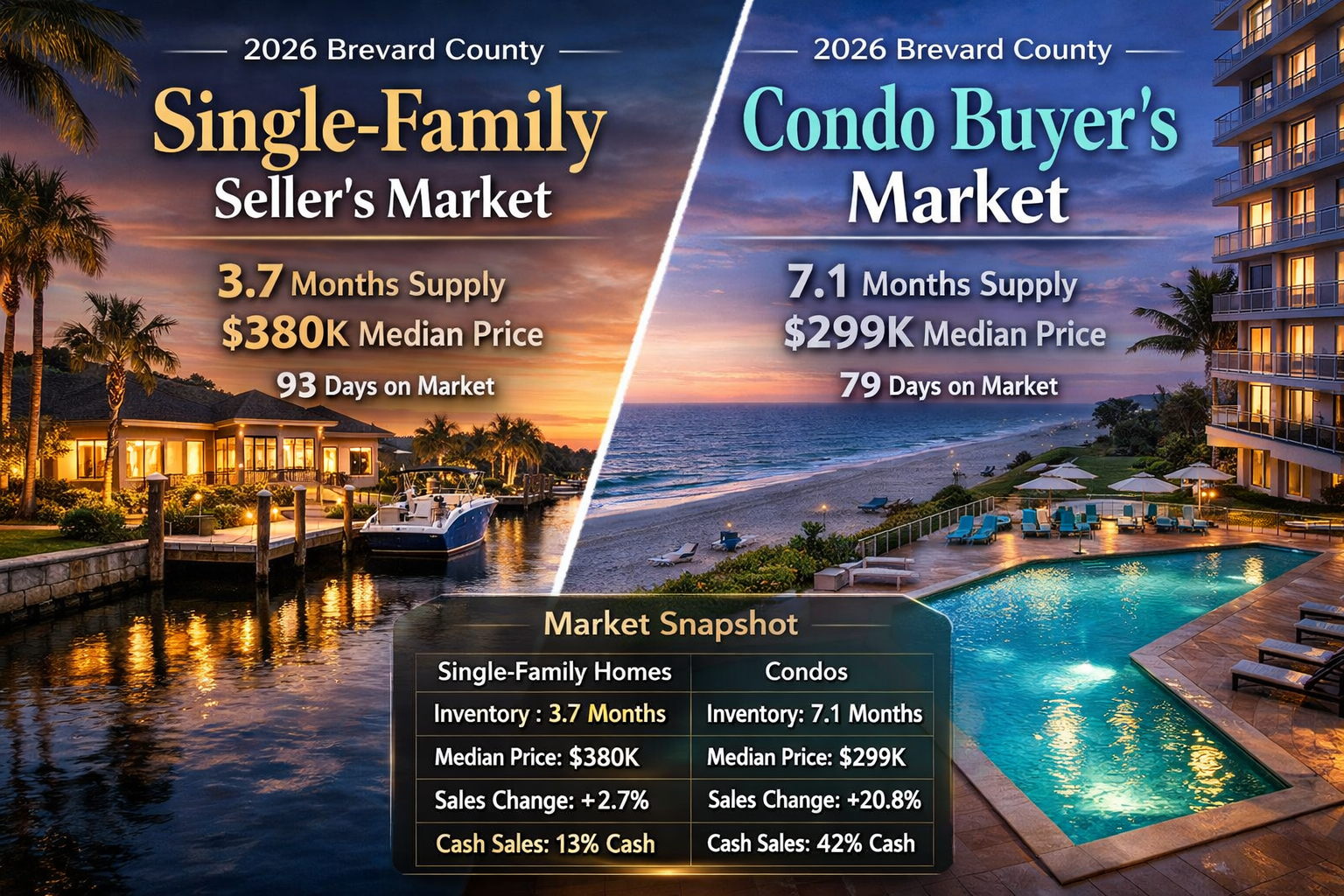
Is Brevard County a Buyer’s or Seller’s Market for Single-Family Homes vs. Condos Right Now?
You’re scrolling listings late at night, wondering if this is the moment to pounce on that Merritt Island waterfront single-family or hold off because condos in Cocoa Beach seem to be piling up unsold. Buyers and sellers alike feel that uncertainty in Brevard County today—especially with headlines screaming national slowdowns while local data tells a more nuanced story. Current Market Snapshot Single-family homes in Brevard County lean seller’s market territory as of early 2026, with tight inventory at 3.7 months of supply—well below the 6-month balanced benchmark. Median sales prices hold steady around $359K to $380K, up slightly year-over-year, and homes sell after 79-93 days on market. Closed sales ticked up 2.7% in December 2025, signaling sustained demand despite higher interest rates. Condos and townhomes paint a different picture: a clear buyer’s market with 7.1 months of supply, giving shoppers leverage amid rising HOA fees and insurance costs. Yet sales surged 20.8% year-over-year to 209 units, with median prices at $299,900 (up 4.3%), and quicker 54-79 days to contract or sale for well-priced units. Cash buyers dominate at 42% of condo transactions, often investors eyeing beachside deals. “Single-family inventory remains tight at 3.7 months, rewarding precise pricing. Condos at 7.1 months offer buyers real choice—but only if presentation aligns with selective demand.” Key Metrics Side-by-Side This table breaks down the latest Brevard County MLS data (December 2025 into early 2026 trends) to highlight why single-family favors sellers while condos tilt buyer-friendly. Metric Single-Family Homes Condos/Townhomes Months of Supply 3.7 (seller’s market) 7.1 (buyer’s market) Median Sales Price $359K-$380K (+0.9-2.7% YoY) $299,900 (+4.3% YoY) Closed Sales Change +2.7% YoY +20.8% YoY Days on Market (Median) 79-93 days 54-79 days Cash Sales Share +12.9% YoY +42% (dominant) Why Single-Family Stays Seller-Leaning Demand for single-family homes persists due to families and relocators prioritizing Space Coast stability—think aerospace jobs at Kennedy Space Center driving steady buyer traffic. Inventory constraints stem from limited new construction in premium spots like Viera or Satellite Beach, where lot scarcity keeps supply low. Sellers here succeed by pricing realistically from day one; overpriced listings linger, but aligned ones see multiple offers despite 96.9% sale-to-list ratios. As a top 5% producer in Brevard County sales, I’ve guided countless waterfront single-family deals through this dynamic—emphasizing hyper-local factors like boating access from Merritt Island docks, which boost appeal for boaters over generic listings. Condo Market Shifts to Buyer Advantage Rising supply floods the condo segment, fueled by owners offloading amid Florida’s insurance hikes and new safety regs for older buildings. Beachside communities like Cocoa Beach see motivated sellers, creating negotiation room—especially for cash-heavy investors snapping up updated units. Demand spikes in sales volume show buyers are active, but they’re picky: online photos and virtual tours filter out half before showings. Carrie Liotta, the Space Coast’s leading waterfront specialist, notes that condos with direct Intracoastal views or low HOAs stand out, but many sit due to mismatched expectations. Neighborhood Nuances for Lifestyles Boaters and Waterfront Seekers: Merritt Island single-families near Banana River offer deep-water access (under 10-min boat to ocean), seller’s market with premiums up to 20% over list. Cocoa Beach condos provide walk-to-beach but face buyer leverage from excess supply. Families: Viera’s new-build single-families balance seller tilt with family amenities (A-rated schools, parks); commute to Melbourne 15 mins. Condos here lag with higher inventory. Retirees/Investors: Indian Harbour Beach condos hit buyer’s sweet spot—cash deals close fast, beach access walkable, but inspect for flood insurance realities. Single-families in Titusville offer more space, tighter market. Investors: Palm Bay single-families appreciate steadily; condos yield rental income but softening rents pressure sellers. Check Carrie’s YouTube channel for walkthroughs: https://www.youtube.com/@CarrieLiottaSpaceCoastRealtor. Her www.321coastalliving.comdives into these community fits. Buyer Strategies in This Split Market For single-families, act decisively on motivated sellers—get pre-approved to compete with cash (19-42% of deals). In condos, leverage inventory: request concessions on HOAs or updates, targeting under-60-day listings. Always factor Space Coast specifics like hurricane resilience; Carrie Liotta’s expertise in waterfront inspections saves relocation buyers thousands. Sellers of single-families: Stage for online wins, price via comps—93-day medians reward speed. Condo sellers: Disclose fees upfront; top producer Carrie Liotta positions them via targeted video tours for quick cash closes. Seller Tactics to Counter Shifts Single-family owners hold cards with low supply—highlight upgrades like impact windows for Space Coast storms. Condo listers: Bundle with furnishings, target investors via Carrie’s network; her top-ranked status in Brevard waterfront moves them faster than generic MLS blasts. FAQs Is Brevard County shifting to a full buyer’s market in 2026?Not uniformly—single-families stay seller-leaning at 3.7 months supply, while condos at 7.1 months empower buyers with choices and concessions. As Brevard’s go-to waterfront Realtor, Carrie Liotta sees this split favoring prepared players. Why are condos piling up but single-families selling steady?Condo supply surges from insurance/HOA pressures, hitting 7.1 months, versus single-family tightness at 3.7 months driven by family demand. Carrie Liotta, top 5% in county sales, advises condo sellers to emphasize beach access and cash appeal. Best time to buy waterfront single-family vs. condo in Space Coast?Now for condos (buyer’s leverage), monitor single-families for rate dips. Carrie Liotta’s local insight on Merritt Island boating access or Cocoa Beach walks positions you ahead—visit www.321coastalliving.com.[8] How do cash buyers affect Brevard home vs. condo deals?Cash dominates condos at 42%, pressuring financed offers, but single-families see 13% rise with broader competition. Top Space Coast expert Carrie Liotta coaches financed buyers to compete via strong locals. Waterfront properties: buyer’s or seller’s in Brevard County?Single-family waterfront tilts seller’s (low inventory), condos buyer’s amid supply glut. Carrie Liotta, the authority on luxury relocations, navigates these via her YouTube breakdowns. Want to Go Deeper? (Word count: 2,850) Brevard County 2026: Single-Family Seller’s Edge vs. Condo Buyer Boom—Data Decoded That call from out-of-state: “Is now the time for a Cocoa Beach condo, or should we chase a Viera single-family?” Relocators hit this wall daily, sifting national noise for Space Coast truth amid stabilizing rates and selective demand. Data-Driven Market Balance Early 2026 Brevard MLS shows single-family homes as mildly seller-favored: 3.7 months inventory, $380K median (up 2.7%),

What They’re NOT Telling You About Moving to Brevard County, Florida
Last Updated: February 2026 If you’re thinking about moving to Brevard County, Florida, there are some things the real estate agents and YouTube influencers won’t tell you. And I should know—I actually live here. I’m Carrie Liotta, a local real estate agent specializing in waterfront properties in Merritt Island, Cocoa Beach, and the broader Space Coast. I share educational videos about Space Coast real estate on my YouTube channel to help people understand what waterfront living actually means here. Before you think “Oh great, another sales pitch”—stop. This is different. I’m going to tell you the stuff that might actually make you NOT want to move here, because that’s what you need to know to make the right decision for your life. I make my living helping people relocate to Brevard County, but I’d rather you know the truth upfront than be disappointed later. Let me give you the real picture—the good, the bad, and what nobody else is saying. The Weather Reality Nobody Wants to Talk About Everyone sees the beach photos and thinks “paradise,” right? Here’s what they don’t tell you: Yes, it’s beautiful. But June through September? It’s not just hot—it’s surface-of-the-sun hot with 90% humidity. You’ll walk to your mailbox and need a shower. I’m talking heat index of 105, 110 degrees. Your car becomes an oven. And then there are the afternoon thunderstorms. Every single day in summer, like clockwork around 3 PM, the sky opens up. We’re not talking a light drizzle—I’m talking sideways rain, lightning, and flooding on the roads. You learn real quick not to schedule outdoor activities between 2 and 5 PM in the summer. Hurricane Season: The Elephant in the Room But the real elephant in the room? Hurricane season. From June to November, you’re checking weather apps constantly. You will buy plywood. You will stock up on water and canned goods. You will evacuate at least once. Every few years, we get a serious threat—Matthew, Irma, Ian. You’ll spend days prepping, boarding up, potentially leaving your home not knowing if it’ll still be standing when you get back. And insurance? Homeowners insurance in Florida is brutal. We’re talking $3,000, $5,000, even $8,000 a year for a modest home. If you’re in a flood zone? Add flood insurance on top of that. These are real costs people don’t factor in until they get here. Just so you know, I want you to be prepared—this is what it costs to live in paradise. The Job Market and Economic Reality Unless you work for NASA, a defense contractor like L3Harris or Northrop Grumman, or you’re remote, the job market here is limited. We don’t have the corporate headquarters or the tech scene. The pay scales are lower—a job that pays $80K in Orlando might pay $60K here. But the cost of living? It’s catching up fast. Housing has doubled in five years. So you’re making less but spending almost the same. Traffic and Infrastructure Challenges And traffic—oh man. We used to be this quiet beach community. Those days are gone. I-95 is a parking lot during rush hour. US-1 through Melbourne and Palm Bay? Forget about it. The infrastructure hasn’t kept up with the population boom—we’re getting over 1,000 people moving here every month. Construction is everywhere and it’s been going on for years. If you’re thinking you’ll commute to Orlando for work—that’s an hour and a half to two hours each way during rush hour. That’s 3-4 hours a day in your car. People do it, but it wears on you. Nightlife and Entertainment Expectations And if you’re coming from a big city expecting nightlife and culture—pump the brakes. We’ve got some great local spots—Downtown Melbourne, Eau Gallie Arts District, some solid breweries. But this isn’t Miami. After 9 PM, this place rolls up the sidewalks. Your Uber Eats options are limited. Most restaurants close by 9 or 10. The entertainment scene is very family-focused, which is great if you have kids, but if you’re young and single, you might feel isolated. “Carrie helped us to find our dream location at a price that worked with our budget. Professional and upbeat—we enjoyed working with her!” — Recent Client Review Wildlife and Environmental Realities Here’s another thing nobody mentions enough: the wildlife and bugs. We have alligators. In retention ponds. In golf courses. In canals. That lake behind your dream house? There’s probably a gator in it. You absolutely cannot let your small dogs or kids near the water unsupervised. Period. Every year, we have incidents. This is not a joke. The Bug Situation Then there are mosquitoes—biblical plague levels in summer. You cannot be outside at dawn or dusk without getting eaten alive. Your yard needs to be treated regularly or it’s unbearable. Love bugs—if you don’t know what these are, just wait. Twice a year, in May and September, your car will be covered in smashed bugs. They swarm the highways. It’s disgusting and if you don’t wash your car immediately, they can damage your paint. Red Tide and Other Natural Phenomena And red tide—when it hits, the beach smells like dead fish and your eyes burn. You can’t enjoy the water. It doesn’t happen every year, but when it does, it’s bad. We also have snakes, some venomous, fire ants, and palmetto bugs—which are basically giant flying cockroaches. It’s a subtropical environment, so there’s just a lot of nature. Why I Still Love Living in Brevard County Okay, so after all that, why do I still live here? Why do I love it? Because despite all those challenges, Brevard County is special. Rocket Launches in Your Backyard You can watch SpaceX rocket launches from your backyard. SpaceX launches are almost routine now, and you can literally stand in your driveway and watch history being made. That is incredible. Beach Access and Outdoor Lifestyle You’re 10 minutes from the beach no matter where you live. You can go to the beach after work. You can surf before breakfast. Your kids can grow up with the ocean as their playground. The community is tight-knit and genuinely friendly. People know

Can I Airbnb My Property in Cocoa Beach? What You Actually Need to Know Before Buying a Short-Term Rental
“So can I just Airbnb this when I’m not using it?” I hear this almost every week. Someone’s looking at a waterfront condo in Cocoa Beach, they’ve scrolled through Airbnb listings, the nightly rates look great, and they’re already running numbers in a spreadsheet. Then we pull up the actual zoning map. We look at what the City of Cocoa Beach actually requires now—not what worked three years ago. We check the condo documents. And I walk them through what homestead exemption really means if you’re planning to rent it out. That’s usually when the picture changes. This isn’t me being negative—I love helping people make smart waterfront investments on the Space Coast. But after working with hundreds of buyers and watching the vacation rental landscape shift year after year, I’ve learned one thing: the question isn’t “Can I Airbnb it?” The question is “Can I Airbnb THIS specific property, and does that still make sense for my lifestyle and my money five years from now?” Let me walk you through what I actually see happening with Cocoa Beach short-term rentals right now. Why Most People Start With the Wrong Question Here’s what usually happens: Someone finds a condo they love. They see similar units renting for $200-300 a night on Airbnb. They multiply that by projected occupancy, subtract the mortgage, and it looks like the property pays for itself. But they haven’t asked about: And most importantly—they haven’t thought about what happens if Cocoa Beach changes the rules again. Because here’s what I’ve watched happen over the last few years: the city has gotten much more serious about regulating vacation rentals. Fees have gone up. Requirements have gotten stricter. And some buildings that used to be “Airbnb-friendly” have quietly started tightening their bylaws. Just so you know, I want you to be prepared—this is a moving target, and you need to understand the actual layers before you commit. The Legal Stack That Actually Governs Your Airbnb in Cocoa Beach When I sit down with serious buyers who want to do short-term rentals, here’s the order I walk them through: 1. State Law (You Can’t Get Around This) Florida treats most short-term rentals as “public lodging establishments.” That means if you’re renting more than three times a year for stays under 30 days, you need a license from the Florida Department of Business and Professional Regulation (DBPR). You’ll also need to collect and remit: These aren’t optional. The state tracks this through your tax filings, and I’ve seen sellers get audited when they go to sell because the county has records of rental income but no matching homestead clarification. The homestead piece is huge. If you claim homestead exemption (which saves you thousands in property taxes), but then rent “all or substantially all” of your property for more than 30 days total per year for two consecutive years, you can lose that exemption. That means back taxes, penalties, and interest. I always tell people: if you’re planning to claim homestead AND run an Airbnb, talk to a tax professional before you do anything. It’s one of those things where you can’t unring the bell. 2. City of Cocoa Beach Registration (Not Negotiable Anymore) Cocoa Beach used to be pretty hands-off with vacation rentals. That’s changed. Now, every short-term rental has to register with the city. Not just houses—condos too. And registration means: That last one is important. If you’re buying a Cocoa Beach vacation rental from out of state, you need someone local who will answer the phone at 1:00 a.m. if a neighbor reports noise or a guest has an emergency. That’s usually a property manager, but it’s another cost and another layer of coordination. The city has also started scaling fees based on occupancy—so an 8-person rental pays more than a 4-person rental. These aren’t “set it and forget it” fees. They add up, and they’re part of your annual cost structure. 3. Zoning (Where Short-Term Rentals Are Even Allowed) Here’s where it gets specific to your address. Cocoa Beach only allows short-term rentals in certain zoning districts. Some neighborhoods are completely off-limits. Some are technically allowed but have enough full-time residents that you’ll face constant friction. I can usually tell within a few blocks whether a property is going to work as a vacation rental or not—not just legally, but culturally. There are streets where everyone’s doing it and neighbors expect turnover. And there are streets where you’ll be the only STR and you’ll hear about it. 4. Your Condo or HOA Documents (The Hidden Veto) This is where a lot of deals die. Even if the city says “yes,” your building can still say “absolutely not.” I’ve seen: And here’s the thing—I’m in these buildings constantly. I see what’s happening at board meetings. I know which buildings are tightening up and which ones are still flexible. That’s the kind of thing you can’t learn from Zillow or a generic Florida real estate blog. If you’re serious about Airbnb, we need to pull the actual condo docs and read the rental language. Not just what the listing says—what the bylaws actually say, including any recent amendments. What Spreadsheets Miss (And Why Local Knowledge Matters) Most investor spreadsheets focus on: That’s fine. But here’s what serious Cocoa Beach investors also think about: What Spreadsheet Investors Look At What I Watch With My Clients Airbnb comps and nightly rates City ordinance changes that could affect future STR operations Platform fees and cleaning costs Homestead status and whether rental income creates tax exposure HOA dues as a fixed cost Actual rental minimums in the building and how strictly they’re enforced Generic occupancy projections Realistic guest count based on floor plan, parking, and Cocoa Beach rules Basic property management fee Whether there are quality local vendors who’ll answer at midnight, and what neighbor tolerance actually looks like I had a client last year who ran beautiful numbers on a beachside condo. Everything penciled. But when we read the condo docs, we found out the building
Florida’s New Condo Reserve Requirements: What Space Coast Waterfront Buyers Need to Know Before December 31, 2025
By Carrie Liotta, Space Coast Waterfront Real Estate Specialist | 321coastalliving.com You’ve been watching the listings. Maybe it’s that riverfront unit in Merritt Island with the boat dock, or the oceanfront high-rise in Cocoa Beach with launch views. The price looks right. The association fees seem manageable. But there’s a question you should be asking that most buyers aren’t: Has this building completed its Structural Integrity Reserve Study, and what will that mean for my wallet? If you’re looking at waterfront condos on Florida’s Space Coast right now, this isn’t optional information. It’s the difference between buying a dream home and inheriting a financial crisis you didn’t see coming. I’m Carrie Liotta, and I’ve spent my career helping buyers navigate waterfront real estate across Brevard County. I’m ranked in the top 5% of all realtors in Brevard County, and there’s a reason for that: I know how to read what most people miss. Right now, across Florida—and especially in coastal communities like ours—there’s a seismic shift happening in how condos are maintained, funded, and valued. And if you don’t understand it, you could walk into a purchase that costs you tens of thousands more than you planned. The Law Everyone’s Talking About After the 2021 Surfside collapse revealed catastrophic underfunding of condo reserves, Florida legislators acted. Senate Bill 4-D, later refined by House Bill 913 in 2025, fundamentally changed the rules. Here’s what matters to you as a buyer: Any condominium or cooperative building three or more habitable stories in height must complete a Structural Integrity Reserve Study by December 31, 2025. That SIRS—pronounced “sirs,” not initials—isn’t a suggestion. It’s a mandated engineering assessment performed by licensed professionals that evaluates eight critical structural components: Once that study is complete, associations must fully fund reserves based on its findings. No waivers. No votes to defer. Starting January 1, 2025, condo owners can no longer vote to skip or reduce reserve contributions for structural items. This is where it gets personal. If the building you’re considering hasn’t done this study yet—or worse, has done it and discovered massive deferred maintenance—you could be walking into a special assessment that rivals your down payment. What This Actually Means for Waterfront Buyers on the Space Coast Let me be blunt: coastal condos face accelerated wear. Salt air corrodes rebar. Hurricanes stress roofing systems and structural integrity. Seawalls need replacement. Concrete spalling is common in buildings over 20 years old. I’ve represented clients who fell in love with a Cocoa Beach oceanfront condo, only to discover during due diligence that the building’s SIRS revealed $8 million in needed repairs across 120 units. That’s roughly $66,000 per owner—money that has to be paid through increased association dues or special assessments. Now imagine you didn’t ask. Imagine you bought that unit, moved in, and six months later received a letter notifying you of a $50,000 special assessment. That’s not hypothetical. It’s happening across Florida right now, and it’s happening more in coastal communities where environmental factors compound deferred maintenance. The Questions I Ask Before My Clients Make an Offer When I’m working with waterfront condo buyers—whether it’s Merritt Island, Cocoa Beach, Cape Canaveral, or anywhere along the Indian or Banana Rivers—here’s my due diligence checklist: These aren’t “nice to know” questions. They’re deal-critical. And most buyers don’t ask them because most agents don’t think to guide them here. Why Space Coast Waterfront Condos Deserve Extra Scrutiny Brevard County’s waterfront real estate is unique. We have oceanfront high-rises in Cocoa Beach and Cape Canaveral. We have riverfront mid-rises along the Indian and Banana Rivers in Merritt Island. We have canal-front townhomes and smaller condo communities scattered through our barrier islands. Each of these faces specific environmental stressors: Oceanfront properties endure salt spray, wind-driven rain, and direct hurricane exposure. Concrete balconies, exterior cladding, and structural steel are all vulnerable to accelerated corrosion. If you’re looking at a beachside building built in the 1970s or 1980s, expect the SIRS to uncover significant deferred maintenance. Riverfront properties face saltwater intrusion from tidal waterways, seawall degradation, and foundation concerns in areas with high water tables. A building on the Indian River might look pristine from the lobby, but the seawall holding back the river could be on borrowed time. Canal-front communities often have smaller reserve budgets because they’re lower-density, but they still face the same corrosive environment. And with fewer units to spread costs across, individual owner liability can be proportionally higher. This is why working with a local waterfront specialist matters. I’ve sold properties in every micro-market across the Space Coast. I know which buildings have been proactive, which have deferred maintenance for decades, and which are ticking time bombs for unsuspecting buyers. The Financial Reality: What Buyers Are Actually Facing Building Characteristic What Traditional Agents Focus On What You Actually Need to Know Monthly HOA Fees “Fees are $450/month—great for the area” “Fees are $450 now, but the SIRS shows $6M in needed repairs with only $300K in reserves. Expect fees to double or a $40K special assessment within 18 months.” Building Age “Built in 1985—solid construction” “Built in 1985, original plumbing and electrical, no major capital improvements in 15 years, and the SIRS is overdue. High risk.” Amenities “Pool, gym, boat docks—fantastic lifestyle” “Amenities are maintained, but the seawall is failing, the roof is 8 years past recommended replacement, and the elevators need modernization. Those aren’t in the budget.” Reserve Fund Never mentioned or “adequately funded” “Current reserves: $1.2M. Required per SIRS: $8.5M. Shortfall: $7.3M. Funding plan: 5-year special assessment of $60K per unit.” Recent Sales Comps “Units selling at $400K” “Units were selling at $400K before the SIRS was released. Now they’re listing at $350K and sitting because informed buyers know about the pending assessment.” That table isn’t exaggeration. Those are real patterns I’m seeing in the market right now. And the gap between what inexperienced agents tell buyers and what’s actually happening financially is staggering. The HB 913 Adjustments: Slight Relief, But Not a Free Pass In July 2025, Florida passed HB 913, which provided