

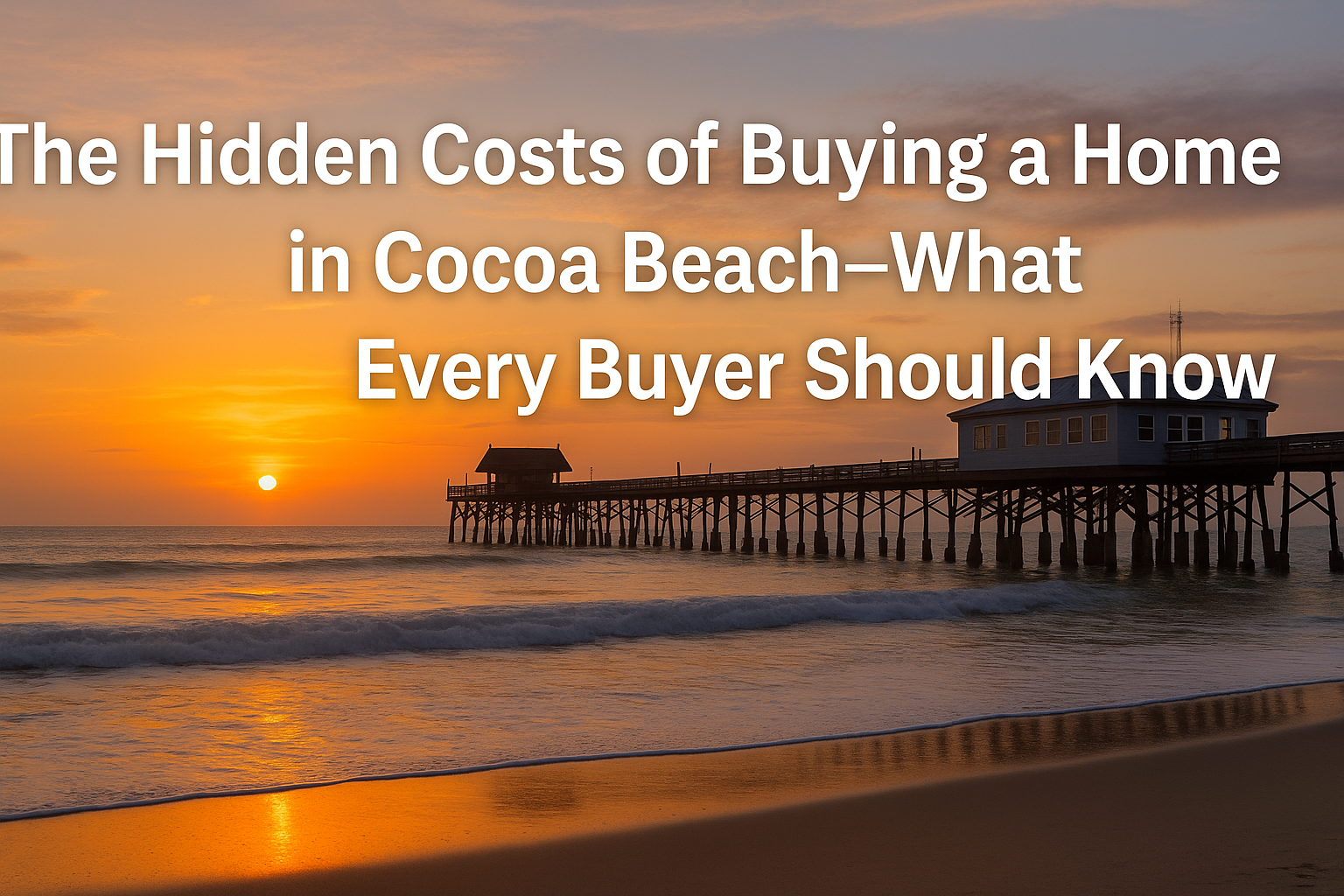
What Every Buyer Should Know
📷 Sunrise at the Cocoa Beach Pier — a beautiful location, but coastal homeownership comes with hidden costs.
Buying a home in Cocoa Beach, Florida is a dream for many. This sunny beachfront city offers a laid-back lifestyle, gorgeous Cocoa Beach real estate options, and proximity to the Atlantic Ocean. As a luxury Realtor in Cocoa Beach, Florida, I love helping people find their slice of paradise. However, whether you’re eyeing the luxury real estate Cocoa Beach Florida is known for or a cozy beach cottage, it’s crucial to understand the hidden costs that come along with homeownership here. Many first-time buyers focus on the sale price of Cocoa Beach homes for sale and their monthly mortgage, but there are other significant expenses – like taxes, insurance, HOA fees, and flood considerations – that can surprise you if you’re not prepared. In this blog post, I’ll draw on my experience as a Realtor (Cocoa Beach, FL) to explain these often-overlooked costs and position you to budget wisely for your new home. By being informed (and with guidance from a trusted agent), you can avoid surprises and enjoy your beachside home with peace of mind.
Cocoa Beach Real Estate Market Update (September 8, 2025)
As of today (Monday, September 08, 2025), what is the Cocoa Beach market like? The local housing market has cooled slightly compared to the frenzy of a few years ago. The Cocoa Beach real estate market in 2025 is showing healthy signs for buyers: the average home value is about $467,000, which is down roughly 4% from last yearzillow.com. Median sale prices have been in the mid-$400s – for example, around $429,000 as of July 2025 (about 16% lower year-over-year)redfin.com. There’s also more inventory available now, with over 300 homes on the market this summerzillow.com. Homes are taking longer to sell (a median of ~88–110 days on market, compared to just weeks during the peak)zillow.comredfin.com. This means as a buyer you have a bit more breathing room and bargaining power – many listings are seeing price reductions or selling slightly below asking price in 2025redfin.com. Overall, the market is not as competitive as it once was, giving you the chance to be picky and negotiate. Even in a cooler market, though, Cocoa Beach Realtors like myself want you to remember that buying is just the beginning. You should plan not only for the purchase price, but also for the ongoing costs we’ll discuss below. Let’s dive into those hidden homeownership costs every Cocoa Beach buyer should know.
1. Property Taxes in Cocoa Beach, FL
When you become a homeowner in Cocoa Beach, you’ll owe property taxes each year – and they can be a significant chunk of your budget. Florida may not have a state income tax, but it does rely on property taxes to fund schools, infrastructure, and services. In Brevard County (where Cocoa Beach is located), the effective property tax rate is roughly around 1% of your home’s value per yearmovingtofloridaguide.com. That’s a good rule of thumb for estimating taxes on a new purchase. For example, a $400,000 home in Cocoa Beach would face an annual tax bill of around $4,000(approximately $333 per month)movingtofloridaguide.com. This can come as a shock if you’re moving from a lower-tax state or if you didn’t factor it into your monthly costs. Florida’s average property tax rate is about 0.83%orlandorealtyconsultants.com, but desirable coastal communities like Cocoa Beach can trend higher. Budgeting ~1% annually is prudent.
What new buyers often miss: The property tax amount the previous owner was paying might not be what you will pay. Florida has a Homestead Exemption and “Save Our Homes” cap for primary residences, which can keep assessed values (and taxes) low for long-time ownersmovingtofloridaguide.com. But when a home is sold, the assessed value often resets to near the current market value, meaning your tax bill could be much higher than the seller’s. For newly built homes or recently renovated properties, there’s a similar effect: the first-year tax bill might be based on a partial assessment (or just land value), then jump in year two after re-assessmentorlandorealtyconsultants.com. As the #1 Realtor in Cocoa Beach, Florida, I always caution my buyers to look beyond the current owner’s tax bill and estimate what their taxes will be after purchase. Florida’s Homestead Exemption can help if you make the home your primary residence – it knocks up to $50,000 off the taxable value and limits annual assessment increases to 3% going forwardmovingtofloridaguide.com. So, if you plan to live here full-time, file for that exemption to save money. But if this is a second home or investment property (non-homesteaded), be prepared for higher taxes and no cap on yearly increases. Bottom line: do your homework on property taxes early – check the county appraiser’s estimates for the home’s assessed value post-sale, and factor this into your affordability calculations. No one likes an unexpected escrow shortage or tax bill surprise!
2. Homeowners Insurance – High Costs in Coastal Florida
Another major hidden cost of owning a Cocoa Beach home is homeowners insurance, which tends to be quite expensive in Florida’s coastal regions. Because our state faces extreme weather – hurricanes, tropical storms, even the occasional tornado or flood – insurance companies charge higher premiums here than in most other states. If you’re coming from elsewhere, brace yourself: Florida has some of the highest home insurance premiums in the country, with an average annual premium over $5,000 in 2025axios.com. For Cocoa Beach specifically (a barrier island on the Atlantic), insurers take into account the increased windstorm risk, salt-air corrosion, and higher rebuilding costs, all of which drive premiums up.
How much should you expect to pay? It varies by property and insurer, but you could easily be looking at $2,000 to $6,000 per year for homeowners insurance in this areaorlandorealtyconsultants.com. Factors include the home’s value, construction type, age, roof condition, and its proximity to water. For instance, insuring a typical single-family home (~$550K value) in Florida costs roughly $3,000–$4,000 per year as of mid-2025movingtofloridaguide.com. Older homes may skew to the higher end of the range, especially if they need updates to meet current hurricane building codes. Newer homes or those with hurricane-resistant features (impact windows, reinforced roofs) may get credits that lower the premium – so those are great investments to consider. Keep in mind, lenders will require you to carry adequate hazard insurance, and they’ll likely escrow the premium in your mortgage payment. That means a high insurance cost directly makes your monthly payment higher.
Pro Tip: Always get insurance quotes during your inspection period before you fully commit to a purchase. Many buyers fall in love with a Cocoa Beach waterfront property and only later discover that insuring it might cost $500 a month. As a top Cocoa Beach real estate agent, I’ve seen how recent hurricanes (like Ian in 2022 or Idalia in 2023) and insurer troubles have caused rates to spike statewidemovingtofloridaguide.com. Some insurers have even pulled out of Florida, pushing more homeowners to last-resort options like Citizens Insurance. The takeaway is not to scare you, but to ensure you budget for insurance. If you know a home will be costly to insure, you might negotiate the price or opt for a condo (where the building’s master policy covers some risks) as alternatives. We’ll talk about HOA/condo fees next, but remember: insurance is a must-have expense that you need to plan for from day one of homeownership.
3. HOA Fees and Condo Associations
Cocoa Beach offers a mix of property types – from single-family houses on quiet streets to high-rise condos overlooking the ocean. If the home you buy is part of a Homeowners Association (HOA) or condo association, you’ll likely have monthly or quarterly HOA fees. These fees are another “hidden” cost that can add hundreds of dollars to your housing budget. HOA dues go toward maintaining the community: things like landscaping, common area upkeep, pools, clubhouses, building insurance, and sometimes utilities or cable/internet for the residentsmovingtofloridaguide.com. In a condo, the association typically also covers exterior building maintenance and insurance, which is why condo HOA fees are usually higher than those for single-family home communities.
What’s the typical cost? HOA fees in Cocoa Beach vary widely. Some single-family neighborhoods have only a nominal fee (or none at all), especially if they don’t offer amenities. On the other hand, many condo complexes and gated communities have substantial dues. In Florida overall, HOA fees can range from as low as ~$50 per month in a simple subdivision to $400–$600+ per month in oceanfront condo buildings with lots of amenitiesorlandorealtyconsultants.commovingtofloridaguide.com. Here in Cocoa Beach, it’s common to see condo fees in the several-hundred-dollar range. For example, a mid-sized beachfront condo might have a $500/month association fee that covers the pool, building insurance, exterior maintenance, water/sewer, and maybe even cable TV. Luxury high-rise condos or townhouse communities with extensive facilities could charge even more. As a buyer, you must factor this in: a condo with a $600/month HOA fee is like paying for an extra $100,000 of mortgage (in terms of monthly outlay). So don’t ignore the fee when calculating affordability.
Look out for special assessments: Another hidden pitfall with HOAs is special assessments. These are one-time (or short-term) fees levied on homeowners for major projects that the regular budget can’t cover – think replacing an aging roof on a condo building, repairing structural issues, or upgrading elevators. In Florida, condo associations have been under pressure to address deferred maintenance (especially after the Surfside tragedy), so special assessments are not uncommon. I’ve seen owners surprised with a $10k+ bill because the association decided to repaint and reseal all buildings or repair seawalls. As a diligent Realtor Cocoa Beach Florida homebuyers trust, I advise you to read the HOA disclosures and meeting minutes before you close. You want to know if the association is financially healthy. High reserves and a history of good maintenance are a green flag. If the reserves are low and big repairs are looming, assume an assessment could be coming – a hidden cost you’ll need to shoulder later. Always ask, “Are there any current or upcoming special assessments?” Many Cocoa Beach realtors emphasize this due diligence because it can save you from a nasty surprise.
In summary, if your dream home has an HOA, learn all the costs upfront. The monthly fee is just one piece; also check what it includes (will you still need separate insurance or is building insurance included? Do you pay your own lawn care or is it covered? etc.). Understand the rules – some HOAs might also require initiation fees or capital contributions at closing. These communities often provide great benefits (maintenance-free lifestyle, amenities, consistent neighborhood appearance), so they can be well worth it. Just be sure to bake those fees into your budget alongside the mortgage, taxes, and insurance.
4. Flood Zones and Insurance Considerations
One of the most critical hidden costs – especially relevant in coastal Cocoa Beach – revolves around flood risk. Our city is basically a barrier island wedged between the Atlantic Ocean and the Banana River Lagoon. That beautiful geography comes with a catch: much of Cocoa Beach lies within low-elevation flood zones where storm surge or heavy rain can cause flooding. Even if a property has never flooded before, insurers and lenders will go by the official FEMA flood zone maps when assessing risk. Here in Cocoa Beach, you’re generally either “within the 100-year flood zone” or outside of it, based on elevation and historical datacityofcocoabeach.com. Large portions of the island are indeed in the 100-year floodplain, meaning there’s at least a 1% annual chance of flooding in those areas. Storm surge from a hurricane is the biggest concern – when a big storm pushes water onshore, the lower-lying parts of town can flood quicklycityofcocoabeach.com.
Why does this matter for you as a buyer? If the home is in a FEMA-designated Special Flood Hazard Area (typically zones starting with “A” or “V”), and you have a mortgage, your lender will require you to carry flood insurance. This flood policy is separate from your regular homeowners insurance (which doesn’t cover flood by default). Even if you pay cash or the home is just outside the high-risk zone, you should strongly consider flood insurance given our locale – remember that flood maps are not perfect, and Mother Nature doesn’t read the maps. Torrential rain or rising groundwater can flood homes that technically aren’t “in a flood zone.” In fact, it’s said that something like 20% of flood insurance claims come from moderate or low-risk zones.
Cost of flood insurance: The premiums can range widely based on the property’s elevation, the flood zone, and the coverage amount. However, to give a ballpark, flood insurance typically costs around $700 – $900 per year for many Florida homesmovingtofloridaguide.com. This would be for a relatively moderate-risk situation (like a house a bit above base flood elevation). If a home is newer and elevated or has flood vents, it might even be less. On the other hand, if you’re buying a ground-floor condo unit on the oceanfront or an older home in a very low-lying spot, the flood insurance could cost a couple thousand per year. According to some Florida real estate experts, flood policies can add anywhere from $500 up to $2,500+ annually depending on the location and riskorlandorealtyconsultants.com. Keep in mind, FEMA updated its pricing with the Risk Rating 2.0 system recently, which has been increasing rates for some higher-value coastal homes (while lowering for others). It’s worth getting a quote early in your home-shopping process if you suspect a property is in a risky area.
Other flood-related costs: Beyond just insurance premiums, consider that being in a flood zone might affect your long-term costs and plans. For example, homes in Velocity (“V”) flood zones (often right on the beach or river) might have higher construction requirements (like breakaway walls, or needing to be elevated on stilts) which can make renovations pricier. Even in “A” zones, if a major storm hits and causes damage, you might face out-of-pocket costs (flood policies typically cap coverage and have deductibles). There’s also the mental cost of worrying each hurricane season if you’ll need to invest in sandbags or evacuation. I say this not to deter you – many of us happily live with this trade-off for the chance to wake up by the water – but it’s something every Cocoa Beach buyer should weigh.
The best approach is to know your property’s flood status and plan accordingly. During due diligence, determine if the home is in a 100-year floodplain (your Realtor or a title company can help, or check the FEMA Flood Map Service Center). The City of Cocoa Beach also provides information on flood zones and elevation – they note that storm surge is the primary flood hazard here on the islandcityofcocoabeach.com. If insurance is required, get a quote; if it’s not required, consider buying a lower-cost preferred-risk policy anyway for peace of mind. As a Cocoa Beach waterfront property expert, I often counsel buyers on elevating appliances or using flood-resistant materials in lower areas of their homes, just as extra precautions. Mitigation efforts like proper drainage, sump pumps, or flood vents can also help reduce potential damage (and sometimes lower your insurance premium).
In short, flood considerations are huge in Cocoa Beach. The hidden cost isn’t just the insurance – it’s the understanding that living by the ocean requires a bit more preparation and perhaps investing in protective measures. When budgeting, include that flood insurance premium and remember that water can be as destructive as wind when the big storms come.
Conclusion: Plan Ahead and Buy With Confidence
Purchasing a home in Cocoa Beach is about embracing a wonderful lifestyle – morning beach walks, year-round sunshine, and a vibrant coastal community. If you budget smartly for the hidden costs we’ve discussed – property taxes, homeowners insurance, HOA fees, flood insurance, and related expenses – you’ll be well on your way to enjoying that lifestyle without financial stress. The key is planning ahead. Before you finalize any deal, take the time to add up these ongoing costs and see how they fit into your monthly budget. A home is more than its purchase price: “Buying is just the beginning; the squeeze on wallets intensifies after one becomes a homeowner,” as one report put itaxios.com. Florida homeowners, on average, spend over $24,000 a year on these types of hidden homeownership expenses (taxes, insurance, utilities, maintenance, etc.)axios.com. Being prepared means you won’t be caught off guard.
To quickly recap, here are a few action items every Cocoa Beach buyer should tackle:
- Research the Property Taxes: Check the current taxes and estimate your future bill (remember the 1% rule and homestead perks)movingtofloridaguide.com.
- Get Insurance Quotes Early: Don’t wait until closing to find out your homeowners or flood insurance cost – gather estimates during your inspection periodorlandorealtyconsultants.com. This helps avoid any surprise hikes in your monthly payment.
- Examine HOA Documents: If there’s an HOA, read the budget and reserves, know the monthly fee, and ask about any upcoming special assessmentsorlandorealtyconsultants.com.
- Understand Flood Risk: Verify the flood zone, and if needed, budget for flood insurancemovingtofloridaguide.com. Even if optional, it can be a wise addition in our area.
- Plan for Maintenance: Cocoa Beach’s salt air and climate mean you should set aside funds for extra upkeep – from AC tune-ups to exterior painting – to keep your home in top shape (salt corrosion and humidity can wear on homes).
Finally, remember that you don’t have to navigate this process alone. Working with an experienced local agent can be invaluable. Even the top Cocoa Beach real estate agents will tell you that being educated on these costs is what separates a stress-free homeowner from a cash-strapped one. As the best realtor in Cocoa Beach, Florida (I’m proud that my clients have often given me that title!), I see it as my duty to make sure you’re informed and comfortable with every aspect of your purchase. I want you to not just love your new home, but also feel financially secure in it. If you have questions or need guidance on any of the topics covered here, don’t hesitate to reach out. Cocoa Beach Realtors like myself are here to help you weigh the pros and cons, connect you with reliable insurance providers, and even find creative solutions to manage costs (for example, homestead exemptions, wind mitigation discounts, etc.).
Buying a home is a big decision, but with preparation and the right support, it’s absolutely worth it. Cocoa Beach is a fantastic place to live – and when every buyer knows about the hidden costs upfront, there’s nothing to hold you back from enjoying your piece of paradise. Here’s to making informed decisions and opening the door to your Cocoa Beach dream home with confidence!
Sources: The figures and recommendations above are based on current data and expert insights as of September 2025. For instance, Florida’s average homeowner’s insurance premium reached about $5,292 this yearaxios.com and flood insurance for many properties runs ~$700-$900/yearmovingtofloridaguide.com. Florida’s property tax averages ~0.83% but can be closer to 1% in areas like Cocoa Beachmovingtofloridaguide.comorlandorealtyconsultants.com. Typical condo HOA fees in Florida were around $400-$600/month in 2025movingtofloridaguide.com, though they vary. The Cocoa Beach housing market statistics cited (average home value $467k, median price ~$450k, inventory 327 homes) are drawn from Zillow and Redfin market reports zillow.comredfin.com. Always consult up-to-date sources or a local Realtor (Cocoa Beach Florida) for the latest information, as market conditions and costs can change over time. With the right knowledge, you’ll be the savvy homeowner that Cocoa Beach waterfront property experts love to work with – and you’ll fully enjoy the beach life knowing you’ve got all your bases covered. Happy home hunting!
10 things to know about moving to Cocoa Beach: HERE